





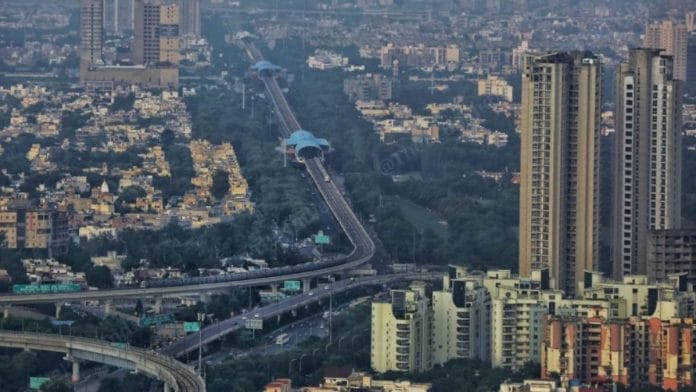



New Delhi: The national capital is all set to conduct its first city-wide tree census after more than three decades of the implementation of the Delhi Preservation of Trees Act. The Centre has sanctioned Rs 2.9 crore for the exercise, which will be carried out in phases over the next four years
Apart from Dehradun’s Forest Research Institute (FRI), which will oversee the census, the Delhi government has also roped in an expert panel comprising environmentalist Pradip Krishen and Indian Forest Service (IFS) officers MD Sinha and Sunil Limaye.
A senior official from the Delhi government’s environment department said that scientists from FRI will begin the census in the next three to four months.
“The process will be carried out in phases, and only the non-forested areas will be covered in this census. This will give a picture of urban trees,” the official told ThePrint.
The process
The trees will be counted using the latest technologies like Light Detection and Ranging (LiDAR), geographic information systems (GIS), drones and remote sensing. Once trees are detected as ‘objects’, they will be transferred to a centralised server, which will speed up and improve the accuracy of final counting.
In areas with dense tree populations, where individual trees cannot be detected, humans will be deployed to carry out the counting manually.
The trees will not only be counted but also categorised by species, country of origin, height, girth, age, and health.
“The process should not be very challenging in Delhi because it does not have very dense tree pockets in the urban spaces,” a senior scientist from FRI told ThePrint.
The official said that a pilot census will begin in parts of central and south Delhi within the next fortnight.
Also read: LPG crises bringing chulhas back, migrant workers suffering most. ‘Will leave city soon’
No census till now
Since the implementation of the Delhi Preservation of Trees Act (DPTA) in 1994, the city has not witnessed a tree census. In 2024, the Supreme Court first asked the Delhi Tree Authority (DTA) to conduct a tree census for the Capital.
In 2025, the court brought FRI on board and approved the institute’s plan to carry out the survey, which also included suggestions to increase the city’s green cover. The bench, comprising Justices Abhay S Oka and Ujjan Bhuyan, noted that a comprehensive tree census will also help keep a closer eye on illegal tree felling in the city and directed FRI to carry out the exercise in a short period.
After these directions, the FRI had submitted an affidavit to the top court, stating the estimated budget of the exercise.
“FRI proposes an estimated budget of Rs 443 lakh for the execution of phases one and two on the standardisation of methodology and pilot trial for the development of an action plan for the implementation of phase three,” FRI’s affidavit read.
Officials said that once the process has been standardised, it can be repeated every few years.
Localised tree census
While the government has been dragging its feet on conducting the census, some neighbourhoods have taken it upon themselves to conduct such surveys in their own areas.
Delhi’s first unofficial tree census was carried out by the residents of South Delhi’s Sarvodaya Enclave. It was carried out in 2012 by environmental activist Padmavati Diwvedi. Residents, with the help of local authorities, have also re-conducted the survey every few years to estimate the amount of tree loss in the city.
Since the first such survey, localities such as Vasant Vihar, Gulmohar Park, and New Friends Colony have also initiated similar exercises.
(Edited by Saptak Datta)