



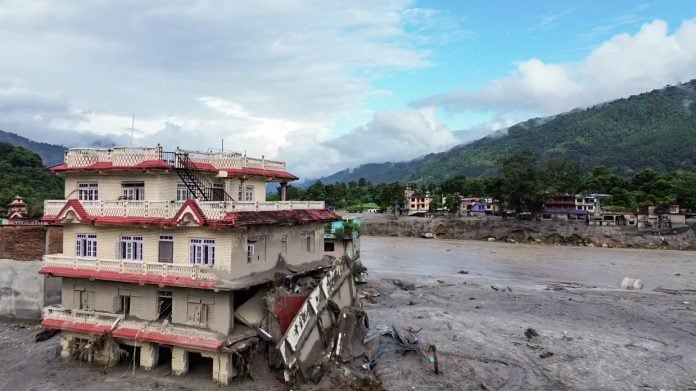
New Delhi: Atmospheric warming triggered by the burning of fossil fuels played a key role in triggering and intensifying the flash floods in Nepal and Tibet earlier this year, which killed over 1,400 people, confirmed a new study by the World Weather Attribution.
Researchers from WWA found that the disaster was not caused by a single extreme weather event, but a “compound crisis” that was escalated by long-term warming, glacier retreat, geological instability and permafrost thaw.
For the analysis, WWA gathered researchers from Nepal, the UK, Ireland, Pakistan, Sweden, Denmark, Norway, the US, New Zealand and the Netherlands, including experts in mountain hydrology, climate science, glaciology and seismology, to examine the range of factors that may have contributed to the event.
“While the underlying geological structure controlled where and how the slope failed, longer-term warming and changing precipitation phase from snow to rain may have reduced its stability by weakening ice-filled fractures and rock–ice contacts and increasing water pressure,” the analysis read.
It added: “Climate change is thus best understood as a destabilising factor acting on a pre-existing geological predisposition, rather than the fundamental cause of the failure.”
What did the report find?
WWA highlighted that the observations from local weather stations in Nepal showed unusually warm conditions before the mountain slope failed on 26 August. Between September 2025 and August 2026, the surrounding areas recorded higher than average temperatures, with July and August being the warmest two months of the year.
These conditions were anomalous at the location of the slope failure and across the wider Himalayan region.
“We find in all datasets a significant increase in the likelihood and intensity of the very warm July-August temperatures at the grid cell nearest to the slope failure as well as in the wider region with an increase in temperature attributable to human-caused climate change during July and August of about 1.5 degrees Celsius, comparable to the level of global warming,” the analysis read.
It added, “Annually, the attributable increase is larger than global warming, at about 2 degrees Celsius. In individual winter months, the observed increase is as high as 3 degrees Celsius.”
The analysis also found that the glaciers in the region were also losing mass for decades at a rate equivalent to more than half a metre of thinning per year.
Since 2010, the recession rate of the Langtang-Lirung Glacier has accelerated, increasing from 0.5 per cent per annum over the previous two centuries to 1-2.3 per cent per annum in the last 16 years.
“Glacier thinning and retreat can reduce buttressing and alter stresses within adjacent rock walls, potentially weakening existing fractures and increasing slope instability. Combined with increased meltwater, these processes may have interacted to amplify the compound event,” the report read.
Scientists explained that as temperatures rise, the precipitation-snow transition moves upward. This increases the fraction of precipitation falling as snow at higher elevations. Rain produces an immediate liquid-water input to the slope, and snowfall temporarily stores water at the surface. This was significant because the intense and prolonged rainfall can rapidly increase water supply to fractures and potentially increase fracture water pressure.
Recordings also showed that stations at the rock-ice-avalanche site in the upper reaches of the Himalayas recorded high precipitation in October last year. This, combined with subsequent heat, may have become a source for meltwater during the following spring and monsoon season.
“There is also a tendency for a greater fraction of precipitation falling as rain than snow in recent years. This means there can be an increase in the amount of water stored in the land under the avalanche site, even in the absence of anomalously high total precipitation,” the WWA said.
(Edited by Insha Jalil Waziri)