





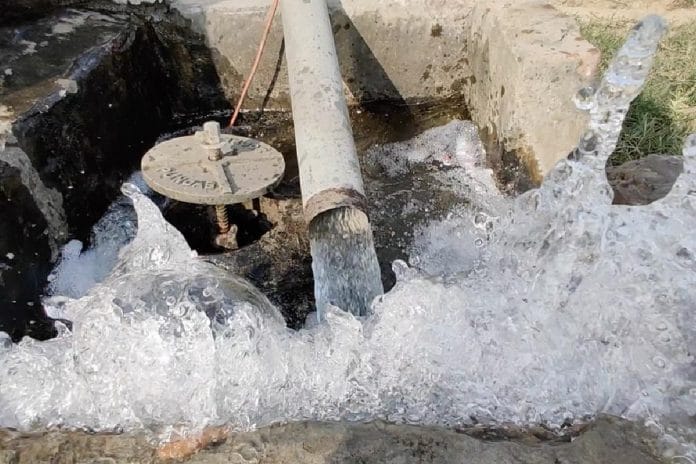



New Delhi: Delhi has one of the lowest groundwater levels in the country, trailing Haryana, Punjab and Rajasthan, according to data released by the Reserve Bank of India (RBI) in the 10th edition of Handbook of Statistics on Indian States, 2024-25.
The Capital has crossed the ‘over-exploited’ mark in 2024 and 2017, and was close to it in 2023 and 2020. The Central Ground Water Board (CGWB) categorises an area as ‘over-exploited’ when groundwater extraction exceeds 100 per cent, meaning annual consumption has surpassed recharge.
Groundwater resource assessments are periodically conducted by state ground water departments and the CGWB, guided by state-level committees and supervised by the central level expert group. These joint assessments, which started in 1980, have been conducted annually only from 2022.
In 2024, Delhi used more groundwater than its available resource of 0.34 billion cubic metres. And in 2023, the National Capital consumed up to 99.13 percent of the same volume.
Delhi’s groundwater situation has been critical for a decade. In 2024, several pockets in the city were marked ‘over-exploited’. New Delhi district saw the highest extraction. Red-flagged areas included Karol Bagh, Mayur Vihar, Delhi Cantt, Chanakyapuri, Vasant Vihar, Narela, Yamuna Vihar, Karawal Nagar, Vivek Vihar, Shahdara, Mehrauli, Kapashera and Rajouri Garden.
Where does Delhi get its water
Despite the Yamuna flowing through the city, high contamination from industrial effluents and untreated sewage forces Delhi to depend on external drinking water supplies, especially from the Tehri dam in Uttarakhand.
P.S. Vijayshankar, co-founder of the Samaj Pragati Sahyog, an organisation that studies irrigation and land conservation, attributed Delhi’s groundwater depletion to “uncontrolled urbanisation”, as the city does not extract groundwater for irrigation and is not an arid state like Rajasthan. Samaj Pragati Sahyog is a non-profit organisation and grassroots initiative based out of Madhya Pradesh which works on water and livelihood security.
As for other states, research shows irrigation accounts for 80–90 percent of India’s water use, with rice, wheat and sugarcane alone consuming 80 percent of that share. Rajasthan, Punjab and Haryana’s overconsumption is attributed to its intensive irrigation needs following the Green Revolution.
According to the CGWB, Rajasthan extracts up to 150 percent of its groundwater reserves. A shift in western and central Rajasthan towards water-intensive crops such as wheat, cotton, olive, groundnut and pomegranate has further increased groundwater use.
According to Vijayshankar, areas like Vasant Kunj, Munirka and Gurgaon fail to adequately recharge groundwater because these areas are built on a hard bed rock that does not absorb rainwater easily.
Also, “rapid urbanisation, malls and commercial complexes bring Delhi at par with states that use water for agriculture”, he said.
A recent CGWB water-quality report also flagged high levels of uranium and other contaminants in Delhi’s groundwater. It found that 13–15 percent of the samples contained uranium above the acceptable limit of 30 parts per billion, raising concerns over public health and drinking water safety.
In July, according to media reports, the Delhi Jal Board had announced the planning of ‘One Zone, One Operator’ policy to manage groundwater and sewage services by dividing the Capital into eight zones, aiming to curb 50–52 percent of water-supply losses.
(Edited by Viny Mishra)
Also read: India’s groundwater recharge went up in last 7 yrs, but 5 states extracting over 100% of their share