



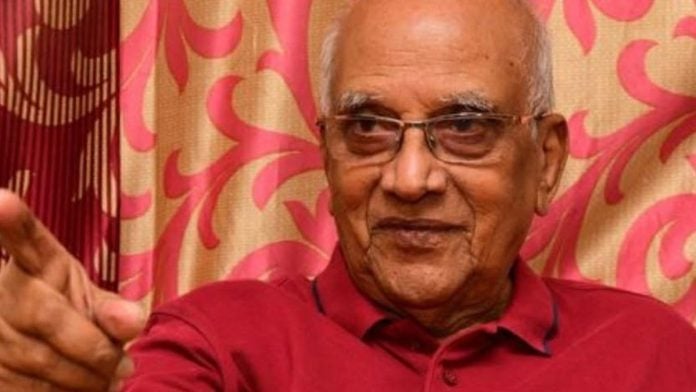
New Delhi: Legendary filmmaker Singeetham Srinivasa Rao died Saturday aged 94, in Chennai, following age-related health complications. He was among the oldest active filmmakers in the world, having directed his 61st film, Sing Geetham, which was released in June.
At a stage in life when many filmmakers speak about the nuances of auteur cinema, Rao continued to create it. His final work was the musical fantasy Sing Geetham, produced by Nag Ashwin under Vyjayanthi Movies and Swapna Cinema.
Set in the fictional village of Kuberapuram, Sing Geetham follows Pratap, who returns after his father’s death to claim his inherited property. He gets caught in a conflict over the village’s gold reserves and its last surviving tree. After the tree is cut down, a curse causes the villagers to lose their normal speech and communicate through songs. The film stars Ayaan, Shalini Kondepudi, Ahilya Bamroo and Agu Stanley.
Rao was often regarded as one of India’s most versatile and experimental filmmakers. Over a career spanning more than six decades, he worked across genres, including black comedy, horror, animation, mystery, science fiction and fantasy, directing films in Telugu, Kannada, Tamil and Hindi.
His innovative approach to filmmaking can be traced back to Mayabazar (1957), where he worked as an assistant to director K V Reddy. The film remains celebrated for its groundbreaking visual effects and technical innovations.
Rao made his directorial debut with Neethi Nijayithi in 1972. The film starred Krishnam Raju and Kanchana. Throughout his career, Rao directed several films dealing with social issues. Among them was Dikkatra Parvathi (1974), which won the National Film Award for Best Feature Film in Tamil.
His collaboration with Kamal Haasan started with Sommokadidhi Sokokadidhi in 1979 and continued with films including Raja Paarvai (1981), Apoorva Sagodharargal (1989) and Michael Madana Kama Rajan (1990).
Pushpaka Vimanam (1987), starring Haasan, is often regarded as one of India’s landmark dialogue-free films. The black comedy follows an unemployed graduate who assumes the identity of a wealthy man, leading to a series of chaotic situations. The film went on to win the National Film Award for Best Popular Film Providing Wholesome Entertainment.
Also read: Drishyam 3: Jaideep Ahlawat steps into Akshaye Khanna’s shoes, fans react
‘I aspire to live as he did’
Remembering the filmmaker after his death, Haasan called himself one of Rao’s disciples
“Singeetham Karu, according to his own wishes, in his youth, breathed his last along with his youth. His youth did not spread to many. In the desire that quality should spread, among the friends he held by the hand and walked with, among the disciples, I am one,” Haasan wrote. “Dying young need not be a tragedy. It can be glorious. Singeetham Srinivasa Rao is a great example. I have admired him since I knew him. Now I aspire to live as he did.”
In 1989, Rao directed Apoorva Sagodharargal, which featured Haasan in the role of Appu, a dwarf circus performer seeking revenge for his father’s death. The film was also produced by Haasan under Raaj Kamal Films International.
Rao later directed Aditya 369 (1991), known for its pioneering use of time travel in Indian cinema. Blending history and science fiction, the film revolves around a time machine that takes its characters between different periods, including the era of Sri Krishnadevaraya and a distant dystopian future.
He made his Bollywood directorial debut with Phool (1993). The film starred Kumar Gaurav and Madhuri Dixit and was produced by Rajendra Kumar.
In 2008, Rao directed the animated children’s film Ghatothkach and also composed its soundtrack. Based on Ghatotkacha, the son of Bhima and Hidimba from the Mahabharata, the film premiered at the 2008 Cannes Film Festival.
(Edited by Saptak Datta)