



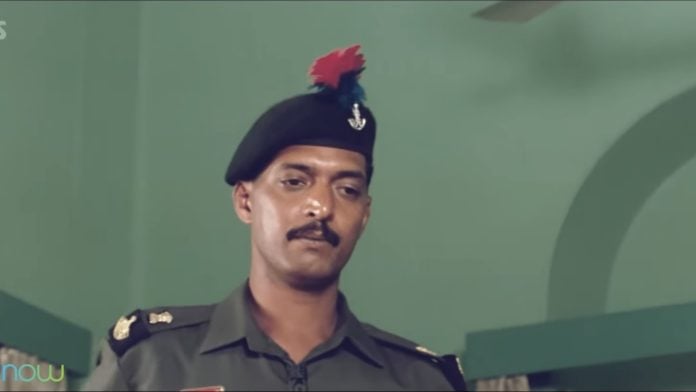
New Delhi: While Bollywood had its ‘Angry Young Man’ era, Nana Patekar was its angry soldier. In Prahaar: The Final Attack, his only directorial venture, Patekar played Major V.S. Chavan, a soldier whose anger comes from discipline, duty and the hardships of military life. But the character was not built only from a screenplay. Before making the 1991 film, Patekar had joined the Territorial Army and trained with the Maratha Light Infantry in Belagavi to understand what it meant to live like a soldier.
Nearly a decade later, during the Kargil War, he returned to the uniform, this time to serve the nation at the frontline.
When Major Chavan is first introduced in the film, he is on the training ground, teaching cadets how to climb ropes, cross obstacles and jump over fire. His methods are harsh because for him, military training is about eliminating fear before a soldier reaches the border.
Peter D’Souza, played by Gautam Joglekar, a new trainee in the Maratha Light Infantry Regiment, struggles with Chavan’s strict rules and eventually decides to leave the camp. Chavan stops him and delivers the film’s iconic single-take monologue, telling Peter that running away will make him a coward in the eyes of society, his family and the woman he loves.
But Prahaar goes beyond the familiar image of the soldier, who sacrifices himself for the nation. It asks what happens to that soldier when the battlefield is behind him.
Nana Patekar and the Kargil War
During an operation, Peter loses his leg and is discharged from his duties. Later, on his wedding day, he is killed by local Goans. His death devastates Chavan, particularly when no one is willing to come forward and testify. Chavan takes matters into his own hands and goes after those responsible, eventually being accused of abusing his power.
The film’s anger comes from that contradiction. Soldiers are expected to protect the country with their lives, but once they return to civilian life, their injuries, financial struggles, family pressures and personal battles can become invisible.
Patekar experienced that connection with the armed forces again during the Kargil War, nearly eight years after Prahaar. At the time, he approached senior Army officers, including Lieutenant Colonel V.K. Singh, who also makes a cameo in Prahaar, and sought permission to serve in the war.
Later, during an interview, Patekar recalled that he had been keen to join the Army during the war. “I was a good shooter. I had played at the national level in 300 metres rifle shooting. I had done well there and won a bronze medal at the Mavlankar (shooting championship),” he recalled.
When he was told that civilians could not be taken into the Army, he did not give up. He called then Union Defence Minister George Fernandes to convince him.
“A civilian gets commissioned in six months; I had already trained for three years,” Patekar recalled as saying.
He eventually became part of the Quick Reaction Team, an elite unit of the Indian Army. He recounted shedding 20 kgs in a span of two months. “I had become skin and bones,” he said.
Patekar served 60 days in the Army during the Kargil conflict. The experience he gathered while making Prahaar had become part of his own life.
Patekar’s Major V.S. Chavan was not created as a conventional Bollywood action hero. Hindi cinema has often portrayed soldiers as larger than life figures who perform impossible feats and make the ultimate sacrifice. Patekar, instead, focused on the man inside the uniform, his discipline, pride, anger, relationships, financial pressures and the cost his profession takes from his family.
This was also the peak period of Patekar’s acting career. He had begun with Gaman in 1978, alongside Farooq Shaikh and Smita Patil, and went on to appear in critically acclaimed and commercially successful films including Salaam Bombay!, Ghulam-E-Mustafa, Kranti Veer and Tirangaa through the late 1980s and 1990s.
His relationship with the Army remained separate from his stardom. Even years later, Patekar spoke about his bond with people in the armed forces, including Ajit Doval, whom he described as a brother.
“Ajit Doval sahib is like an elder brother to me. Calling it just friendship would be wrong. Our relationship is of a different kind,” he said.
(Edited by Aakriti Handa)