


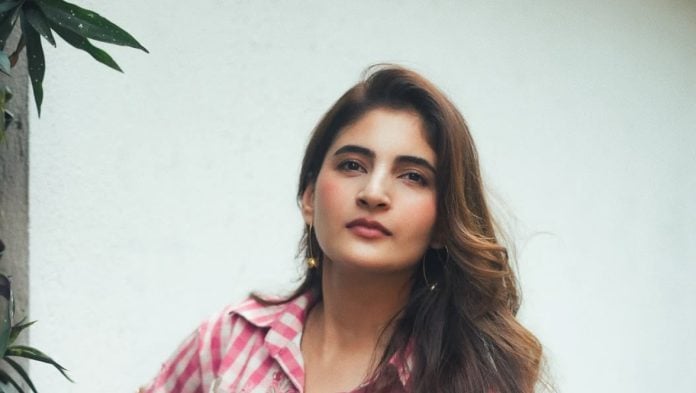
Comedy comes less naturally to actor Shivani Raghuvanshi than emotional performances. But she believes the bigger problem in Indian cinema is not whether women can make people laugh, but whether writers know how to write funny women. Female characters are rarely given the comic freedom afforded to men, she argues, and when filmmakers do attempt humour, they often fall back on stereotypes or simply borrow male comic tropes.
Kajol in Kabhi Khushi Kabhie Gham and Raveena Tandon and Karisma Kapoor in Andaz Apna Apna are among the exceptions Raghuvanshi points to. But such roles remain few and far between.
“Writers lack an understanding of women. They don’t know women, they don’t sit with them and crack jokes. They think, ‘women won’t be funny enough.’ So, if they don’t understand women, how are they going to write comedy for them? They see somebody doing it, perhaps an influencer, and then they just chepo (copy-paste) it and deliver it,” Raghuvanshi told ThePrint.
Her recently released OTT show, Dupahiya Season 2, is a light-hearted comedy, but Raghuvanshi says the distribution of humour between its male and female characters left her questioning why women were not given equally funny material.
Recalling her reaction while watching the first season, she said she had approached the director to ask why her co-stars Bhuvan Bam and Sparsh Shrivastava got most of the memorable comic lines. Her character, despite being central to the story, was largely left with the emotional scenes.
“The story revolves around this girl who is getting married, but all the funny parts were given to the boys. What am I doing? I am crying, right?” she recalled. She spots a similar pattern in Andaz Apna Apna. While she considers Raveena and Karisma’s performances excellent, she points out that the film’s most memorable comic lines largely belonged to Aamir Khan and Salman Khan.
Despite the limited opportunities, Raghuvanshi is keen to explore comedy. She admits, however, that emotional performances come more naturally to her.
“Being emotional or crying on camera has been pretty much easy for me. With comedy, you just have to go all out. It is never just about delivering the punchlines as they are written. You have to approach it with complete honesty and believe in what you are doing, so that the audience believes it too. You cannot approach a scene with the intention of making it funny or getting a laugh out of it,” she said.
For her, Kajol’s performance in Kabhi Khushi Kabhie Gham is a good example of how comedy works when an actor inhabits a character rather than consciously trying to be funny. The audience believes Kajol as the quirky girl from Chandni Chowk, she says, rather than seeing someone performing for laughs.
There is also the question of how much freedom female actors have to let go of their carefully cultivated screen image. Raghuvanshi says that the pressure on actresses to look beautiful can make them hesitant to embrace physical comedy or slapstick, which often requires exaggerated expressions and an absolute disregard for looking glamorous.
“You have to make certain faces. You have to stop worrying about how pretty you look all the time. But we have put that idea in their heads that they have to look beautiful at all times. You have never seen a quintessential Bollywood heroine doing slapstick. So I don’t think a lot of women are comfortable with that,” she said.
Raghuvanshi also believes that writing comedy for women requires an understanding of how humour operates differently in their everyday interactions. The kind of jokes men might casually crack do not necessarily translate to female characters, she argues.
“If we start laughing about something, it is usually situational. It will never be, ‘He he, look at that fat guy going.’ We don’t talk like that. In general, women are a little more sensitive. People are not going to like a woman slut-shaming somebody or saying, ‘Kya maal lag raha hai.’ It doesn’t come naturally and it doesn’t look good on camera. So you have to write the part really well for it to work,” she said.
She also takes issue with the industry’s tendency to associate comedy with a particular kind of female appearance. The funny woman, she says, is often expected to fit the stereotype of the overweight or unconventional-looking character, while conventionally attractive actresses are rarely imagined in comic roles.
“People think the fat girl makes jokes because she has to be the funny one. That’s the stereotype. You see all the cute, pretty girls and automatically assume they won’t do comedy, right? You have that perception,” she added.
‘OTT can make people stars, but theatre is irreplaceable’
Raghuvanshi made her Bollywood debut with Kanu Behl’s Titli in 2014. She played Neelu opposite Shashank Arora in the crime drama. The film brought her an unexpected moment of validation when veteran actor Shabana Azmi reached out to appreciate her performance.
“It was a really big moment. She told me she loved my performance,” Raghuvanshi recalled.
Nearly 12 years into her career, Raghuvanshi has built a varied body of work, with some memorable performances as Vasudha in Raat Akeli Hai, Jazz in Made in Heaven and ASI Firdaus Rabbani in Murder in Mahim.
While several of her most recognised projects have been on OTT, Raghuvanshi says that, if given a choice, she would still pick theatre releases. For her, the experience of watching an actor perform repeatedly, without losing the audience’s interest, is what truly builds stardom.
“OTT can make people stars. But the experience that theatre gives you can never be replaced by OTT. You could watch Shah Rukh Khan doing the same thing 10,000 times and still not get bored. That is what makes you a star, because your recall value is higher,” she said.
The explosion of OTT platforms has undoubtedly opened up more opportunities for actors, but Raghuvanshi believes it has also made fame increasingly fleeting. With new shows and faces emerging every week, holding the audience’s attention has become harder than ever.
“There is a new show coming out every week. How many can you possibly keep up with? You cannot love everyone. You are today’s news and tomorrow you are forgotten,” she said, describing how audiences quickly move from one new obsession to another. An actor might become the subject of intense attention after delivering a successful show, she explained, only to be replaced by the next breakout face a few months later.
“Every six months, the national crush keeps updating, keeps changing,” she added.
Raghuvanshi describes the current moment in the industry as a ‘trial phase’, with actors, filmmakers and platforms experimenting with different kinds of content and storytelling. Not everything works, she says, but the larger concern for actors is the growing competition for substantial roles.
“A lot of things are being made, a lot of things are not working, and people are experimenting. Within the actor community, you are fighting for roles, especially those meaty parts. And then you also have competition from influencers,” she said.
Social media following has increasingly become a consideration in casting decisions, something Raghuvanshi understands from a business perspective. A large following can offer producers the assurance of an existing audience, but she believes there is a fundamental difference between attracting viewers through short-form content and holding their attention through a full-length show or film.
“For them, it is like, ‘Okay, this person has so and so followers, maybe they give you the assurance of a certain audience’,” she said.
“But what they have to understand is that watching somebody for two minutes on a reel is very different from watching them for two or three hours, or even six hours, if you cast them in a project.”
No soul in microdramas
While OTT platforms were competing for viewers and big-ticket content, microdramas emerged as the latest entrant in India’s entertainment landscape. The format has already attracted several familiar faces from television and films, including Zareen Khan, Hiten Tejwani, Karanvir Bohra and Sharad Malhotra. More recently, Kusha Kapila and Sheeba Chadha also joined the vertical storytelling wave with Likhe Jo Khat Tujhe.
The format is no longer just a passing digital trend. India’s microdrama market was estimated at around Rs 2,300 crore in FY26, and Redseer projects it could grow to Rs 23,500-25,500 crore by FY32.
But Raghuvanshi isn’t in favour of the format. The actor says she has been approached with scripts for microdramas but has turned them down without much deliberation, calling the format “disrespectful towards the artist”.
“I feel you have taken the art out of it. You are just making something for entertainment, without really putting anything into the storytelling. It kind of breaks my heart,” she said.
The format, according to her, often prioritises quick consumption over the craft of storytelling. Comparing it to the rise of TikTok, Raghuvanshi questioned why filmmakers would try to replicate short-form social media content instead of investing in more meaningful narratives.
“Like how TikTok came, then why are we even trying to do this? Just make TikTok, right? It irritates the heck out of me. I couldn’t even read the scripts properly. I just said no straight away,” she said.
For Raghuvanshi, experimenting with a new format is not the problem; the lack of creative investment is. If filmmakers want to explore microdramas, she believes they should commit to the craft rather than churn out content simply to keep audiences entertained.
“If you want to try something, put your heart and soul into it and do it properly. There is no soul to it,” she added.
(Edited By Raunaq Lekhi)