





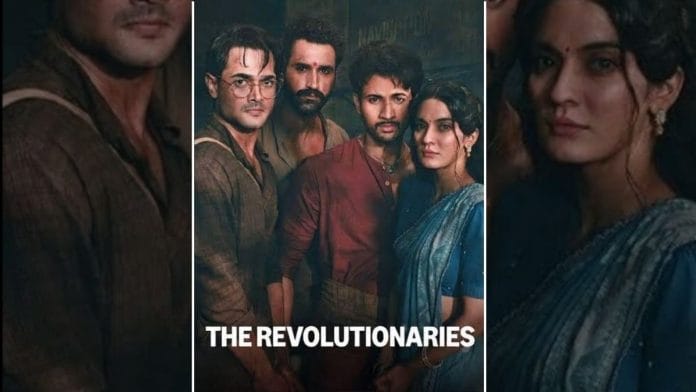

New Delhi: Indian economist Sanjeev Sanyal says the upcoming TV series The Revolutionaries could challenge the familiar image of India as a meek and pacifist civilisation. Reflecting on how Indian history is often presented, Sanyal highlights that history books strip Indians of their historical agency, with India’s story largely reduced to the history of people who conquered the country.
“This is not actually the real story. We had agency. We were sailing the Indian Ocean. We were doing explorations and trade and conquest. And much of that history of agency is resistance against these conquests over us. Revolutionaries is one of those episodes,” Sanyal told ThePrint ahead of the series’ release.
Directed by Nikkhil Advani, the Amazon Prime series is based on Sanyal’s book Revolutionaries: The Other Story of How India Won Its Freedom. It is set to release on September 12.
Sanyal says the series is a cinematic interpretation of history, rather than a documentary. Yet, he says, many of the events depicted on screen are firmly rooted in fact.
“Some of the most outrageous things you will see in the series are actually true. When you say, ‘No, that cannot possibly be true,’ Google it up; you will find it is actually the bit that is true,” he said.
Sanyal also stresses that his book is not intended to diminish or undermine any other strand of India’s freedom struggle. Instead, he says, its purpose is to bring attention to a lesser-documented chapter of the independence movement, one that has often not received the same level of attention in mainstream accounts of history.
The larger aim, according to him, was to broaden how India’s freedom struggle is remembered and to ensure that the stories of those who chose the revolutionary path are given their due place in that history.
“The revolutionaries weren’t forgotten for lack of stories; figures like Netaji (Subhash Chandra Bose), (Vinayak Damodar) Savarkar, and Chandrashekhar Azad are well known. What’s been missing is the thread connecting them,” he said. “We remember them as isolated heroic individuals, not as a continuous movement, unlike the Congress narrative, which is taught as an unbroken political lineage from the 1880s onward.”
In reality, the revolutionaries operated as a generational chain: one cohort would rise, fail, get sent to Kala Pani or the gallows, and another generation would simply pick up where they left off. Constants like Rash Behari Bose and Sachin Sanyal ran through this entire arc, tying decades of sacrifice together into a single, sustained movement with real networks, strategy, and global reach, not scattered acts by “hotheads with a gun.”
Also read: Actor Shefali Shah announces her debut book—on divorce, parenting, and ageing in Bollywood
‘Manifested Bhansali inside me’
According to Advani, the narrative of non-violence emerged only in the 1920s, after MK Gandhi arrived on India’s political scene. Till then, the revolutionaries were unaware that non-violence was a probable option.
“Their whole idea was that the British are going to shoot, we’ll shoot them back,” he told ThePrint.
Speaking about the sheer scale of the project, Advani said he had ‘manifested Sanjay Leela Bhansali inside’ himself.
“You have to understand that very rarely does a director get the kind of support that Amazon said, ‘Go.’ Yeh badi kahani hai. Yeh hamara bada show hai. (This is a big story. This is a big show of ours). We have recreated Chandni Chowk. We’ve recreated Chinatown. We’ve recreated the docks of Calcutta. We’ve recreated Bengali Tola in Banaras. It is some 120 sets. You know, so I was having a ball,” Advani said.
For Sanyal, Bengali Tola recreation carries a deeply personal significance. He recalls that his family lived there from around 1780 until 1927, when the British forced them out due to the aftermath of the Kakori train incident.
Apart from the Prime Video series being based on his book, Sanyal has another personal connection. The characters Sachindra Nath Sanyal and Pratibha Lahiri, played by Rohit Saraf and Pratibha Rana in the show, are Sanyal’s great-granduncle and his wife.
Sachindra also authored what may have been India’s first draft manifesto for a free India, envisioning a democratic republic with universal franchise at a time when the mainstream political leadership was still negotiating for dominion status.
“The revolutionaries weren’t just fighting for freedom; they were the first to articulate what kind of nation that freedom should build,” Sanyal said.
Yet seeing these historical figures, who were his family, brought to life on screen was an unusual experience for him.
“At some level it was strange because there was a dissonance in my head because I have grown up looking at their photographs and hearing their stories and so on. And suddenly they pop up here and they, of course, look different,” he added.
(Edited by Saptak Datta)