





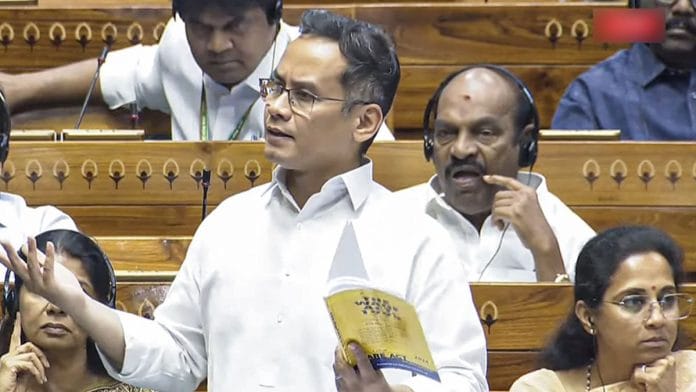


New Delhi: Congress’s Assam chief ministerial face Gaurav Gogoi faced a stinging loss in Jorhat where Bharatiya Janata Party’s Hitendra Nath Goswami won by a margin of 23,182 votes.
Goswami got 69,439 votes, while Gogoi came second with 46,257 votes, according to the Election Commission (EC) results.
The result carries significance well beyond the constituency. Jorhat is widely seen as a proxy battle between Gogoi and Chief Minister Himanta Biswa Sarma—a contest that distils a decade-long rivalry into a single seat. A three-term MP and state unit chief, Gogoi contested for the first time in an Assembly election.
Goswami, the sitting MLA, has held Jorhat since 2016 and had served as Speaker of the Assam Assembly from 2017 till 2021. He is an influential figure in Jorhat, with deep organisational support in a constituency where the Ahoms, an ethnic group that ruled the Brahmaputra Valley for six centuries, form a significant share of the electorate.
The rivalry
The Gogoi-Sarma contest has its origins in a Congress split that reshaped Assam’s politics. Sarma built his career inside the Congress, rising to prominence as a powerful minister under then Chief Minister Tarun Gogoi. Veteran Congress leaders say his exit was partly driven by Tarun Gogoi positioning his son Gaurav as his political heir.
In 2015, after 22 years in the Congress, Sarma joined the BJP. He went on to become one of the party’s key strategists in the Northeast and played a central role in ending the Congress’s long rule in Assam in 2016. He wen on to become the chief minister in 2021.
Since then, Sarma has regularly targeted Gaurav Gogoi, casting him as a symbol of “dynastic politics” while presenting himself as a self-made leader. Gogoi has been an equally sharp critic, accusing Sarma’s government of authoritarian functioning, governance failures, and misuse of power.
The rivalry sharpened in poll campaigns this year.
In February, Sarma cited the findings of a Special Investigation Team (SIT), alleging links between Gogoi, his British wife Elizabeth Colburn Gogoi, and a Pakistan-based individual, Ali Tauqeer Sheikh. Gogoi rebuffed the allegations, dismissing them as politically motivated.
In 2025, Sarma accused Gogoi of acting “at the behest of Pakistan” over a Lok Sabha speech during the Operation Sindoor debate, triggering a sharp exchange in which the Congress leader questioned the Modi government over US President Donald Trump’s claims that America had mediated the ceasefire between New Delhi and Islamabad. The government has repeatedly denied any third-party mediation.
What’s at stake?
Political analysts have described the Jorhat contest as a “make-or-break moment” for the Congress’s leadership in Assam.
For Gogoi, it was a test of whether parliamentary success can translate into a state-level mandate—and whether he could lead the Congress into a credible challenge for power in Assam. As for the BJP, the win in Jorhat reinforces Sarma’s consolidation of Upper Assam, a region where the party has steadily built its organisational base since 2016.
(Edited by Prerna Madan)
Also Read: As Assam votes, Jorhat frames a contrast between Himanta & Gaurav Gogoi—intensity vs reticence