



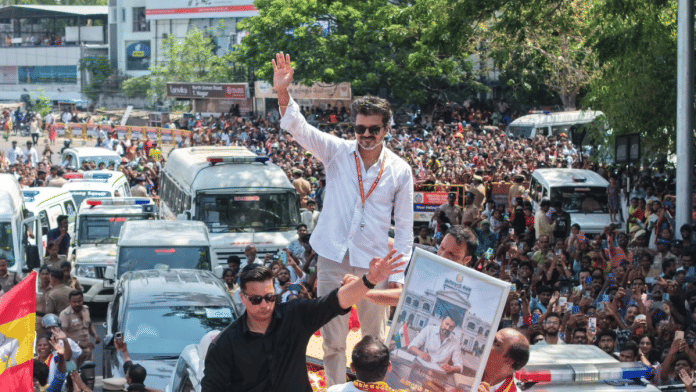

Chennai: As news spread of the Tamilaga Vettri Kazhagam (TVK) sweeping the Assembly elections within an hour of the start of counting on Monday, a crowd began gathering outside the party’s office in Panaiyur, Tamil Nadu. It kept growing, and soon spilled over into Chennai’s streets.
Chants of ‘TVK’ rent the air, and it became clear that Vijay had achieved what no filmstar could in the last few decades: becoming Tamil Nadu Chief Minister as a new political entrant, a triumph that only M.G. Ramachandran (MGR) pulled off in 1977.
It was a momentous transition—the day the ‘Thalapathy’ ceased to be just an actor and stepped into his new reality as the chief minister-to-be. In one fell swoop, Vijay had translated decades of celluloid charisma into a potent votebank that disrupted the entrenched Dravida Munnetra Kazhagam (DMK)-All-India Anna Dravida Munnetra Kazhagam (AIADMK) duopoly.
Vijay is seen as the biggest disruptor in Tamil Nadu politics after MGR. While MGR built his political path through years of political engagement within the DMK before launching the AIADMK and leveraging his on-screen image in an era of Congress dominance, Vijay’s rise is different.
The actor-politician did not have prior administrative experience when he launched the TVK in 2024. He directly targeted youth and women with his message on welfare, social justice and corruption, utilising social media to mobilise first-time voters, and converting his fan base into votes.
Vijay’s political career has been years in the making, and his political messaging around that construction remained in place.
Also Read: Vijay’s TVK unleashes tsunami in Tamil Nadu polls, DMK & AIADMK fall by the wayside
Reel-life story
Vijay was born into the celluloid world. His father S.A.Chandrasekhar is a noted director and producer; Vijay entered cinema as a child artist in Vetri in 1984. At the age of 18, Vijay debuted in a leading role with Naalaiya Theerpu. He rose to superstardom through the 1990s as a romantic hero; the boy-next-door image delivering an emotional appeal to every household, which in hindsight looks like years of effective political groundwork.
Vijay’s filmography is not just an entertainment list, but reflects the gradual building of public sentiment around the themes of justice, the fight against corruption, youth empowerment and social issues into narratives of mass appeal.
Early films like Thamizhan—released in 2002—positioned Vijay as a young lawyer battling systemic corruption and legal injustice. Vijay’s career kept evolving, a sharper role in Thupakki (2012) epitomised the rise beyond romance, messaging patriotism with a sense of duty.
#Ilayathalapathy #Vijay #Bhagavathi #UHD No Watermarks! pic.twitter.com/hhDbbuU0kR
— KING OF KOLLYWOOD (@m_gajan) September 6, 2016
“Vijay’s movies centered around youth politics and he slowly moved to movies that positioned him as someone with responsibility, and [as a] changemaker. He captured the appreciation of women and youngsters with Bhagavathi where he talked about corruption,” political analyst Sunil Kumar says. “Family sentiments, women’s safety and empowerment issues are the emotional appeals that stayed with the people over the years, and they [have] rendered support to the TVK chief now.”
In 2014, Kaththi highlighted agrarian distress; in Mersal that was released in 2017, Vijay took on the lack of healthcare infrastructure and ubiquity of corruption, criticising initiatives like the Goods and Services Tax (GST) and sparking controversies that only amplified his image as a political voice.
In 2018, Sarkar directly addressed electoral malpractices and the abuse of power, while Bigil in 2019 appealed to women, highlighting empowerment through sports, a role that resonated with women and young people.
From fan clubs to political party
Vijay’s fan clubs, reorganised as Vijay Makkal Iyakkam (VMI), were constituted around 2009. The fan groups soon shifted to welfare as they organized flood relief, education aid, and community service.
This grassroots network laid the foundation for the TVK, turning passive fans into active participants. In 2011, VMI offered support to the AIADMK, but Vijay did not directly enter politics. In 2021, Vijay fans offered support to the DMK, maintaining good rapport with its leader M.K. Stalin, Prime Minister Narendra Modi, as well as political leaders of neighbouring states, including K. Chandrashekar Rao of Telangana and Puducherry Chief Minister N. Rangaswamy.
Vijay’s entry into politics was thought out, not impulse-driven. Launching the TVK on 2 February 2024, Vijay took to social media platform X, announcing, “It is my long-term intention and desire to help the people of Tamil Nadu, who gave me name, fame, and everything after my parents.” Calling his politics a “debt of gratitude to the Tamil people” who gave him fame, he said it is “not a hobby for me”.
The shift was complete in December last year when Vijay announced his retirement from films to focus solely on politics, signalling clear commitment. TVK rejected pre-poll alliances, emphasising a “clean alternative” to dynastic, and corrupt politics.
In an interview to ThePrint in March, TVK treasurer P. Venkatramanan said, “Our leaders believes in building a party on secularism, social justice, drawing from Periyar, Ambedkar, Velu Nachiyaar, and Kamaraj, MGR and Annadurai. The party believes in practical service to the people, drawing ideological inspiration from multiple leaders with Dravidian roots… we are not just trying to become another party with Dravidian leaders.”
Also Read: Don’t dismiss Vijay’s victory as irrational. It’s Tamil people’s emotional investment
On the offensive
Vijay’s evolution from challenger to power claimant was evident at his rallies. The October 2024 Vikravandi conference, the first such state-level event of the TVK that marked Vijay’s entry into politics, established an ideological basis, while the second state-level event at Madurai in August 2025 asserted dominance, positioning the DMK and the BJP as enemies and declaring an independent contest in 2026.
Flanked by cutouts of MGR and Annadurai, Vijay declared that history would repeat itself. “Just as political changes happened in Tamil Nadu in 1967 and 1977, I firmly believe that such history will repeat in 2026,” he proclaimed. “Every vote for TVK is a vote for me. I am the maternal uncle of every child in Tamil Nadu. I, your Vijay, have come to work sincerely for you.”
உங்க விஜய் உங்க விஜய்
உயிரென வர்றேன் நான்
உங்க விஜய் உங்க விஜய்
எளியவன் குரல் நான்
உங்க விஜய் உங்க விஜய்
தனி ஆள் இல்ல கடல் நான் pic.twitter.com/FRQcu4b8aq
— Vijay (@actorvijay) August 22, 2025
Questioning their failures on several issues, Vijay called the DMK a political enemy and the BJP an ideological one. His speeches stayed largely critical of the DMK, promising better governance and focus on regional issues. Apart from the broader issues of women’s safety, unemployment and law and order, Vijay took up turmeric cultivation in Erode, organ theft in Namakkal, industrial growth in Trichy and concerns of fishermen and farmers in Nagapattinam and Vellore, respectively.
“It is not just that people were attending the rallies because they were offered money to do so, but people wanted change that could offer hope,” Satish, a party functionary from Namakkal, says. “Our leader Vijay raised [his] voice against the government regarding the issues of common people in our area, including egg processing, employment and women’s safety. When interacting with the administrative wing members, he asked us to always ensure a local connect to understand the problems of the people and discuss likely solutions.”
A day after Vijay’s major rally at Namakkal last September came a stampede at a follow-up event in Karur that claimed 41 lives. It was an inflection point in Vijay’s political career, and he didn’t pause. Insinuating malintent behind the incident, Vijay addressed Stalin: “CM sir, if you want to take revenge, do whatever you want to me. But do not lay hands on my supporters. I will be at home, or if not, at the office.”
He later met the families of affected victims, offering financial support of Rs 20 lakh to the kin of every victim. The tragedy is still being investigated by the Central Bureau of Investigation (CBI), but it did not have a major impact on the TVK’s political prospects. The DMK and TVK blamed each other over the stampede, even as residents of Karur said that they have moved on, viewing it as a tragedy caused by crowd frenzy and poor planning.
Soon after, the TVK manifesto and Women’s Day announcements focused on Rs 2,500 monthly aid for women heads of families, six free LPG cylinders yearly, free bus travel for women, gold and silk sarees for brides from low-income groups, gold rings for newborn girls and free sanitary napkins. The broader promises focused on education reform, employment, anti-corruption drives and institutional accountability.
Lack of political experience and grassroots-level organisational involvement of the TVK remains its strongest criticism. In response, TVK functionaries insist that their focus would be on ensuring that the people believe in the governance by the party.
Vijay has also been criticised for a limited ground presence; cancelled rallies, postponed events and limited campaigns bear witness to this charge. TVK leaders, in turn, have blamed the DMK government and police for denying permission for roadshows and public gatherings.
Speaking to ThePrint last month, TVK district secretary V. Siva alleged that excuses were made whenever the party sought permission. “Even if we apply for approval as per the Election Commission rules, we are not getting it. We are more concerned about the people’s safety, so we are accepting the terms, and we do not want to violate anything.”
Victory & challenges
A TVK functionary from Trichy, Palaniswami, credits Vijay’s triumph to his being an individual who wants to stand with the people, rather than the appeal and charisma of being a popular actor.
“People should not think that since we are a new party, we are not experienced. Our leader asks us to learn what we do not know or understand in politics because we are here to serve the people. He still has a huge future in cinema but he came to politics with the sole intention of being the people’s voice. It is the same messaging that he gives to us. He wants us to reach every household and work for the people,” Palaniswami asserts.
Palaniswami, who has worked for Vijay’s campaign in Trichy East, adds that Vijay focuses on connecting with the people beyond his fan base. “He does not want to focus only on his charisma because he wants the people to be able to access the responsible government leaders and be able to ask for their rights. Even among party workers, he remains a humble leader who personally engages with everyday struggles.”
Amid governance fatigue, youth unemployment, and dynasty politics, Vijay offers hope for change, especially among Gen Z and women. Political analyst Sunil Kumar observes that the TVK has “paved the way” for youth participation in local politics, converting sentiments into votes and reviving the conversation on politics in Tamil Nadu among youngsters.
That said, a limited number of experienced individuals in the party means that the challenge of ensuring satisfactory governance, implementation of welfare schemes and policies remains.
Political analyst Arun Kumar says that perennial issues of law and order, unemployment and women’s safety remain, and that the solutions offered by the DMK were not enough.
“Vijay has to set things straight because people not only voted for him, but to solve these concerns. The delivery of his manifesto promises, like gold to women, free bus rides to all women across the state and others, will be real governance issues in the following months. People were looking for an alternative and they chose Vijay, but to prove if their choice is right or not, Vijay must act strategically,” he says.
Echoing the same opinion, political analyst Ramu Manivannan tells ThePrint that voters did not see the ideological stance or political reactions to national issues. While Vijay stands as a clear winner, his stance on national issues such as delimitation, decentralisation and federalism is not crystal clear. “There is no isolation in state politics from these issues, and the discussion on national issues is going to come back.”
(Edited by Nardeep Singh Dahiya)
Also Read: How did we miss the Vijay phenomenon in Tamil Nadu?