





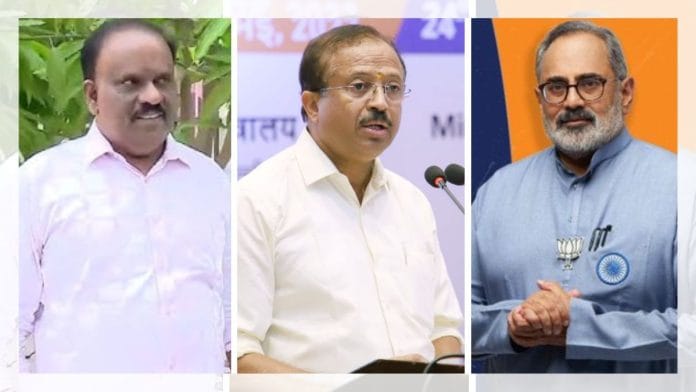


Bengaluru: The Bharatiya Janata Party (BJP) has won three seats in Kerala, with B.B. Gopakumar registering the first victory for the party in Chathannoor assembly constituency in the state’s Kollam district, according to the ECI. Gopakumar secured 51,923 votes, defeating R. Rajendran of the Communist Party of India (CPI) by 4,389 votes.
Defeating CPI(M)’s V. Sivankutty by 4,978 votes, Kerala BJP chief Rajeev Chandrashekar won the Nenom seat, recreating the success of veteran BJP leader O. Rajagopal, who secured a historic win for the party from the constituency in 2016. Also, V. Muraleedharan won the Kazhakoottam seat by a narrow margin of 428 votes, with incumbent Kadakampally Surendran from the CPI(M) close on his heels.
Both these constituencies fall under Thiruvananthapuram district where the BJP won the corporation election in the city in December 2025. Prime Minister Narendra Modi campaigned for both candidates in April this year, drawing significant crowds.
On the other hand, Shobha Surendran lost in Palakkad to Ramesh Pisharody of the Congress by 13,147 votes.
The BJP has been struggling to convert vote-share into seats in the state but appeared confident of breaking the jinx ahead of the 2026 assembly elections.
In 2021, the BJP contested 115 out of the 140 seats across the state, securing 11.3 percent of the total vote share but failing to convert it into a single seat. However, the party’s momentum has shifted since 2024, following Suresh Gopi’s Lok Sabha victory in Thrissur. This momentum continued into the 2026 urban local body (ULB) polls, where the BJP-led NDA emerged as the single largest party in the Thiruvananthapuram Corporation, winning 50 of 101 seats, besides securing victories in 24 village panchayats.
Polling for 1,199 of the 1,200 local bodies was conducted in two phases on 9 and 11 December, with the exception of Mattannur.
‘Fourth-time unlucky’
In Kasaragod district’s Manjeshwar, the BJP had pinned hopes on former state president K. Surendran, who had come agonisingly close to a victory on at least three occasions.
In 2021, Surendran lost to AKM Ashraf of the Indian Union Muslim League (IUML) by just 745 votes. In 2016, Surendran lost to P.B. Abdul Razak of the IUML by just 89 votes. “I hope it will be fourth-time lucky for me,” Surendran had earlier told ThePrint.
However, on Monday, IUML’s A.K.M. Ashraf defeated Surendra by a whopping 29,252 votes.
In the neighbouring Kasaragod assembly constituency, Ashwini. M.L. had raised hopes for the party, effortlessly switching between Hindi, Kannada, Tulu, English, and Malayalam to reach out to her diverse constituents.
However, IUML’s Kallatra Mahin defeated Ashwini M.L. by a whopping 22,698 votes.
Both Ashwini and Surendran emphasised the persistent neglect of development in Kasargod by successive governments in Kerala. They also leveraged the ‘Mangaluru model of development’ to seek votes, promising growth and prosperity along the lines of neighbouring Karnataka. However, it hasn’t worked for them.
The BJP was confident of winning anywhere between five and eight seats which would give the party a foothold to expand further. The party also hoped that its alliance with millionaire Sabu Jacob of Twenty20 would yield favourable results.
However, Twenty20 sis not win any seats, though it managed to capture a sizeable share of votes.
Twenty20, a political party that emerged from a 2013 CSR initiative of Sabu M. Jacob’s Kitex Group, which deals in garments, currently holds two panchayats in Ernakulam district. In January this year—a month after the local body polls—the party joined the BJP-led National Democratic Alliance.
The Jacob-led outfit fielded 12 candidates, including TV actors, social media influencers, and other well-known personalities, such as Varghese George, son-in-law of Oommen Chandy, Kerala’s former chief minister.
The BJP, meanwhile, contested 97 seats, and its biggest ally, Bharath Dharma Jana Sena (BDJS), contested 27 seats. Kerala has a total of 140 seats.
The party had carried out extensive outreach to the Christian community with Prime Minister Narendra Modi meeting heads of the Church in late 2025.
In its poll manifesto, it promised Christians “micro-minority status” and “equitable access to welfare schemes, scholarships, and community development benefits. Earlier in 2017, the BJP appointed Alphons Kannanthanam as the Union Minister of State (MoS) of Electronics and Information Technology and MoS (Independent Charge) of Tourism.
In the years that followed, the BJP inducted more Christian faces into its state leadership—George Kurian as Union Minister in 2024, as well as three state office bearers, Shone George, Anoop Antony Joseph, and Jiji Joseph. In 2023, the BJP organised major outreach events, such as the ‘Sneha Yatra’ campaign, visiting homes and church leaders, with its national faces such as PM Narendra Modi meeting senior bishops.
Also Read: In Kerala’s Kasargod, BJP bets on ‘Mangaluru model’ of development