




New Delhi: Over the past five years, New Delhi has repeatedly implemented a singular customs duty on cotton, alternating between its activation and deactivation. Each deactivation results in a rapid decline in earnings for cotton farmers, while each reactivation goes largely unnoticed, as public attention shifts elsewhere. This narrative remains unresolved.
India’s economic growth will be insignificant if it does not generate large-scale
employment. The textiles and apparel sector offers India’s most promising
opportunity to transition workers from agriculture to stable, secure jobs.
The knitwear cluster in Tiruppur, comprising approximately 20,000 interconnected units forming a cohesive production ecosystem, along with institutions such as the Tiruppur Exporters Association, exemplifies a model worthy of study and replication.
A critical question arises that influences the interpretation of this narrative: How does
the cluster acquire its raw materials at such a low cost, and who ultimately incurs the
associated expenses?
Ajay Vir Jakhar, the chair of the Krishak Samaj and a long-time advocate for farmer livelihoods, highlighted this issue in a recent post on X. He noted that cotton pricing is “controlled by the textile ministry via the Cotton Advisory Body,” rather than by agricultural markets.
This omission constitutes a significant gap in an otherwise compelling argument.
Also read: Bangladesh considers ending duty-free Indian yarn imports, impose tariffs amid textile sector unrest
The lever behind the cluster
In India, the cotton market does not conform to the traditional textbook definition of a market. The Ministry of Textiles, in collaboration with the Cotton Advisory Board, a statutory body funded by the ministry, regulates the import and export duties on cotton.
This regulatory framework was established to balance the interests of farmers, who seek fair compensation for their crops, and mills, which require a consistent and affordable supply of raw materials. However, over the past five years, this system has operated more like a unidirectional valve.
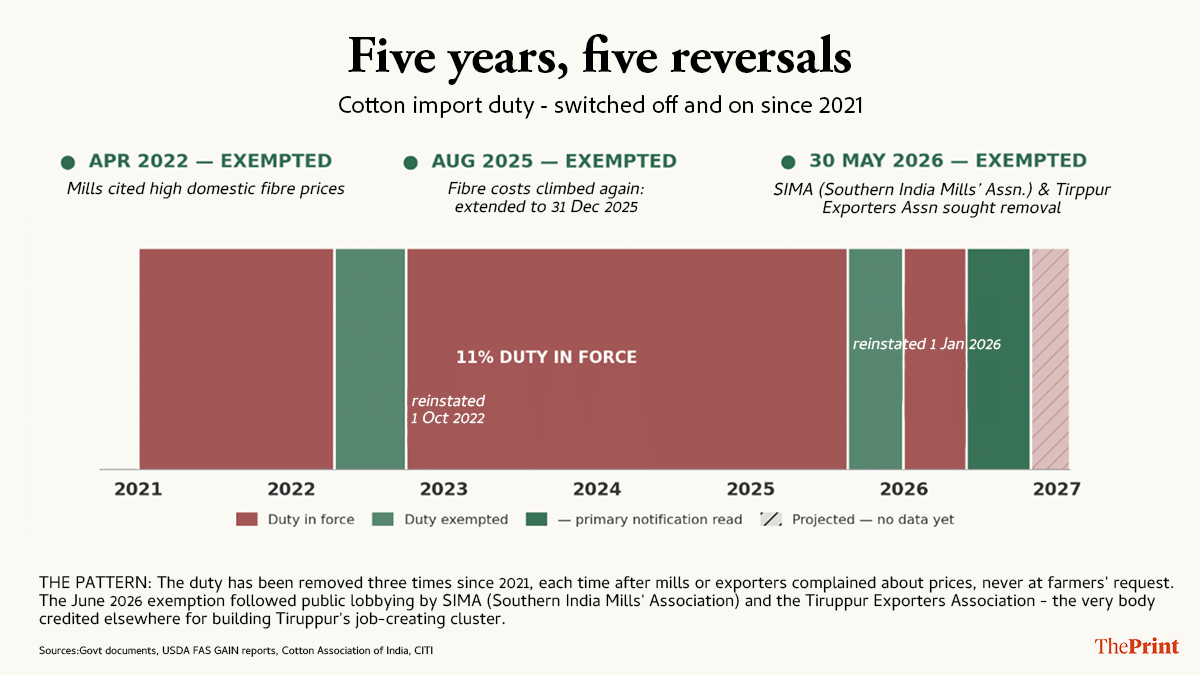
The sequence of events is illustrative. In April 2022, the government waived the import duty on cotton following reports from mills that domestic fibre prices had escalated excessively. This duty was reinstated in October of the same year once the supply was deemed sufficient.
A similar pattern emerged in August 2025, with the duty being removed, extended through December, and then reinstated on 1 January 2026. This cycle repeated on 30 May 2026, following public petitions from the Southern India Mills’ Association (SIMA) and the Tiruppur Exporters Association, prompting governmental intervention.
The Tiruppur Exporters Association is rightly recognised for establishing the
collective institutions that facilitate the cluster’s functioning.
Additionally, this association engaged in public lobbying that preceded the recent elimination of a duty partially intended to safeguard cotton farmers’ income. The occurrence of five reversals over five years, each prompted by organised industry representation and none by organised farmer representation, is not merely coincidental. Rather, it is a consequence of institutional design.
A price that moves on schedule
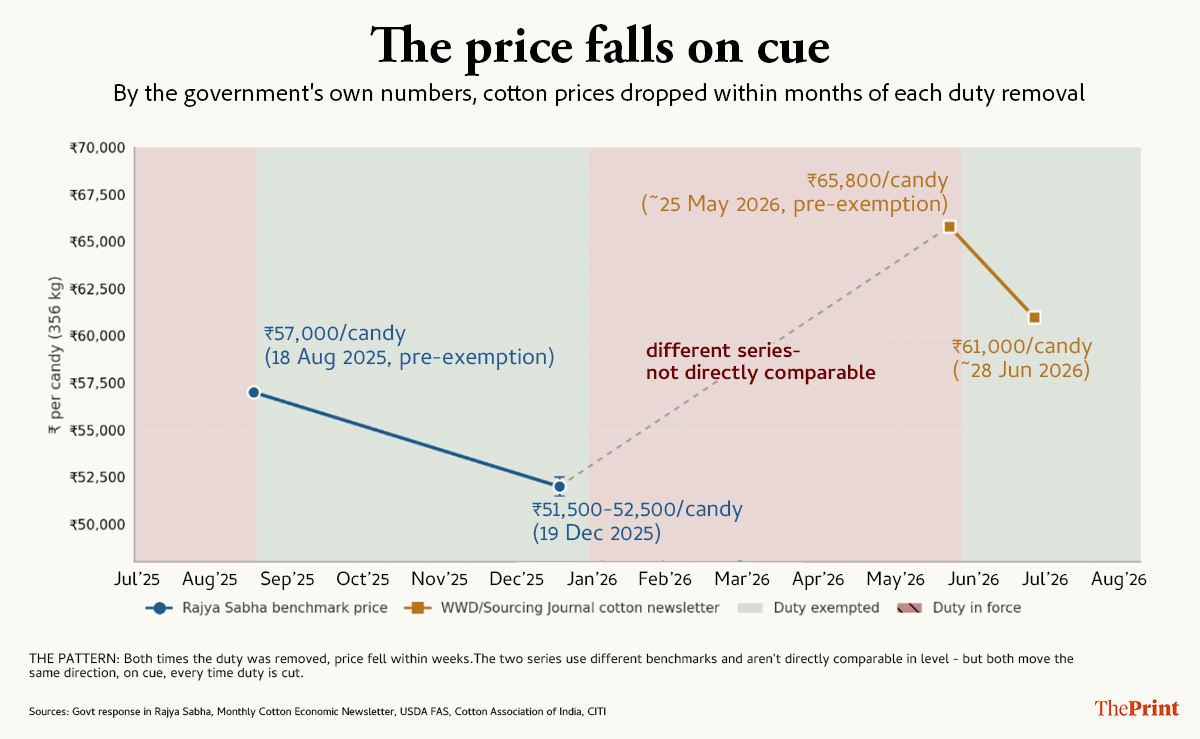
Government data corroborate the mechanism’s effectiveness, aligning with the expected pattern. A written response in the Rajya Sabha in December 2025 documented a decline in domestic cotton prices from approximately Rs 57,000 to around Rs 52,000 per candy following the August 2025 exemption.
Similarly, a specialist cotton-market newsletter observed a comparable trend after the May 2026 exemption, with prices decreasing from about Rs 65,800 to Rs 61,000 per candy within a month of the duty removal.
Although these two series measure distinct benchmarks and should not be interpreted as a continuous sequence, the consistent pattern is evident: each exemption is invariably followed by a reduction in the prices received by farmers within weeks.
George Stigler identified this pattern half a century ago. In his 1971 paper, “The Theory of Economic Regulation,” he asserted that “as a rule, regulation is acquired by the industry and is designed and operated primarily for its benefit,” which constitutes the foundational statement of what economists now refer to as regulatory capture.
The mechanisms involved are not conspiratorial. Mills and exporters maintain established, well-funded associations with direct access to the ministry. In contrast, cotton farmers, numbering in the millions and dispersed across numerous states, lack comparable representation. Given this asymmetry, regulatory capture is not merely a possible outcome; it is a predictable one.
A second concept from an industrial organisation further elucidates the situation. When a market comprises numerous small sellers facing a concentrated group of large buyers, economists describe this as monopsony power, the counterpart to monopoly, where bargaining power is structurally vested in the buyer.
India’s cotton value chain exemplifies this scenario even before any duty is imposed: millions of small farmers sell to a spinning and milling industry concentrated in a few hubs. A duty mechanism that operates reactively, responding to the loudest complaints, fails to address this imbalance; instead, it exacerbates it.
These considerations do not detract from Tiruppur’s significant accomplishments or
the argument for positioning textiles as a leading employment sector in India. Tiruppur’s achievements are significant, and the textile industry should remain a leading employment sector in India. However, the data introduces a crucial variable: a policy instrument that frequently favours processor margins over farmgate prices, each time justified by a seemingly reasonable public-interest rationale, helps maintain the sector’s competitive cost structure.
What should change
The resolution does not require a choice between farmers and exporters, nor does it require dismissing Tiruppur as a model. Three specific modifications could bridge the existing gap.
Firstly, discretionary duty announcements should be replaced with a published, rule-based trigger. A pre-announced formula, linked to the differential between the domestic benchmark and an international reference price, such as the Cotlook A Index, would inform all stakeholders in advance of the exact conditions that activate an exemption or a reinstatement.
This approach would eliminate the current pattern of duty changes being influenced by recent lobbying efforts and restore the predictability exporters say is necessary, as the inconsistency has already undermined India’s credibility as a dependable cotton supplier.
Second, farmer organisations should be granted a statutory seat in the Cotton Advisory Board’s decision-making process, rather than merely a consultative role. While industry associations currently have effective channels into ministry decisions, a formal, non-negotiable seat for organisations representing cotton growers would address the representational imbalance at its root, rather than relying on ad hoc political pressure post facto, as occurred during the 2012 export ban reversal.
Thirdly, each duty exemption should be paired with an automatic, symmetric floor for farmers, involving an MSP top-up funded from the same fiscal resources used to justify the exemption’s cost to the exchequer.
If the government is willing to forgo duty revenue to support mills during a price surge, it should activate equivalent, formula-linked support for farmers when domestic prices fall below a specified threshold in subsequent months.
India does not need fewer narratives like Tiruppur’s; it needs the institutional framework underpinning cotton pricing to align with the ambition of the employment narrative built on it.
(Edited by Ajeet Tiwari)
Also read: About half of farm produce sold outside APMCs anyway. But Modi govt wants one-size-fits-all