



New Delhi: In the summer of 1991, India undertook an action that no sovereign nation desires: it pledged its gold reserves. Under strict confidentiality, approximately 47 tonnes from the Reserve Bank of India’s vaults were transported abroad and deposited with the Bank of England and the Bank of Japan. This measure secured a $405 million loan, giving the country a temporary reprieve.
Records from the Reserve Bank of India (RBI) reveal the precarious situation at that time, with India’s short-term foreign debt exceeding its dollar holdings by one and a half times, and its reserves covering merely 7 percent of its total international liabilities.
Economists refer to the situation India experienced that summer as a “sudden stop,” a term coined by Guillermo Calvo to describe the abrupt cessation of foreign capital inflows, leading a nation to realise that the foreign currency it relied upon was not truly its own.
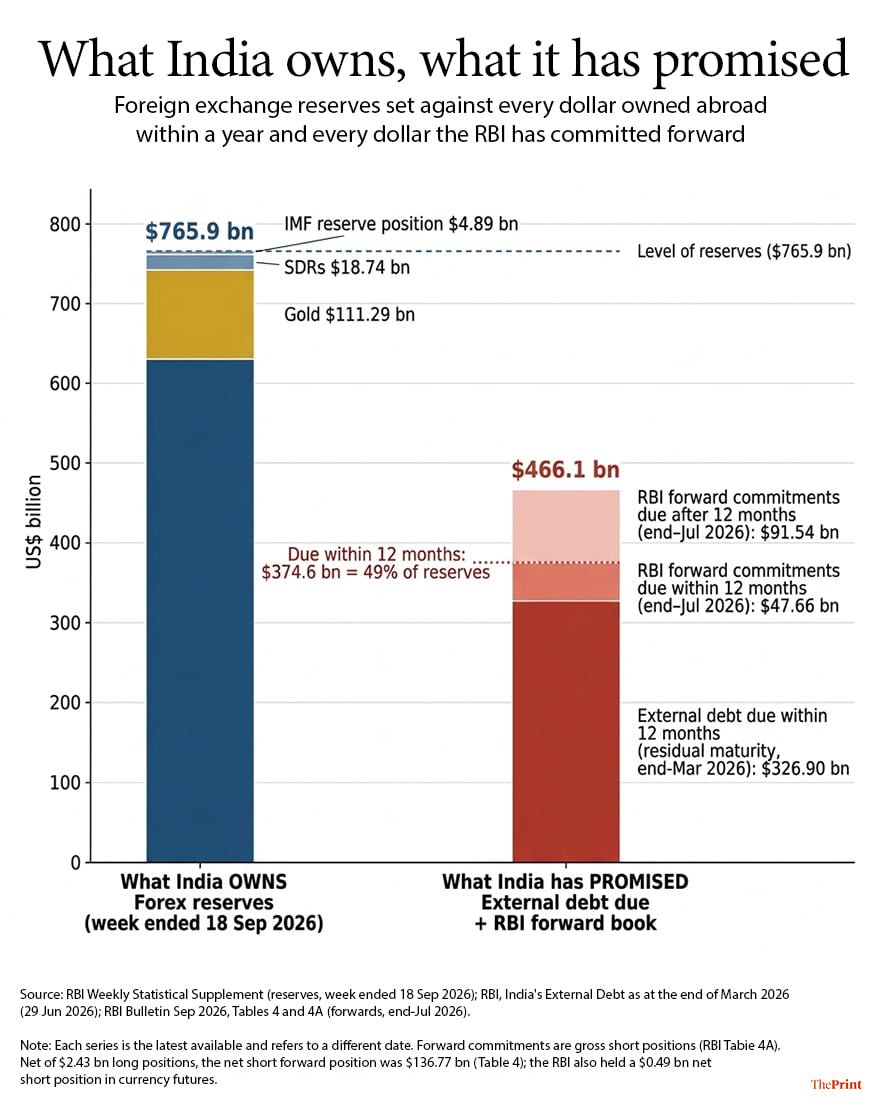
Thirty-five years later, on 18 September 2026, the RBI’s weekly statistics reported India’s foreign exchange reserves at $765.9 billion.
Recently, ThePrint analysed Pakistan’s record $21.4 billion in reserves and found that a significant portion was borrowed from allied governments and bond markets, effectively representing borrowed time rather than genuine financial strength. Subsequently, readers requested a similar analysis for India. The question of whether India’s reserves genuinely belong to the nation is pertinent and warrants thorough examination.
Also Read: Saudi Arabia to lend another $3 bn to Pakistan to boost forex reserves, days after $5 bn pledge
The dollars we borrowed
Critics are likely to focus initially on the following developments.
Since the end of March, India’s reserves have increased by $74.8 billion.
In June, the RBI introduced a special window allowing banks to raise three-to-five-year dollar deposits from Non-Resident Indians (NRIs) under the Foreign Currency Non-Resident (Bank) scheme, with the option to swap these dollars with the central bank. The RBI accepted the dollars immediately, committing to return them when the deposits matured.
This approach traces back to the work of Robert Mundell and Marcus Fleming in the 1960s, which showed that a country cannot simultaneously maintain a fixed exchange rate, allow free capital movement, and pursue an independent monetary policy; it must relinquish one of the three.
With the rupee facing pressure, the conventional response would have been to raise interest rates, potentially hindering economic growth. Instead, the RBI maintained its repo rate at 5.25 percent and chose to address the capital account by engaging the diaspora.
The diaspora responded positively. By 18 September, the special window had attracted $143.6 billion, with $132.98 billion sourced from NRI deposits alone. This amount is nearly double the increase in reserves since March. As a result, a significant portion of the recent reserve accumulation is borrowed, with each commitment to return a dollar recorded in the RBI’s forward book, which was valued at $136.77 billion at the end of July.
However, borrowing in isolation provides limited insight, as all central banks that manage their currencies engage in borrowing to some extent.
The critical issue is whether a country’s assets comfortably exceed its liabilities and the timing of these obligations.
The test India passes
In 1999, amidst the aftermath of Asia’s financial crisis, Argentina’s former Deputy Finance Minister, Pablo Guidotti, proposed a straightforward rule, which was subsequently endorsed by then US Fed chairman Alan Greenspan in a speech at the World Bank. This rule stipulates that a nation’s reserves should be sufficient to cover all foreign debt maturing within the next twelve months. The economies most severely affected in 1997 had accumulated short-term debt that exceeded their reserves.
This criterion has since become a fundamental consideration for any serious analyst.
The RBI’s data allows for a precise evaluation of this criterion. As of the end of March, India had $326.9 billion in foreign debt due within a year. This amount represents approximately 43 percent of the current reserves. In contrast, in 1991, this measure was at 146.5 percent.
The Asian crisis imparted a second lesson. The International Monetary Fund (IMF), in collaboration with central bankers, developed a Reserve Template that mandates countries to disclose their “predetermined drains,” which refer to dollars already committed through forward contracts. By adopting a more stringent approach than Greenspan and Guidotti, we can include every forward dollar the RBI is obligated to deliver within a year, amounting to $47.66 billion as of July, in the debt calculation. This adjustment increases the ratio to approximately 49 percent. As a result, India could fulfil all foreign obligations for the upcoming year while retaining half of its reserves.
Two fundamental characteristics distinguish India’s financial structure from Pakistan’s. The first pertains to the entities responsible for borrowing. Pakistan’s reserves are significantly supported by deposits from allied governments. In contrast, India’s general government has a foreign debt amounting to only 4.6 percent of its GDP, with approximately 78 percent of the nation’s external debt held by corporations and banks, distributed across numerous balance sheets.
The second characteristic concerns the currency denomination of the debt. In 1999, Barry Eichengreen and Ricardo Hausmann introduced the term “original sin” to describe the predicament of emerging economies unable to borrow internationally in their own currency, thereby exacerbating debt burdens with each exchange-rate depreciation.
Currently, 29.4 percent of India’s external debt is denominated in rupees, rendering it immune to depreciation effects. The servicing of India’s total foreign debt requires 5.8 percent of its current receipts, a significant reduction from the 35.3 percent required in 1991.
The cliff that never came
An evident concern persists: borrowed funds in dollars must be repaid.
India has previously addressed this issue. In September 2013, on Raghuram Rajan’s inaugural day as Governor, the RBI initiated a comparable mechanism, alongside a facility for bank borrowings, which resulted in the accumulation of $34 billion.
As these deposits began to mature in the autumn of 2016, critics anticipated a potential dollar shortage. However, the funds returned to depositors without triggering a currency crisis, and India’s external debt fell that year from $484.8 billion to $471.0 billion.
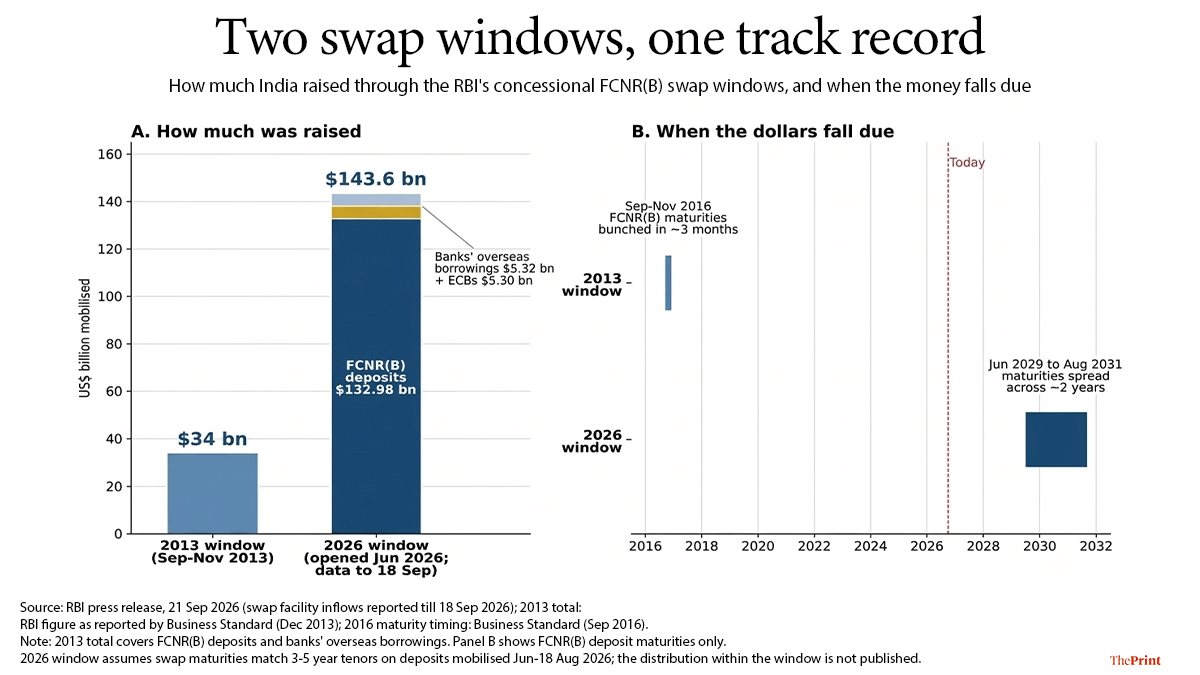
This year’s window is four times larger and better structured. In 2016, the maturities were concentrated within approximately three months. Currently, because deposits span three to five years, the RBI’s commitments are scheduled to mature gradually between mid-2029 and 2031. This arrangement gives the central bank a three-year window to convert borrowed dollars into owned ones by buying them whenever inflows are strong. The RBI has already begun this process, as shown by its net dollar purchases of $18.65 billion in July alone.
Precautionary reserves serve this exact purpose. They function not as a symbol of achievement but as a safeguard against Calvo’s “sudden stop”, with their efficacy measured by their capacity to cover claims when they arise simultaneously.
In 1991, India exported its gold to gain time. Thirty-five years later, the RBI possesses $111 billion in gold within reserves that meet the stringent criteria established by the lessons of the 1997 Asian crisis. While Pakistan’s reserves provide it with time, India’s reserves afford it options. A nation with options is never compelled to transport its gold abroad again.
(Edited by Amrtansh Arora)
Also Read: RBI sold $26 bn of reserves in a month to halt rupee depreciation, but Trump effect eventually won