





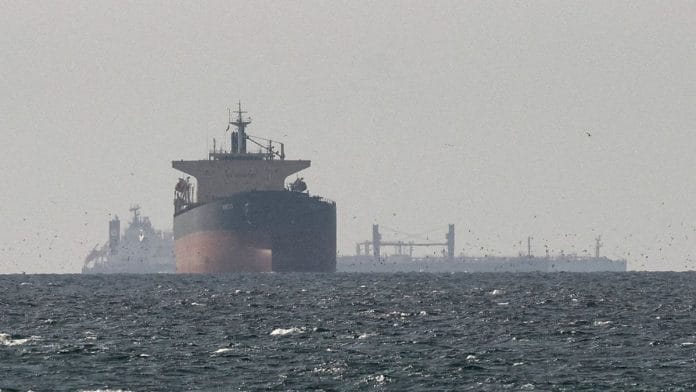


New Delhi: Even though Iran on Friday announced the reopening of the Strait of Hormuz to commercial shipping after over 45 days of blockade, signalling a tentative easing of tensions in one of the world’s most critical energy chokepoints, industry experts warn that a return to normal operations will be gradual, with global energy flows likely to face disruptions for weeks, if not months.
In a statement, Iran’s Foreign Minister Seyed Abbas Araghchi said the Strait of Hormuz had been reopened under controlled conditions. “In line with the ceasefire in Lebanon, the passage for all commercial vessels through Strait of Hormuz is declared completely open for the remaining period of ceasefire,” Araghchi said in a social media post.
He added that vessels would be required to transit through a “coordinated route” designated by Iranian maritime authorities, indicating that movement through the corridor will remain tightly managed.
The Strait of Hormuz, which connects the Persian Gulf to global markets, handles roughly a fifth of the world’s oil trade. The disruption to its operations has resulted in substantial increase in oil prices over the last month or so.
While the reopening reduces the risk of prolonged supply disruption, analysts say the pathway to full normalcy remains complex.
Sumit Ritolia, manager for oil markets and refinery modelling at analytics firm Kpler, underscored that the resumption of energy flows will not be instantaneous. “Even under a reopening scenario, the recovery of Middle East energy flows is expected to be gradual rather than immediate,” Ritolia said.
He explained that upstream production will take time to recover, as oil fields cannot simply be switched back on at full capacity. “Restarting upstream operations will require a phased ramp-up, with thousands of wells brought back online over several weeks rather than all at once,” he noted.
Downstream operations face similar constraints. Refineries across the region will need to carry out safety checks, maintenance, and logistical coordination before ramping up output. “A similar timeline is expected across downstream operations, where refineries will also need to gradually increase utilisation,” Ritolia said.
Shipping logistics are also expected to remain constrained in the near term. Rather than returning immediately to pre-conflict conditions, tanker movements will be closely monitored and coordinated. “Vessel movements will initially be coordinated and monitored, rather than returning to pre-war free-flowing patterns, leading to delays in crude and product deliveries,” Ritolia added.
This controlled reopening suggests that while the immediate threat to global oil supply may have eased, bottlenecks will persist across the supply chain. “A full normalisation of supply chains, including upstream production, refining throughput, and maritime flows, is likely to take several weeks to up to months (3-4), with the early phase representing a controlled ramp-up rather than a full recovery,” Ritolia said.
According to Drewry Maritime Research, a maritime consulting firm, around 1,600 vessels were stuck in the Persian Gulf Friday due to the blockade of Hormuz.
“Even with the opening of Hormuz, insurance premiums for shipping vessels will continue to remain very high until stability and confidence recovers,” said Navin Thakur, Director at Drewry Maritime Research, in a statement to ThePrint.
He added that war-related risks have driven a sharp spike in costs, with premiums for vessels transiting the Strait of Hormuz rising from about 0.5 per cent of hull value before the conflict to roughly 3–5 per cent over the past month.
Hull value represents the agreed monetary value of a ship’s body and machinery, which determines the total loss payout in insurance policies.
For global markets, the development offers cautious optimism. Oil prices may stabilise in the short term, but volatility could continue as traders assess the pace of recovery and the durability of the ceasefire.
(Edited by Viny Mishra)