





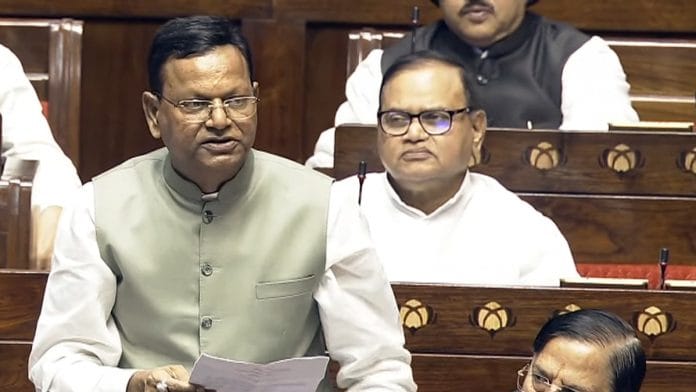


New Delhi: The government Monday informed Parliament that a total of 87 urban cooperative banks (UCBs) have been placed under Reserve Bank of India (RBI) restrictions since 2021, but only 27 continue to remain under regulatory restrictions as of 27 July this year.
The data, shared by Minister of State for Finance Pankaj Chaudhary in response to a question by Samajwadi Party MP Pushpendra Saroj, showed Maharashtra accounted for nearly half of the banks still under the RBI’s All-Inclusive Directions (AID)—a regulatory framework restricting the operations of financially stressed banks to safeguard depositors’ interests.
Among the 27 banks that remain under restrictions, Maharashtra has the highest number at 10, followed by Karnataka with four. Assam, Gujarat, Delhi and Uttar Pradesh have two banks each under the RBI’s directions.
The government also informed Parliament that only three Tier-3 urban cooperative banks were found to be violating capital adequacy norms as of 31 March, 2026. The RBI said it had taken action under the Banking Regulation Act, including removing directors and imposing monetary penalties.
“RBI in exercise of its powers conferred under Banking Regulation Act, 1949 have taken various actions including removal of directors and imposition of monetary penalties to prevent such violations,” Chaudhary stated in the reply.
Separate state-wise data showed that since 2021, monetary penalties for violations related to capital adequacy, lending and governance norms have been imposed on 327 urban cooperative banks. Maharashtra recorded the highest number of such banks at 108, followed by Gujarat (81), Tamil Nadu (35), Uttar Pradesh (21) and Karnataka (16).
Capital adequacy norms require banks to maintain sufficient capital to absorb unexpected losses and protect depositors’ money. According to RBI, UCBs are classified into four tiers based on their deposit size, with higher-tier banks subject to stricter capital requirements.
Under RBI norms, Tier 1 UCBs with deposits up to Rs 100 crore are required to maintain a Capital Adequacy Ratio (CAR) of 9 percent, whereas remaining UCBs are required to maintain 12 percent.
The reply also said the Deposit Insurance and Credit Guarantee Corporation (DICGC) had settled claims worth Rs 18,931.4 crore as of 31 March, 2026 including Rs 11,778.9 crore for 440 banks under liquidation or amalgamation and Rs 7,152.5 crore for 80 banks placed under RBI restrictions.
The data showed that Maharashtra accounted for the highest amount of claim settlements at Rs 12,160.5 crore, followed by Gujarat (Rs 2,509 crore) and Karnataka (Rs 1,718 crore).
On banking frauds, the RBI informed the government that 3.53 lakh domestic payment frauds involving Rs 489 crore had been reported across all banks, including urban cooperative banks, as of 30 June, 2026.
However, the reply did not provide separate figures for cooperative banks.
The finance ministry said the RBI has strengthened supervision of cooperative banks through a revamped supervisory framework, tighter inspections, the Prompt Corrective Action mechanism, deposit insurance through DICGC and awareness campaigns to help prevent frauds and protect depositors.
(Edited by Amrtansh Arora)
Also Read: India’s urban co-op banks are turning the page—crisis to cautious revival, one metric at a time