


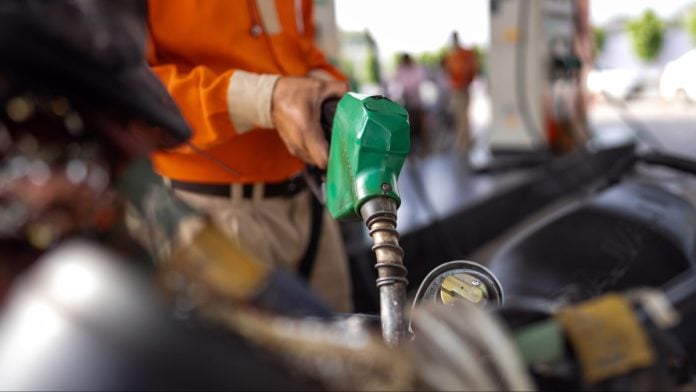
New Delhi: India’s state-run oil marketing companies (OMCs) incurred losses of around Rs 570 crore a day in October from selling petrol, diesel and domestic cooking gas below market rates, which put pressure on profitability and cash flows even as strong refining margins helped boost their September-quarter earnings.
Prashant Vasisht, Senior Vice President and Co-Group Head, Corporate Ratings at credit rating and research agency ICRA Limited, told ThePrint that OMCs incurred average marketing losses of around Rs 12 per litre on diesel and Rs 9 per litre on petrol in October. The under-recovery on domestic LPG was estimated at around Rs 230 per cylinder during the month.
India’s three state-run OMCs are Indian Oil Corporation (IOCL), Bharat Petroleum Corporation (BPCL) and Hindustan Petroleum Corporation (HPCL), which together account for a major share of the country’s fuel retailing business.
The pressure in the marketing business comes even as IOCL, the country’s largest fuel retailer, last week reported a standalone net profit of Rs 21,630 crore in July-September quarter this year—more than double the profit it posted in the same period last year—supported by a brief decline in crude oil prices in July and stronger refining margins.
Pankaj Srivastava, Senior Vice President for commodity market (oil) at Rystad Energy, an independent energy research and business intelligence company, said the reported profits of integrated OMCs reflect earnings from refining, marketing and other businesses, and should not be directly compared with accumulated LPG under-recoveries.
“Under-recoveries on fuel sales do not represent the overall losses of integrated oil marketing companies such as IOCL, HPCL and BPCL,” he told ThePrint.
IOCL’s LPG under-recovery estimates also point to increasing pressure in the coming months.
During the company’s post-results analyst call, Director (Finance) Anuj Jain said the under-recovery had increased from Rs 184 per domestic cylinder in September, to around Rs 229 in October. It is expected to rise to Rs 309 in November and Rs 370 in December.
LPG compensation burden grows
IOCL’s accumulated negative LPG buffer stood at Rs 32,506 crore as of 30 September, after accounting for Rs 7,243 crore of government compensation recognised during April-September. The other two public sector OMCs, BPCL and Hindustan Petroleum Corporation HPCL, reported accumulated LPG under-recoveries of Rs 17,334 crore and Rs 18,049 crore, respectively.
Together, the three companies had an accumulated LPG under-recovery burden of nearly Rs 67,900 crore during said period.
In August last year, the government had approved a compensation package of Rs 30,000 crore to support OMCs selling domestic LPG below market prices. The amount was to be disbursed in equal monthly instalments starting November 2025.
Rising international LPG prices could increase the need for additional assistance. According to Srivastava, the existing compensation package may not fully cover accumulated and ongoing under-recoveries. “Further government support remains possible, although IOCL’s strong September-quarter profit could encourage a wait-and-watch approach before additional compensation is approved.”
Vasisht also said that the government has generally supported OMCs for domestic LPG under-recoveries in the past, and some support could be expected in future.
Petrol, diesel price outlook uncertain
Despite mounting marketing losses, an immediate increase in petrol and diesel retail prices is not certain.
On 1 November, OMCs increased aviation turbine fuel (ATF) prices by Rs 1.37 per litre, and those of commercial LPG by Rs 10 per 19-kg cylinder, taking the latter to Rs 2,820 in Delhi. Petrol and diesel prices remain unchanged.
Srivastava said that any increase in petrol and diesel prices would depend on geopolitical developments, domestic economic conditions and the electoral calendar. A further escalation in the Middle East conflict could push crude oil prices up by $5-10 per barrel from prevailing levels, adding to pressure on OMCs’ marketing margins, he added.
“Our assessment is that the government may delay a retail price increase until around the end of the first quarter of 2027, depending on the Uttar Pradesh election schedule and the severity of the oil price shock,” he told ThePrint.
Vasisht, however, said that predicting the timing of retail fuel price increases was difficult.
Meanwhile, strong refining earnings and opportunities to sell petroleum products overseas could provide some cushion to OMCs. Srivastava said India’s refinery investment plans were likely to remain broadly on track, supported by opportunities in export markets.
For OMCs, the coming quarters will depend on movements in international crude and LPG prices, refining margins, government compensation, and whether higher fuel costs are eventually passed on to consumers.
(Edited by Mannat Chugh)