






New Delhi: That India solar power capacity has increased manifold and is contributing significantly to meeting the high power demand, especially during peak summer months, is now an established fact. But this growth, while helping meet the daytime surge in power demand, is also adding to grid stress, according to a new working paper by the Economic Advisory Council to the Prime Minister (EAC-PM).
India’s solar capacity increased to over 157 GW by May 2026.The share of solar power in total installed capacity has increased from a meagre 2 percent in 2015-16 to 29 percent as of May 2026.
Giving examples across three comparable summers—2023, 2025 and 2026—the paper, written by Sanjeev Sanyal, EAC-PM member, and Satvik Dev, a Joint Director in EAC-PM, argues that the growth in renewables without “concomitant and adequate growth in storage, and without implementation of other net load smoothening policies will add to grid stress”.
The paper has kept 2024 out of the analysis since it was one of the hottest years on record and does not yield comparable figures.
Three signals show the stress, Sanyal wrote on X Tuesday. “First, prices: in May 2026, power on the IEX day-ahead market averaged Rs 1.11 per unit at midday but Rs 9.71 at night. Second, curtailment: about 24 GWh of solar was wasted daily in May. Third, shortages: the grid fell short of non-solar-hour peak demand on 36 days in April-May, compared with only 6 days for solar-hour peak demand.”
How grid functioned 21 May 2026
The authors chose 21 May 2026, when the peak electricity demand recorded an all-time high of 270.8 GW at 3.45 pm, to explain how a large portion of the demand was met by solar panels and not conventional thermal or hydro power plants. After 3.45 pm till about 6.30 pm, as the workday ended, the demand dropped by some 34 GW to 236.7 GW.
But the situation reversed in the evening when the demand started climbing again as people returned home, and switched on lights and cooling appliances. This evening rise pushed demand back up to a second peak of about 252 GW around 10.45 pm. As the sun set, this second peak demand was met entirely by thermal baseload—mostly coal-fired power plants.
The paper notes that thermal power is the single biggest source at every hour without exception, supplying somewhere around 138 to 185 GW. Overnight, when no solar power is available, thermal alone carries roughly three-fourths of the entire load.
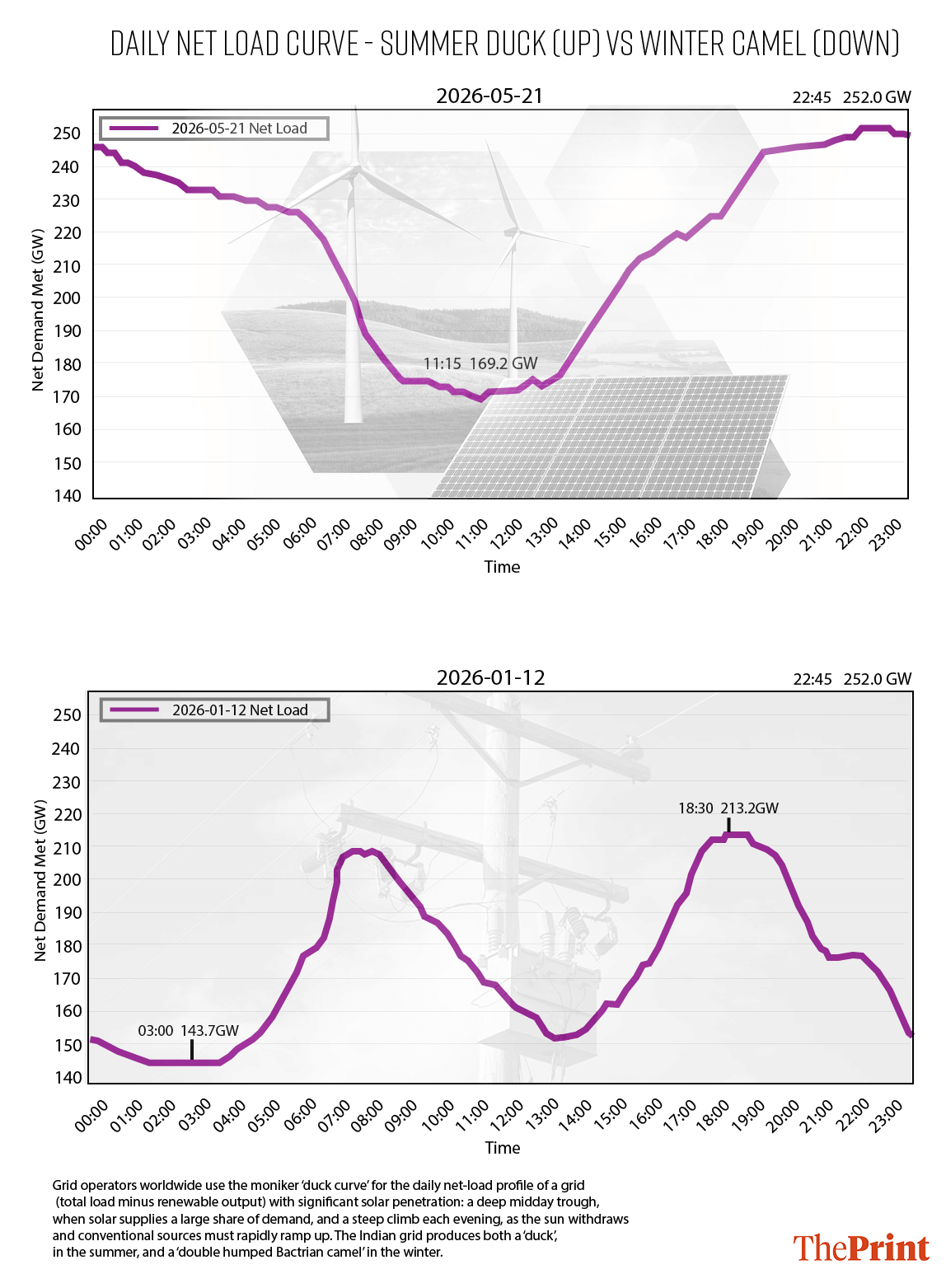
“Solar pushes the midday demand on conventional plants very low, but it does nothing for the evening peak, which arrives precisely when solar has faded. The result is a deep midday dip followed by a steep evening climb, implying that the grid must quickly bring on tens of gigawatts of other supply.”
This is because India currently does not have adequate solar storage infrastructure.
Not enough solar storage
Despite increasing penetration, solar energy is curtailed in volume because it cannot be used the moment it is produced. According to the paper, the curtailment figures are striking. The average per day solar curtailment for May 2026 was equivalent to throwing away electricity that could have powered more than a quarter of Delhi for an entire day.
Using monikers like the ‘duck curve’ and ‘double humped Bactrian camel’, which globally grid operators frequently use to describe grid function, Sanyal and Dev have explained how the grid with significant solar penetration performs in the summer and in winter.
What does it imply
Coal-fired plants, which dominate India’s conventional fleet, become costlier to run the further they operate below their maximum load, the paper notes.
“Forcing them to follow the net-load, i.e. ramping down output through the morning as solar rises, then ramping it up between midday and the evening peak, is expensive,” the authors write.
The paper notes that the evening climb has doubled in three years, from about 36 GW (May 2023) to 74 GW (May 2026). The morning ramp-down, as solar power floods in, has nearly tripled across the same window, from 18 GW to 53 GW.
From midnight until 5 am, and again from 6.30 pm through the end of the day, the clearing price sits at Rs 10/kWh, the binding price ceiling on the IEX day-ahead market.
“It would almost certainly have cleared higher were the ceiling not capping it. For roughly six hours in between, from about 7.45 am to 2 pm, the price collapses below Rs 2/kWh, bottoming at the day’s minimum of Rs 1.56/kWh at 1 pm, when solar is flooding the grid. The energy market spends the day at one of two extremes, rock-bottom while the sun is up, and pinned to the ceiling once it sets,” the paper says.
Need to ramp up storage
The paper notes that in the absence of adequate storage capacity, India cannot use the surplus solar power generated during the day.
The storage will help because currently, during midday, India has so much solar that a lot of it is wasted as the grid does not have the capacity to store it. If there was adequate storage capacity, the extra solar power generated could be used to charge batteries that could be used during evening peak-demand hours.
“…the grid’s challenge is now about when power is available relative to when it is needed. The question has shifted from quantity to timing and flexibility,” the paper states.
The authors argue that a battery build-out can help ease the stress on the grid. They cite how California, with a battery fleet large enough to discharge over 10 GW, charges from its midday solar surplus and discharges into the evening, when the demand surges again, “converting an evening net-load swing of nearly 28 GW into about 10 GW, adjusted for battery discharge”.
“This is the very capability India will need as its own solar fleet expands,” the authors write.
The storage gap, the paper notes, is large and needs to be filled quickly.
“Flattening even a single summer evening ramp by half requires about 130 GWh of discharge across the 1 PM to 8 PM window. India’s entire pumped-storage and battery fleet discharged only about 23.8 GWh across an average day in May 2026,” the paper notes.
It adds that the shortfall is overwhelmingly a battery shortfall. Against the National Electricity Plan’s projection of 8.68 GW of grid-scale batteries for 2026-27, only 0.27 GW was in operation till January 2026, even as pumped hydro very nearly reached its mark at 7.2 GW of the 7.45 GW projection.
According to the paper, there has been significant capacity additions in recent months, which has increased BESS capacity to 2.7 GW, but the gap still remains large.
“That a battery build-out can help ease the stress on the grid is not merely conjecture,” the paper says.
The most direct response to the flexibility problem, the paper says, is to give legal standing to storage systems.
At present, the Electricity Act does not mention storage at all. The Draft Electricity (Amendment) Bill, 2025 has inserted storage into the definition of ‘power system’ itself.
Power systems are the set of facilities (e.g. generation, transmission, and distribution) the Act recognises as the working machinery of the grid. Proposed clause 2(50)(k) adds ‘energy storage system’ to the existing list of power systems in the Act. This is in line with the best international practices.
The paper has also recommended deepening the market for power. The bulk of India’s electricity is sold under long-term power purchase agreements at fixed schedules, outside the exchange. Only the residuary power is traded on the market.
“The paper supports the direction of the Draft Electricity (Amendment) Bill, 2025, and draft Electricity (Rights of Consumers) Amendment Rules, 2026. But it cautions that without adequate storage and net-load smoothing policies, solar growth will intensify grid stress,” Sanyal wrote on X.
(Edited by Viny Mishra)
Also read: SECI’s overly cautious procurement rules will deter investors from India’s renewable projects