





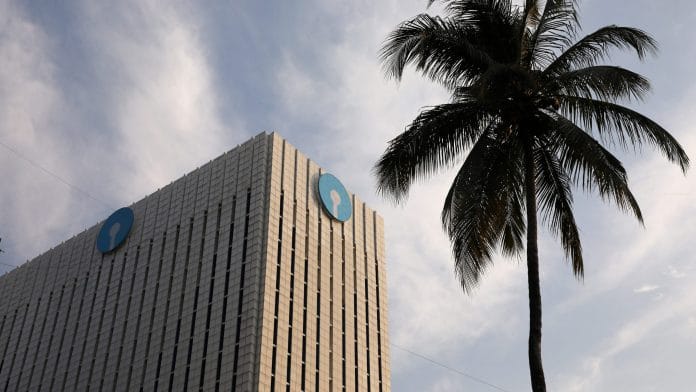

New Delhi: Public sector banks (PSBs) in India were more efficient than private banks in FY 2026, according to a new working paper by the Economic Advisory Council to the Prime Minister (EAC-PM), challenging the widely held view that private lenders are more efficient.
The study found that the technical efficiency of PSBs was at 93.12 percent in FY 2026, compared with 86.02 percent for private banks, whereas foreign banks were at 83-85 percent during FY 2020-FY 2026.
“Contrary to popular perceptions, public sector banks’ (PSBs) efficiency improved to 93.12 percent in FY26,” the paper said.
The working paper, “Reforms, Efficiency, and Productivity of Indian Banking Sector in the Last Decade: A DEA Approach,” released Tuesday, was authored by Soumya Kanti Ghosh, part-time EAC-PM member and Group Chief Economic Adviser at State Bank of India, and Tapas Kumar Parida, an economist in SBI’s Economic Research Department.
The study analysed 47 banks—12 PSBs, 21 private banks and 14 foreign banks—between FY 2015 and FY 2026. These banks account for more than 95 percent of the banking system’s assets.
The overall efficiency of the banking sector also improved, from around 77.9 percent in FY 2020 to 88.34 percent in FY 2026.
The improvement in public sector banks’ efficiency comes after a decade of reforms that began with the Reserve Bank of India’s (RBI) Asset Quality Review in 2015. The exercise forced banks to recognise stressed loans that had built up over several years.
The government subsequently recapitalized PSBs and pushed measures to improve governance, resolve bad loans, and strengthen bank operations. The paper also highlights the role played by technology upgrades in improving efficiency.
According to the study, PSBs were hit hardest during the Covid period, with their efficiency falling to 72.46 percent in FY 2020 from 85 percent in FY 2019. However, following capital infusion and technology upgrades, efficiency recovered sharply, rising by more than 20 percentage points to 93.12 percent in FY 2026.
Bank consolidation was another important part of the reform process, the study cites.
SBI’s associate banks were merged with the parent in 2017, followed by the merger of Bank of Baroda, Vijaya Bank and Dena Bank in 2019. In 2020, 10 PSBs were consolidated into four banks – Punjab National Bank, Canara Bank, Union Bank of India and Indian Bank. This reduced the number of PSBs from 27 to 12.
The report says consolidation aimed at creating banks with stronger capital, wider geographic reach, and greater capacity to finance large projects. However, it also cautions that the benefits depend on successful technology integration, common risk practices, and sustained productivity improvements.
While private banks also improved their efficiency from 78.03 percent in FY 2020 to 86.02 percent in FY 2026, the study says certain weak banks pulled down the private-sector average.
“It seems takeover of weaker banks affected the efficiency in the private sector,” the report says, pointing to DCB Bank and IDFC First Bank.
Across the full FY 2015-FY 2026 period, PSBs had an average efficiency of 88.5 percent, compared with 85.6 percent for private banks.
Technology, AI and the next phase
The study also found that technological improvements have helped banks become more efficient, although the pace has fluctuated. At the overall scheduled commercial bank level, technology improved steadily until FY 2021, before weakening in FY 2023.
It has since recovered, with the frontier-shift score reaching 1.0087 in FY 2026. The frontier-shift measure captures changes in the technology available to banks over time. A score above 1 indicates technological progress.
Authors say this could mark the beginning of another phase of technology-led change, driven by artificial intelligence (AI) and machine learning (ML). “Technological innovations have already peaked in FY23,” the report says, adding that the new generation of AI and ML could bring further innovation to banks.
The paper expects banks to increasingly use AI for personalised customer services, automation, and data-driven decision-making. “In principle, Indian banking system is currently moving towards cognitive banking system. A cognitive bank is enabled by AI and cognitive computing across all business functions and processes,” the study said.
But the sector faces a more immediate challenge on the funding side. Credit growth has outpaced deposit growth since FY 2023, with the gap widening to 5 percent in July 2026. The report says this is pushing up banks’ cost of funds as they turn to certificates of deposit, money markets, and bonds to finance growing credit demand.
The authors also call for further consolidation of banks. They note that market shares vary sharply, from around 20 percent for the largest banks to below 1 percent for smaller ones. The paper suggests creating a few large banks of broadly similar size, while maintaining competition, to help meet the economy’s growing credit needs as India moves towards Viksit Bharat by 2047.
(Edited by Vidhi Bhutra)
Also read: India becomes the least-favoured stock market in Asia. What has investors worried?