



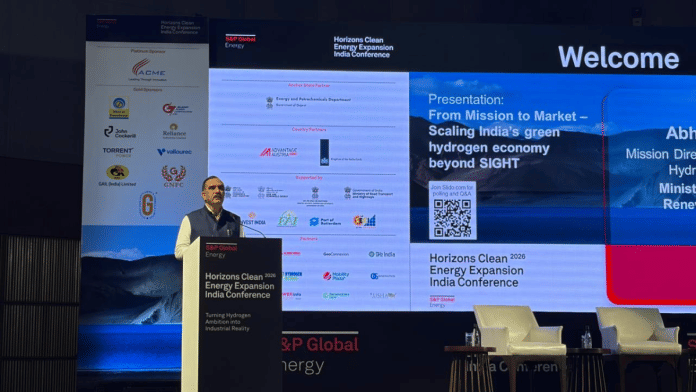
New Delhi: India’s green hydrogen mission could generate Rs 8–10 lakh crore in investment in hydrogen production alone by 2030, with additional spending required on pipelines, storage, transportation and port infrastructure, Abhay Bakre, Mission Director, National Green Hydrogen Mission, Ministry of New and Renewable Energy, said Thursday.
Speaking at S&P Global’s Horizons Clean Energy Expansion India 2026 conference in Delhi, Bakre said producing 1 million tonnes of hydrogen would require around Rs 1.5 lakh crore in investment. Under the National Green Hydrogen Mission, the government is targeting annual production of 5 million tonnes by 2030.
He also stressed the need to develop domestic manufacturing capabilities for electrolysers, fuel cells and other hydrogen-related equipment, saying India should not depend heavily on imported components while building the sector.
The National Green Hydrogen Mission, launched in January 2023, aims to build an ecosystem for the production, use and export of green hydrogen, reduce fossil fuel imports and support industrial decarbonisation.
According to Bakre, India needs to develop green hydrogen as an alternative energy source to reduce its dependence on imported fossil fuels and support economic growth.
“A growing economy like India needs energy for its growth,” Bakre said, highlighting the need to develop an energy ecosystem that can meet rising demand across sectors.
He explained that while electricity accounts for around 23 percent of the energy consumed by the economy, the remaining 76–77 percent is consumed in the form of molecules, primarily fuels such as coal, oil and gas.
“Most of the molecules we are importing. That’s the model here, because the more we grow, the more energy we need, and there are more molecules to be imported,” he said.
Green hydrogen can help reduce this dependence by providing a cleaner alternative for industries such as fertiliser, steel and shipping, which cannot easily run entirely on electricity.
Government seeks to expand hydrogen demand
Bakre said the National Green Hydrogen Mission’s immediate focus was to replace fossil fuel-based hydrogen, also known as grey hydrogen, already used in fertiliser production and refineries.
These two sectors currently consume more than 6 million tonnes of grey hydrogen, he said.
In fertiliser production, green ammonia can replace imported grey ammonia, while refineries can use green hydrogen produced from renewable energy instead of hydrogen made using imported natural gas.
Bakre said the government had already awarded its first major green ammonia tender, which could help replace 25–30 percent of India’s grey ammonia imports.
However, he stressed that the mission was not limited to existing hydrogen-consuming industries.
The government is also working to create demand in sectors that currently use little or no hydrogen. Bakre said this would be essential to reduce production costs through economies of scale.
“The first fundamental challenge is the cost,” he said. “Cost reduction can only happen if there are economies of scale, and scale can only come if we open more and more sectors.”
Mobility is one of the areas being explored. India is conducting trials of hydrogen-powered trucks and buses, with more than six fuelling stations operational across different parts of the country and trials identified across over 20 highways.
Bakre said the government expects around 45–50 hydrogen-powered trucks and buses to be involved in trials by the end of 2026. By 2030, it expects at least 400–500 hydrogen-powered buses or trucks to be operating in India.
Other sectors being explored include steel, process industries and shipping. Bakre said even replacing a small share of maritime fuel with green fuels could create substantial demand, given the scale of global shipping.
India emerges as potential green hydrogen export hub
India is gaining importance in the global green hydrogen market, both as a domestic consumer and an exporter, Matthew Hodgkinson, Hydrogen Senior Analyst at S&P Global Energy, said.
Presenting the company’s analysis of hydrogen projects, Hodgkinson said Indian project developers accounted for around 40–50 percent of hydrogen offtake agreements signed globally in 2024 and 2025, with their share increasing considerably in 2026.
These agreements cover hydrogen and its derivatives, including green ammonia and methanol, which are easier to transport over long distances. Most export-oriented capacity from Indian developers is directed towards Europe and the Asia-Pacific region.
European demand is expected to come largely from industrial decarbonisation, while the Asia-Pacific market includes demand from shipping, power generation and other industrial uses, he said.
Hodgkinson said India’s relatively competitive renewable energy costs could support its emergence as a major supplier.
He also highlighted broader global project development trends. Around 25 gigawatts of electrolyser capacity has been commissioned, is under construction or has reached financial commitment globally, with China accounting for approximately 65 percent.
More than 100 gigawatts of additional capacity is in permitting or early development stages across major regions, including China, India, Europe, the Middle East, the US and Australia.
However, the pace at which projects are moving from development to construction and commissioning has slowed in 2026, despite continued growth in announced capacity. Hodgkinson attributed part of the slowdown to policy uncertainty in key markets, including Europe and China.
(Edited by Viny Mishra)
Also read: Delhi launches hydrogen bus shuttle in Central Vista. Trials underway in Gujarat, Maharashtra