






India’s foreign-exchange reserves climbed to a record high as dollar inflows surged after recent measures by the central bank to attract capital.
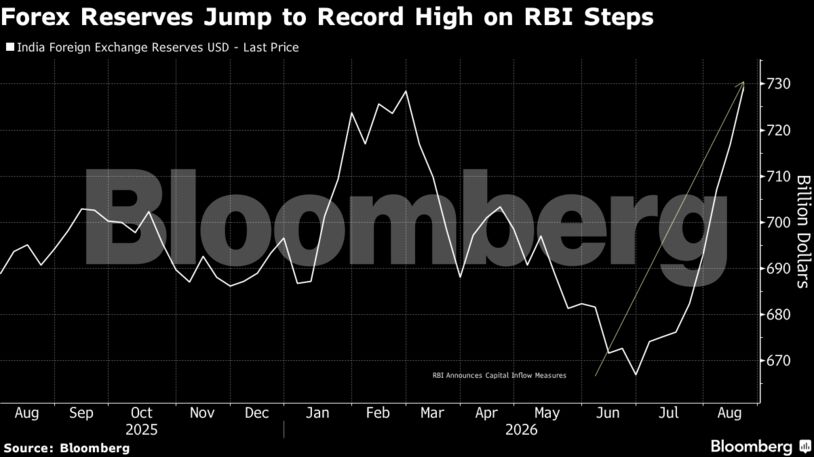
The Reserve Bank of India’s forex stockpile gained by $12.4 billion to an all-time high of $729.3 billion in the week of Aug. 21, according to data released by the central bank Friday. That surpasses the previous high of $728.5 billion in February.
Steps taken by the RBI in early June, including a special deposit program for overseas citizens, have garnered $72.8 billion of inflows through Aug. 21. That’s helped avert what could have been an unprecedented third year of a deficit in India’s broadest measure of money flowing in and out of the economy.
The boost to reserves has given the central bank more firepower to support the rupee, which remains one of Asia’s worst-performing currencies. The unit has recovered about 1.7% from a record low hit in May, but continues to face pressure from elevated oil prices, given the nation’s heavy dependence on fuel imports.
While the dollar inflows cushion India’s external situation, attracting them is expensive as the RBI is bearing banks’ hedging costs under the diaspora deposits, enabling lenders to offer lucrative interest rates to overseas customers.
It is costlier for the central bank to do so now as US interest rates are at much higher levels than they were in 2013, the last time the RBI turned to overseas residents for such deposits.
“The mobilization under the ongoing RBI swap scheme highlights the acute limitations of relying on expensive debt-funded reserve mobilization to stabilize the rupee,” Dhananjay Sinha, head of research at Systematix Shares and Stocks Ltd., wrote in a note.
The central bank typically deploys dollars in assets whose returns are substantially lower than the expense incurred in raising money under the special program, he wrote, adding that the “carry cost” for the country could be around $5.7 billion annually.
Earlier this month, the RBI unexpectedly brought forward the closure of the diaspora deposit program, with Governor Sanjay Malhotra saying flows had been stronger than expected.
Disclaimer: This report is auto generated from the Bloomberg news service. ThePrint holds no responsibility for its content.