




New Delhi: Automation can displace workers without impoverishing them, but whether they share in its productivity gains depends partly on the institutions governing the workplace. Post-war America shared the gains from automation with workers until the 1970s, while Germany gave workers a legal say in how technology was deployed, helping it adopt automation without hollowing out its workforce.
India, by contrast, made permanent hiring more expensive and gave workers little say over technological change.
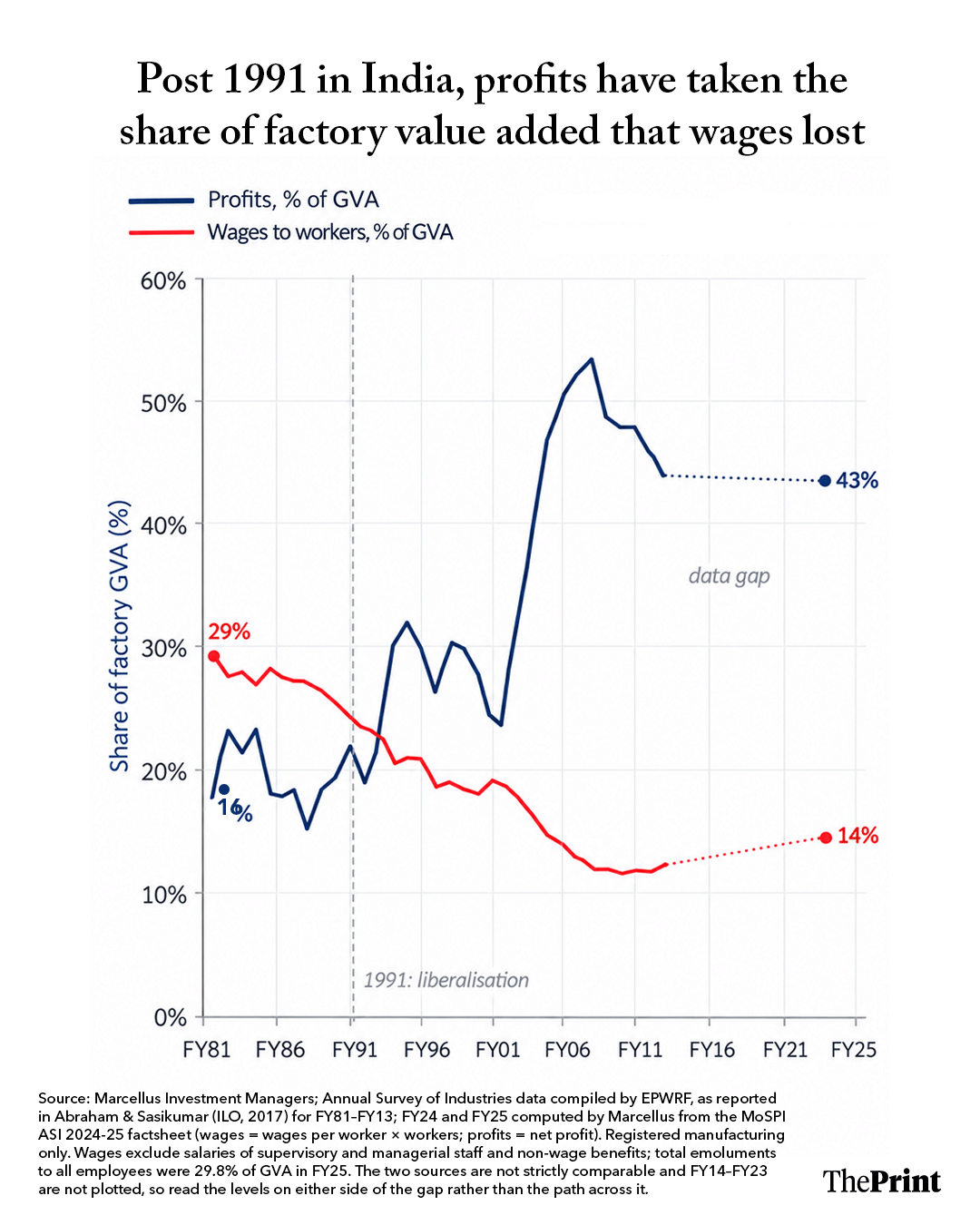
The consequences are visible in its factories: wages as a share of gross value added (GVA) fell from 28.5 percent in FY81 to 11 percent in FY13, while the profit share rose from 15.7 percent to 44.1 percent, according to an International Labour Organization (ILO) study. Contract workers’ share of factory employment has also climbed from about 20 percent in FY2000 to 42 percent in FY25.
The same institutional vacuum now awaits India’s white-collar workers as AI pushes them into gig work.
For investors, this raises an important question about which businesses stand to benefit from the changing relationship between technology, employment and wages.
The machines are coming and we have been here before
In the first half of the 19th century, British output per worker surged while real wages barely moved for decades—a period economic historians call ‘Engels’ pause’. Economist Carl Benedikt Frey makes the point beautifully in his 2019 book The Technology Trap: “Technology that replaces workers rather than enabling them produces a long, politically combustible period of stagnant wages and surging profits, and how a society manages that period decides who wins from the technology”.
Economists Daron Acemoglu and Pascual Restrepo frame this as a race between two forces. Automation displaces workers from tasks they used to perform, while new technologies simultaneously reinstate workers in tasks that did not previously exist. Workers benefit when reinstatement keeps pace with displacement. The measure which needs to be tracked is labour’s share of value added: when it falls, wages are growing more slowly than productivity meaning workers are producing more and keeping less.
There is a benign explanation for a falling labour share. Economists Loukas Karabarbounis and Brent Neiman in their 2014 paper showed that cheaper investment goods explain roughly half of the global decline in labour’s share since the 1980s. However, capital goods became cheaper across countries, while labour’s share diverged sharply between countries using the same machinery and technology. The key variable shaping these outcomes is the set of institutions that determines whether workers have a say in decisions about how new technology is deployed.
Same machines, 2 radically different outcomes
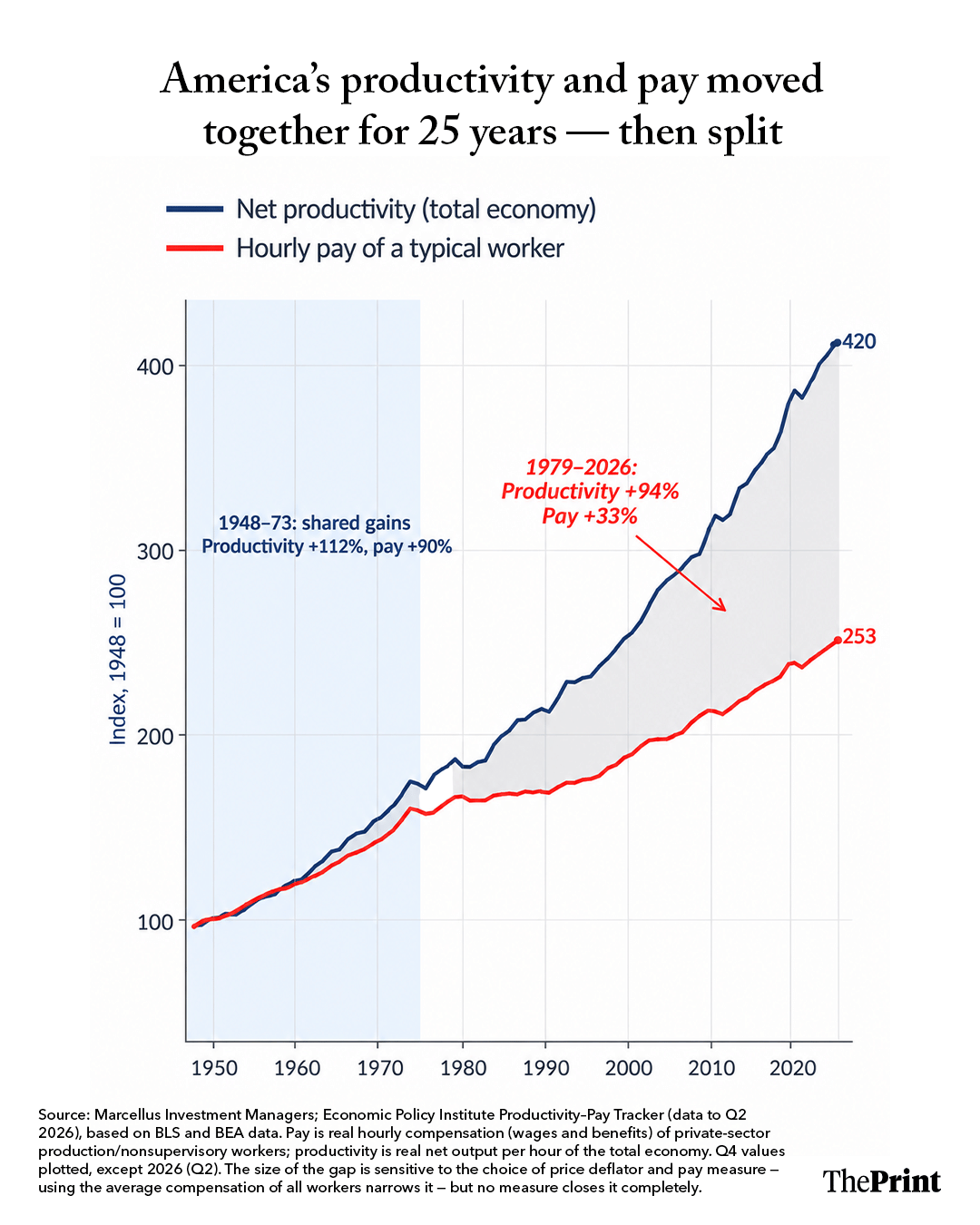
Post-war America is a textbook case of shared gains. The Wagner Act of 1935 gave workers the legal right to organise and bargain collectively, while the war effort turned unions into central partners of industry. Unions bargained not only over pay but also over how new machinery was introduced and whether workers would be trained to operate it. The technology of the era also helped: electrification and mass production automated existing jobs but created entire new categories of operator, maintenance and supervisory roles. Between 1948 and 1973, net productivity grew by 2.8 percent a year, while a typical worker’s hourly compensation grew by 2.9 percent a year.
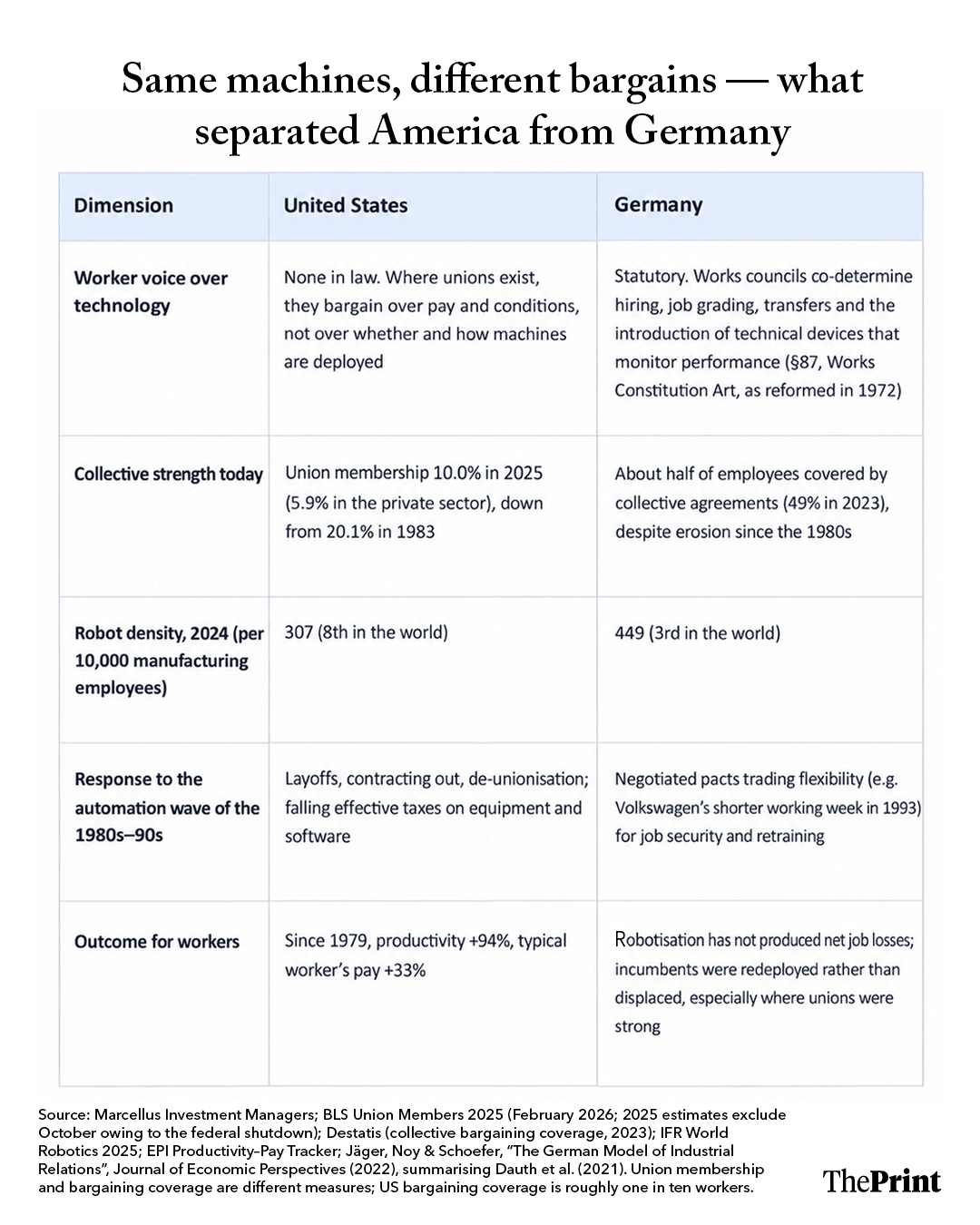
From the 1970s, this arrangement began to reverse. Milton Friedman’s 1970 doctrine that a company’s only social responsibility was to increase its profits became boardroom gospel, while the Reagan administration’s mass dismissal of striking air-traffic controllers in 1981 legitimised union-busting across the private sector. Union membership halved from 20.1 percent of workers in 1983 to 10 percent in 2025, and to just 5.9 percent in the private sector.
Fiscal policy also contributed to the shift. Economists Daron Acemoglu, Andrea Manera, and Pascual Restrepo in a 2020 study estimated that the effective tax rate on equipment and software fell from around 15 percent in the 1990s to about 5 percent by the 2010s, while labour continued to be taxed at more than 25 percent.
Firms were, in effect, incentivised to automate. Since 1979, US productivity has risen by about 94 percent, while a typical worker’s pay has increased by approximately 33 percent. America lacked neither technology nor growth. What it lacked was a mechanism to ensure that workers shared proportionately in the resulting prosperity.
Germany faced the same oil shocks, the same robots and the same forces of globalisation, but its trajectory and outcomes differed sharply from those of the US. Its Works Constitution Act (Betriebsverfassungsgesetz), first passed in 1952 and strengthened under Willy Brandt’s government in 1972, gave elected works councils co-determination rights over matters such as hiring, job grading and transfers and, critically, over the introduction of technical devices designed to monitor employees’ behaviour or performance.
This gave workers some agency over how technology was deployed, rather than leaving them merely to absorb its consequences and adapt afterwards. When pressure from automation and outsourcing intensified in the 1990s, German employers could not always respond simply by laying off workers; they often had to negotiate with employee representatives. In 1993, Volkswagen’s works council accepted a shorter, more flexible working week in exchange for avoiding mass layoffs. Similar agreements across German industry traded greater flexibility and automation for job security and retraining.
Germany now has 449 industrial robots per 10,000 manufacturing employees, the third-highest density in the world, compared with 307 in the US. Yet a research by economists Simon Jäger, Shakked Noy, and Benjamin Schoefer in 2022 found that robotisation has not caused net employment declines in Germany as incumbent workers were redeployed rather than discarded—most visibly in workplaces with strong unions.
German institutions have also eroded. Collective bargaining coverage in western Germany fell from 76 percent in 1998 to 51 percent in 2023, but works councils have retained an important role in decisions concerning technology. Germany’s experience suggests that automation need not require the disempowerment of labour while the US illustrates what can happen when institutions intended to protect workers’ interests weaken.
India after 1991: Cheap capital, expensive workers
So, what did India do at its own critical juncture? The 1991 balance-of-payments crisis forced the country to open an economy that had been relatively closed for four decades. The policy settlement that followed was lopsided. Tariffs on imported machinery were slashed, foreign investment was welcomed and interest rates eventually fell, making capital dramatically cheaper.
Labour law, meanwhile, remained largely unchanged. Chapter V-B of the Industrial Disputes Act, 1947, required factories with 100 or more workers to obtain government permission before retrenching workers or closing down. Crucially, India built nothing resembling a German works council: there was no comparable legal channel through which workers could influence how technology was deployed.
Indian manufacturers responded exactly as the incentives dictated. They automated, and they staffed their shop floors through contractors who were not subject to the same retrenchment restrictions under Chapter V-B. Between 1990-91 and 2009-10, the employment elasticity of organised manufacturing output was a mere 0.05, meaning output grew, but employment barely increased.
Workers who were hired also received a shrinking share of the value they produced. Wages fell from 28.5 percent of factory gross value added (GVA) in FY81 to 11.01 percent in FY13, while the profit share rose from 15.7 percent to 44.1 percent. Of every Rs 100 of additional value created in India’s factories between FY01 and FY13, about Rs 50 went to profits and just Rs 10 to wages.
The latest Annual Survey of Industries suggest that the pattern persists. In FY25, India’s registered factories paid Rs 3.8 lakh crore in wages to 1.67 crore workers and earned Rs 11.6 lakh crore in net profits. GVA per worker more than doubled from about Rs 7 lakh in FY09 to Rs 16.2 lakh, while wages per worker reached just Rs 2.3 lakh—equivalent to a wage share of about 14 percent.
Even when the salaries and benefits of all employees, including managers, are counted, Indian labour receives less than 30 percent of factory GVA, compared with the 50-65 percent typical of OECD manufacturing economies. Productivity has outpaced pay in every decade: real GVA per employee grew by 7.5 percent, 5.1 percent and 5.7 percent a year in the 1980s, 1990s and 2000s, respectively, compared with real earnings growth of 3.5 percent, 1 percent and 2.4 percent.
The pattern also holds across states. Among India’s diversified manufacturing states, the five most productive produce 1.7 times as much per worker as the five least productive, yet have a wage share that is one-third smaller.
Law meant to protect workers ended up taxing them
India’s labour law failed in a way that ran counter to its stated purpose. Chapter V-B was intended to protect workers, but in practice, it functioned as a tax on formal employment: factories employing 100 or more workers could not retrench workers covered by the provision without government permission. Meanwhile, tariff, credit and tax policies made machinery relatively cheaper. As a result, the rational response for many employers was to invest in equipment and hire contract labour, which sat outside the purview of the law.
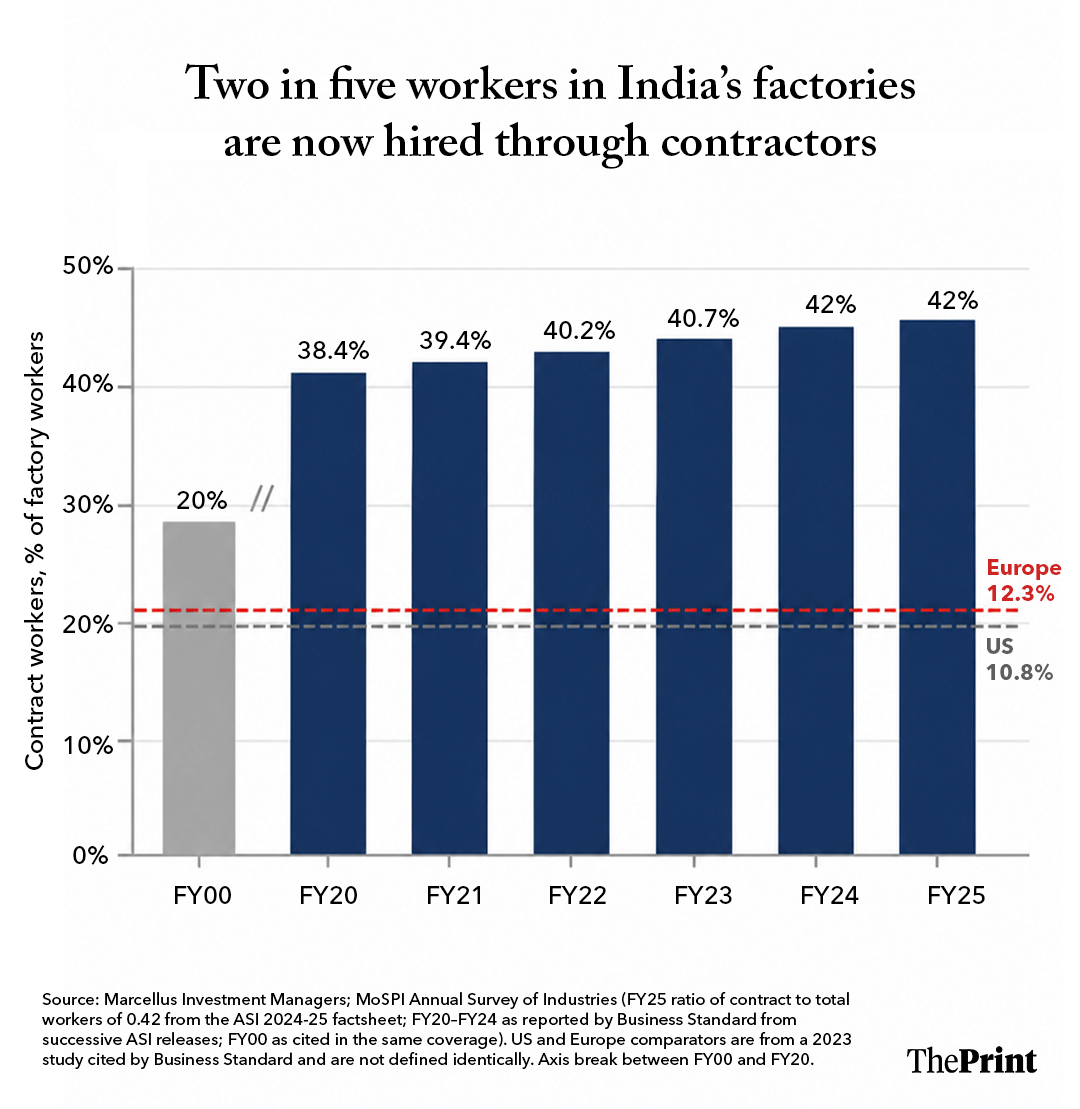
Contract workers have risen from about 20 percent of factory workers in FY2000 to 42 percent in FY25, compared with roughly 11 percent in the US and 12 percent in Europe. According to a study based on plant-level ASI data, contract workers earn an average of 14.5 percent less than regular workers, with the gap reaching 31 percent in large firms. They also receive little training and have limited bargaining power.
The contrast with Germany is instructive. Its Works Constitution Act did not impose a blanket restriction on layoffs; instead, it gave workers a say in how and when technology was getting deployed. India placed blanket restrictions but gave workers no say whatsoever over technology. The result was a system in which protections existed on paper but did not translate into better outcomes—automation became inevitable due to its cheaper pricing with no way for the workers to adapt and learn to the new reality of the workplace. The workers were instead replaced with contract workers, and the jobs the law was meant to save were never created.
Reforms in recent years treat the symptom but not the cause. The Industrial Relations Code, which came into force on 21 November 2025, raises the Chapter V-B threshold from 100 to 300 workers. This will help some firms scale up, but the average Indian factory employs only 76 workers. The change may therefore alter employers’ incentives to remain small without addressing the absence of worker representation in decisions about technology.
The Code’s Worker Re-skilling Fund requires employers to contribute an amount equivalent to 15 days’ wages for each retrenched worker. This provides some support after job loss but it is too little too late and does not give workers a say in the automation decisions itself.
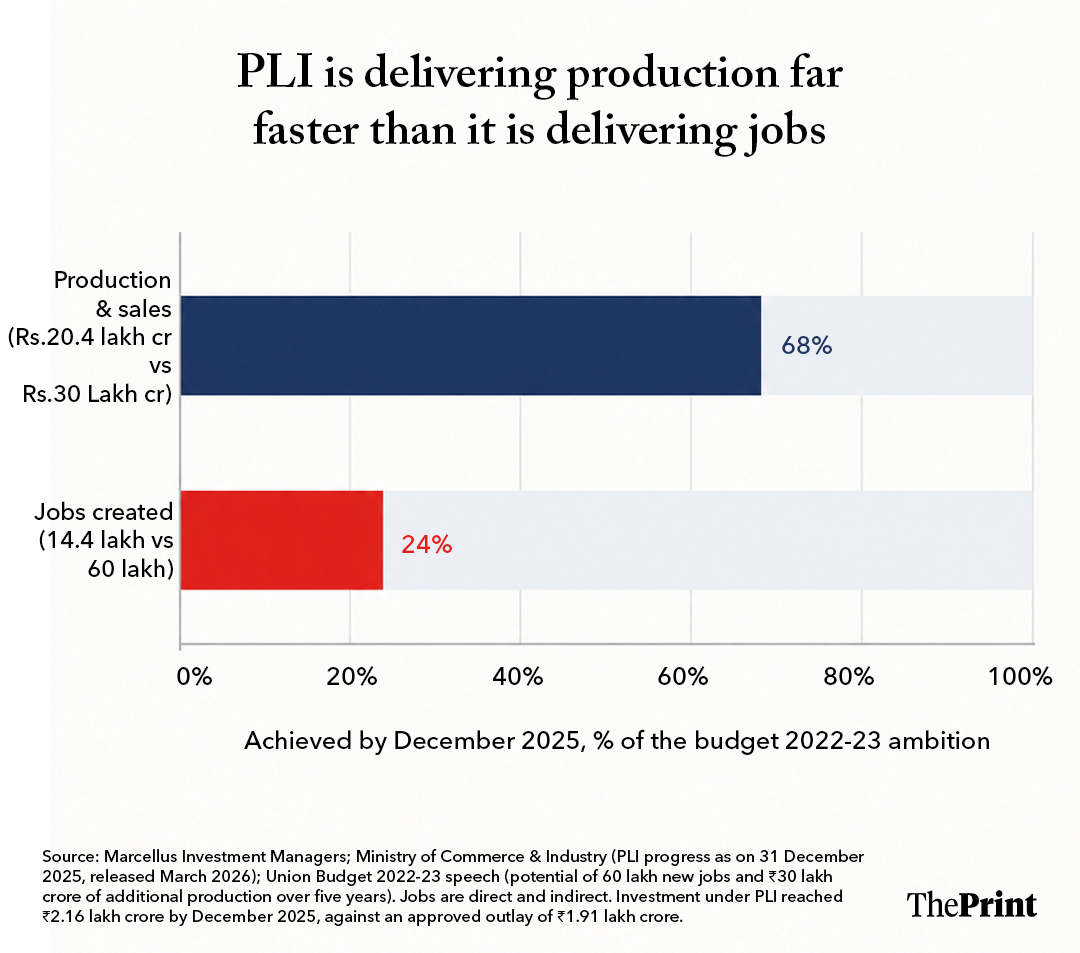
The Production Linked Incentive (PLI) schemes reward incremental sales and investment rather than employment directly. Against the Budget 2022-23 ambition of creating 60 lakh jobs and generating Rs 30 lakh crore in additional production, the schemes had delivered 14.4 lakh jobs and Rs 20.4 lakh crore in production by December 2025.
Most manufacturing workers remain beyond the reach of these measures. Registered factories employ fewer than 30 percent of India’s roughly seven crore manufacturing workers; the rest work in the informal sector, where unionisation is practically impossible.
White-collar India walking into same trap
If shop-floor automation was India’s first test, generative AI is the second—and the institutional framework is, if anything, weaker. As we documented in Breakpoint: The Crisis of the Middle Class and the Future of Work, IT job listings shrank at a compound annual growth rate (CAGR) of 12 percent over FY23-25, while BPO listings fell at a CAGR of 28 percent. White-collar job listings overall have declined by about 20 percent since generative AI began scaling up in 2022. Meanwhile, eight million graduates enter the job market every year, resulting in supply far outstripping the demand.
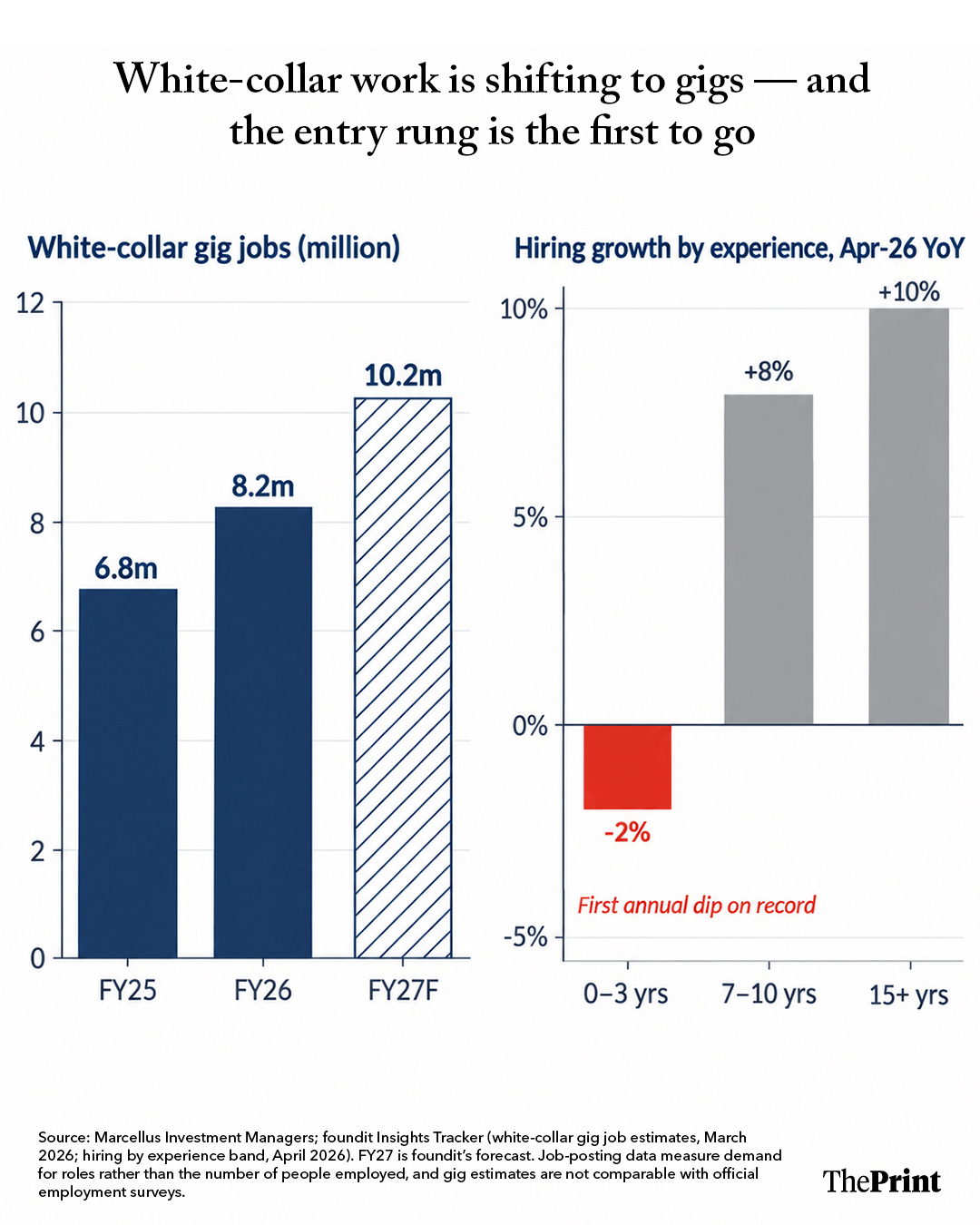
One alternative to salaried employment is gig work. According to foundit, India’s white-collar gig market grew from 6.8 million jobs in FY25 to 8.2 million in FY26 and is projected to exceed 10 million in FY27. Data, AI and machine-learning roles accounted for 49 percent of gig hiring in FY26.
At the same time, entry-level hiring for candidates with zero to three years of experience fell 2 percent year-on-year in April 2026— the first annual decline on record—while hiring of professionals with more than 15 years of experience rose 10 percent. AI is absorbing routine tasks that used to train juniors and the bottom rung of the white-collar ladder is being sawn off clean.
Now consider the institutions these workers can lean on. For more than a decade, Karnataka, home to India’s largest IT cluster, exempted IT and IT-enabled services (ITeS) firms from the Industrial Employment (Standing Orders) Act, which governs certain service conditions. The Industrial Relations Code’s definition of a ‘worker’ excludes those employed in managerial or administrative capacities, as well as supervisors earning above Rs 18,000 a month, which covers much of the white-collar workforce.
Gig workers now have access to social-security funded by a levy on aggregators but as independent contractors, they have no collective bargaining over pay, the algorithms that allocate their work, or the automation that displaces them.
This is the Indian manufacturing story being replayed one floor up: displacement without reinstatement or worker control over decision making, and productivity gains with no established institutional route back to the people producing them.
Nor is there an obvious political force pushing for a change. The Indian state’s response to economic distress has increasingly included cash transfers rather than nurturing institutions. Cash transfers to women by state governments to women alone reached Rs 1.7 lakh crore in FY26. Tight rural labour markets, good harvests and transfers have cushioned rural India, while the urban salaried middle class has borrowed head over heels just to survive.
The 2024 Lok Sabha election, in which the ruling party lost its single-party majority amid concerns over youth employment, illustrated how this equilibrium can wobble but still hold. Welfare measures helped cushion the party’s losses in rural India. Transfers can support household incomes, but they still haven’t addressed the core issue: giving workers a say over what the equipment can and cannot do and how to adapt and learn in this context.
Investment implications
What we have seen in India in the last three decades in manufacturing—of factories and employers swapping labour for capital—is now getting replicated in India’s offices (as discussed in our book Breakpoint: The Crisis of the Middle Class & The Future of Work). If India’s institutions keep channeling productivity gains to capitals, investors like us could benefit in three ways.
- Own the owners of productivity: In a system that routes value added to capital, the likely beneficiaries are firms that can grow revenue without growing headcount—well-run, owner-operated manufacturers and service businesses that deploy automation and technology aggressively. A profit share of 43 percent of factory GVA may reflect structural outcome of India’s institutional set-up rather than merely a cyclical peak, although profit shares can still fall with an economic downturn, competition or policy changes.
- Be selective about mass-market consumption: If wages continue to lag productivity and salaried white-collar jobs give way to gig work, the income base supporting middle-class discretionary spending could remain weak. In our view, consumption and volume growth will come from the affluent and from credit rather than from rising wages—as we have discussed at length in Breakpoint (2026).
- Expect exports to drive a larger share of India’s economic growth: As the $400 billion per annum of forex inflows that previously accrued to India through its IT services industry gradually declines, the rupee is likely to depreciate more than the roughly 5 percent a year it has lost, on average, since 1991. Combined with the free trade agreements (FTAs) and bilateral trade agreements (BTAs) India is signing, this could help Indian manufacturers become more competitive in global markets. That, in turn, could support a new wave of prosperity in India’s industrial belts.
Disclaimer: Nandita Rajhansa and Saurabh Mukherjea work for Marcellus Investment Managers (www.marcellus.in) and are the authors of ‘Breakpoint: The Crisis of the Middle Class & The Future of Work’. Norpell Wilberforce greatly added value to this piece and the authors thank him for his invaluable insights. The views and opinions expressed in this material are those of the authors and do not necessarily reflect official policy. This material is for informational and educational purposes only and should not be considered financial, investment, or other professional advice. The inclusion of any book does not imply endorsement or recommendation by the writers or the publisher of this material.
(Edited by Chingkheinganbi Mayengbam)
Also Read: Agentic AI is the real threat to white collar jobs. It’ll spell more trouble for Indian middle class