


New Delhi: Indian Oil Corporation’s (IOC’s) Panipat refinery, the first in the country to get international certification for sustainable aviation fuel (SAF) production, has got government approval to kick off commercial supplies, which are expected to begin soon. This comes as India prepares to introduce a one percent SAF blending requirement for international flights in 2027, a senior Petroleum and Natural Gas Ministry official said Tuesday.
SAF is a lower-carbon alternative to conventional aviation turbine fuel (ATF), produced from renewable feedstocks such as used cooking oil and other sustainable raw materials. Its use can help airlines reduce lifecycle carbon emissions.
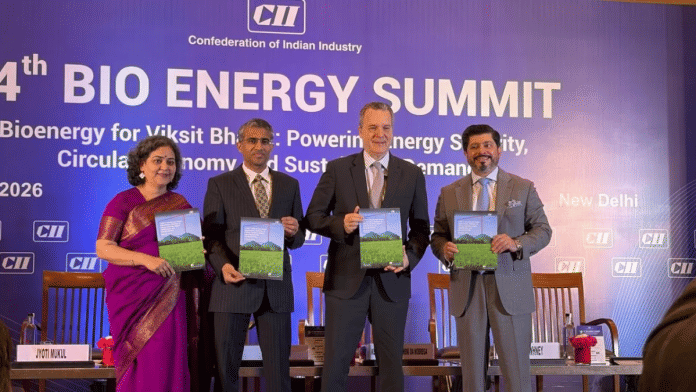
Speaking at the opening session of the 14th Bio Energy Summit organised by the Confederation of Indian Industry (CII) in Delhi, A. Amarnath, joint secretary in the petroleum ministry, said India was looking to expand its biofuel programme beyond ethanol, with greater focus on compressed biogas (CBG), SAF and biofuels for shipping.
Indian Oil’s Panipat refinery received an ISCC CORSIA certification in August 2025, becoming the first Indian refinery to receive the internationally recognised certification for SAF production. Amarnath said Bharat Petroleum’s refinery in Mumbai had also received the certification in May this year.
“Every unit of fuel that we produce at home reduces our exposure towards events like what we are witnessing in West Asia, which are far beyond our own control,” Amarnath said.
India imports more than 85 percent of its crude oil requirements, while its import dependence is around 60 percent for natural gas and 50 percent for LPG, he said.
CBG production targeted to rise 10-fold
Amarnath said India was also looking to replicate its ethanol success in compressed biogas by converting agricultural residues, cattle dung and municipal waste into fuel, fertilisers and additional income.
More than 230 biogas plants have already been commissioned across the country. The government has made CBG blending in the city gas distribution network mandatory, with the blending requirement set to increase to 5 percent from 2028-29.
The government had in August also launched an expanded national version of the GOBARdhan (Galvanising Organic Bio-Agro Resources Dhan) scheme—originally launched in 2018—with the aim of increasing domestic compressed biogas production nearly tenfold by 2035-36.
The scheme offers assured offtake, price stability, capital support, pipeline connectivity and access to credit, particularly for small and medium enterprises, Amarnath said.
The GOBARdhan scheme is one of Prime Minister Narendra Modi’s pet projects, aimed at converting organic waste like cattle dung and agricultural residue to CBG.
Amarnath also said flex-fuel vehicles were entering the market this year and the government had launched a pilot for E85 fuel across the country. Expanding ethanol feedstocks beyond sugarcane to include grains and agricultural residues would be important for sustaining growth, he added.
However, the petroleum joint secretary flagged feedstock availability, technology and consumer confidence as key challenges for the sector. Efficient systems for collecting, storing and transporting biomass would be necessary to ensure reliable supplies, he added.
He also called for internationally recognised standards and credible accounting of lifecycle emissions to establish the environmental credentials of biofuels. “Demand will last only when everyone across the value chain, from the field to the final user, has the confidence to commit to the fuels.”
Brazil offers lessons in bioenergy
Brazilian Ambassador to India Kenneth Felix Haczynski da Nobrega, who also spoke at the Bio Energy Summit, highlighted his country’s experience in developing a large biofuel industry, saying its ethanol programme began in the 1970s following the oil crisis.
The programme, initially driven by energy security concerns, has since transformed Brazil’s agricultural and industrial sectors, he said.
The ambassador highlighted the role of sugarcane in Brazil’s bioenergy ecosystem, where the crop is processed to produce ethanol, while its residue, particularly bagasse (dry fibrous residue left after crushing sugarcane), is used to generate electricity. Sugarcane bagasse accounts for around 8 percent of Brazil’s electricity generation, he said.
Brazil has also introduced a mandate requiring a share of natural gas consumption to be met through biomethane, creating predictable demand and encouraging investment.
Da Nobrega said India and Brazil had considerable scope to cooperate on biofuel technologies, research and industrial partnerships, given their large agricultural bases, domestic energy markets and industrial capabilities.
(Edited by Gitanjali Das)
Also Read: E20 row: Karnataka or OMCs, whom to believe? Auto execs call for independent ethanol content tests