







New Delhi: India’s push to diversify crude sourcing away from the disrupted Gulf region supplies is increasingly visible in a sharp rise in Venezuelan oil imports, which hit multi-year highs in April and are expected to climb further this month.
Last month. India imported around 283 thousand barrels per day (kbd) of Venezuelan crude.
“India imported Venezuelan crude in April 2026, with inflows rising sharply to around ~285 kbd, marking a multi-year high as refiners diversified away from disrupted Middle East supplies,” Sumit Ritolia, the Manager for modelling refinery and oil markets at Kpler, a trade data intelligence firm told ThePrint.
According to Ritolia, the surge in Venezuelan oil import has been led by complex refiners such as Reliance Industries (Jamnagar), HPCL-Mittal Energy Limited (HMEL) and Bharat Petroleum Corporation Limited (BPCL), which can process heavier and sour grades like Merey, exported by Venezuela.
In fact, Reliance Industries was the biggest buyer of Venezuelan crude in India in April with 219 kbd.
Imports from Venezuela are expected to increase further in the coming months. “For May, imports are expected to increase further to ~350–400 kbd, supported by continued supply tightness from the Gulf and available sanctioned volumes,” Ritolia said.
However, he cautioned that Venezuelan crude cannot fully substitute traditional Gulf suppliers.
“The increase is helping sustain refinery runs in the near term, but scalability remains limited due to grade compatibility,” he said. “Venezuelan crude is likely to act as a supplementary swing supply rather than a core replacement for Middle East barrels.”
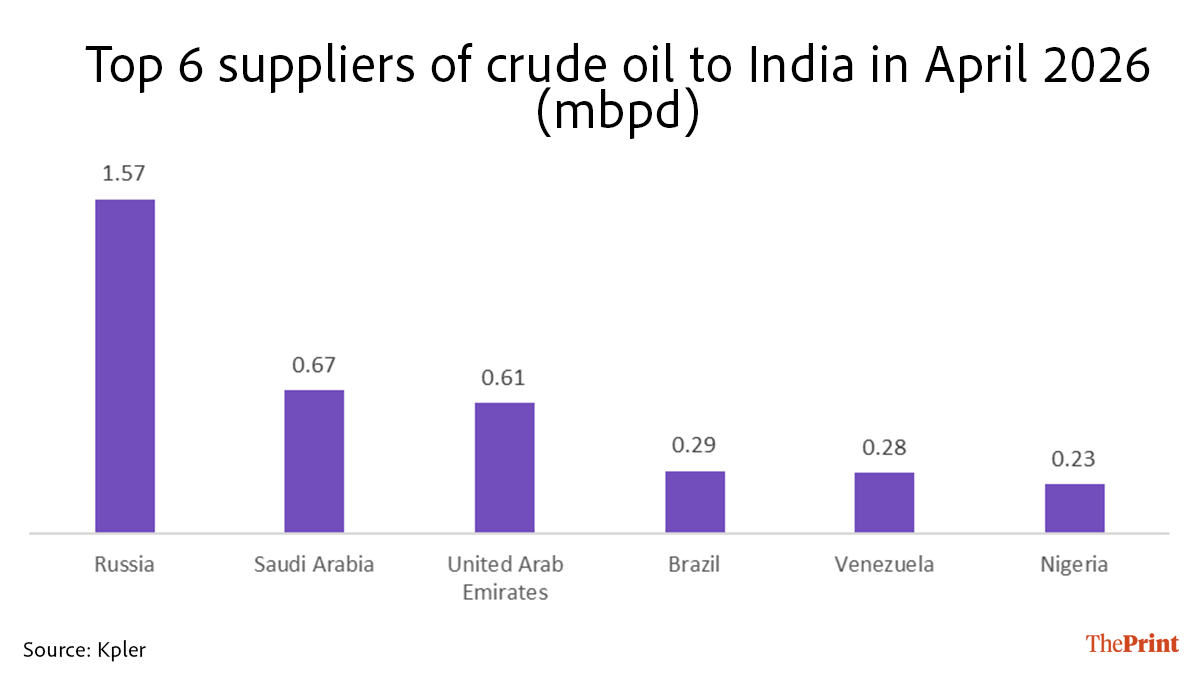
The trend highlights a broader shift in India’s sourcing strategy, with refiners increasingly tapping alternative regions – including the United States, West Africa and Latin America – while navigating ongoing supply disruptions.
Kpler data shows that supplies from Brazil doubled from 137 kbd in March 2026 to 293 kbd in April 2026, whereas sourcing from Nigeria grew 85 percent from 125 kbd to 231 kbd.
Also Read: Venezuela crude returns to India’s oil basket. But only as ‘supplementary’ supply
Russian oil remains core
Despite diversification efforts, Russian crude continues to anchor India’s oil imports, with flows expected to remain resilient even amid geopolitical uncertainty.
Russian crude imports averaged around 1.6 million barrels per day (mbd) in April, down by about 370 kbd month-on-month, primarily due to maintenance at Nayara Energy that temporarily reduced intake during April.
Despite the slight decline, Russian crude accounted for 35 percent of total imports for April.
Among Indian buyers, Indian Oil Corporation (IOCL) was the biggest buyer of Russian crude in April 2026 at 683 kbd followed by Reliance Industries at 229 kbd.
“Looking ahead, flows remain resilient, with May imports expected in the ~1.5–1.8 mbd range, as Russian crude continues to form the core of India’s supply mix despite ongoing diversification,” Ritolia said.
He underscored that India’s reliance on Russian barrels is driven by structural considerations. “Even with waiver uncertainty, it is difficult to see India materially stepping back from Russian barrels,” Ritolia said. “The decision is no longer just about sanctions optics, but about supply security and economics in a more fragile system.”
The continued geopolitical disruptions are affecting traditional energy supply routes for India.
“With continued geopolitical uncertainty and the Strait of Hormuz still not fully normalised—characterised by restricted transits, higher risk premiums and slower flows—Middle East barrels are less straightforward than before,” Ritolia said.
He adds, “In this context, Russian crude continues to offer a clear advantage, supported by competitive pricing and relatively stable logistics via non-Hormuz routes.”
LPG supply remains tight
India’s diversification strategy extends beyond crude to liquefied petroleum gas (LPG), but the segment is facing tight supply conditions, forcing refiners to boost domestic output and explore alternative suppliers.
“India is diversifying both crude and LPG sourcing to reduce reliance on the Middle East amid supply constraints, shifting toward a multi-region supply mix,” Ritolia said.
On LPG, India is increasingly sourcing from the US, Argentina, Australia, Malaysia, Chile, Algeria supported by higher storage and procurement flexibility. However, this shift has operational implications.
“While this diversification helps sustain refinery runs, it introduces longer supply chains, higher freight costs, and operational constraints,” he said. “Resilience has improved but at the cost of efficiency and speed.”
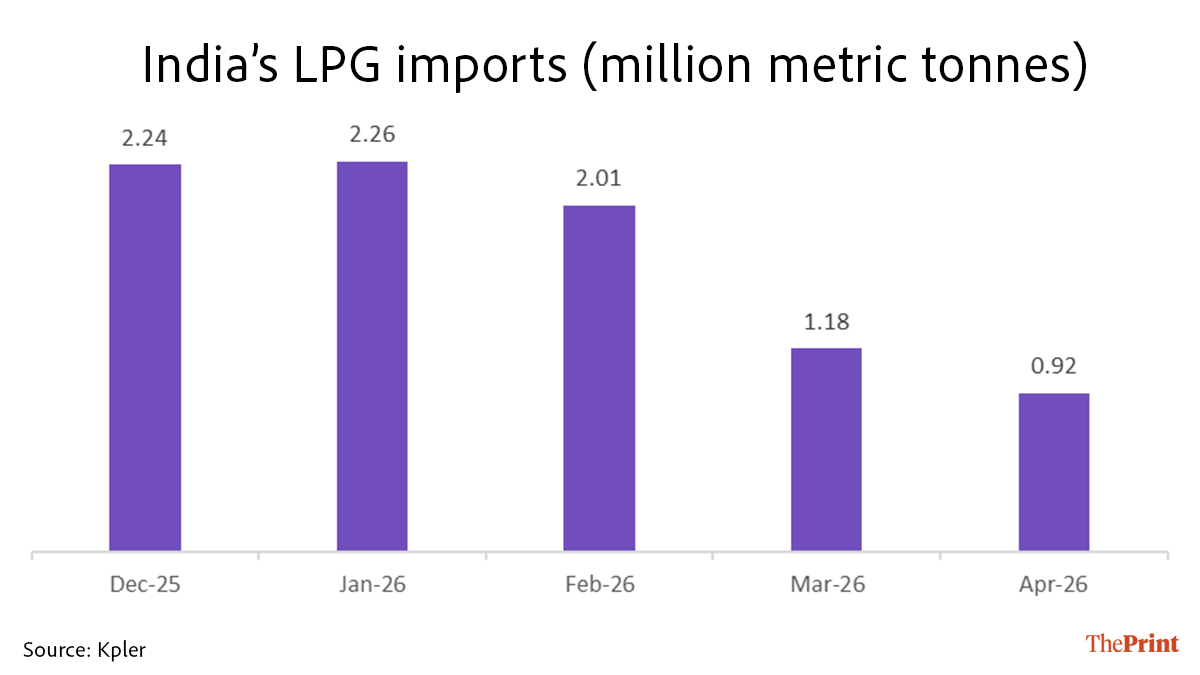
The supply situation remains tight. LPG imports fell to around 1.18 million metric tonnes in March and about 0.92 million tonnes in April, compared to significantly higher levels of 2.0–2.3 million metric tonnes during December–February.
“India is, therefore, likely to continue facing tight LPG import availability in the near term,” Ritolia said.
To offset the shortfall, refiners have ramped up domestic production by maximising LPG recovery from secondary units such as fluid catalytic crackers and hydrocrackers, optimising cut points, and increasing operating severity. As a result, domestic supply rose sharply by around 30 percent month-on-month in March to approximately 1.4 million metric tonnes.
Despite these efforts, the market remains sensitive. “The situation remains sensitive, as disruptions to Middle East supply, India’s key sourcing region, are keeping import availability constrained,” Ritolia said.
There have been some signs of relief through coordination with suppliers. “India has been able to secure selective cargo movements through close coordination with Iran and Gulf producers,” he said, noting that several LPG vessels have successfully transited the Strait of Hormuz despite disruptions in the last two months.
Looking ahead, imports are expected to rise in May with increased inflows from the US and Australia.
However, Ritolia warned that LPG supply pressures will persist. “Despite this uptick and ongoing diplomatic efforts, the overall supply environment is likely to remain tight in the near term and is denting India’s overall LPG demand.”
(Edited by Ajeet Tiwari)