





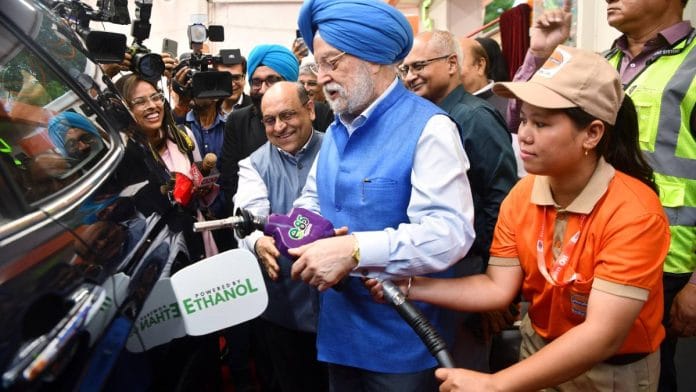

New Delhi: The government Thursday told Parliament that ethanol becomes costlier than pure petrol when international crude oil prices remain around $70 per barrel, but maintained that the ethanol blending programme is meant to reduce India’s dependence on imported crude rather than lower fuel prices.
In a written reply to a question by Congress MP Charanjit Singh Channi in the Lok Sabha, Minister of State (MoS) for Petroleum and Natural Gas Suresh Gopi said India has been able to cushion consumers from the full impact of volatile global crude prices because nearly 20 percent of every litre of petrol sold now consists of domestically produced ethanol.
“Ethanol blending is therefore not about making petrol cheaper. It is about reducing India’s exposure to vagaries of imported crude oil,” the reply said.
The government said oil marketing companies (OMCs) procure ethanol under the Ethanol Blended Petrol (EBP) programme at remunerative prices to ensure farmers receive fair compensation. It noted that the procurement price of maize-based ethanol has been progressively increased to Rs 71.86 per litre (excluding transportation and GST).
For the Ethanol Supply Year 2024-25 (November 2024 to October 2025), the average ethanol procurement cost stood at Rs 71.55 per litre, including transportation and GST, which was higher than the cost of refined petrol.
Despite this, the Centre argued that the programme has delivered significant economic benefits by reducing crude oil imports. According to the reply, ethanol blending has resulted in foreign exchange savings of Rs 1.66 lakh crore over the last five years.
The government also said India witnessed only a moderate increase in retail fuel prices despite unprecedented global disruptions caused by the West Asia conflict. It cited international comparisons, saying petrol in June 2026 in Delhi is priced at Rs 102.12 per litre, compared with Rs 109.82 in Bangladesh, Rs 129.48 in Pakistan, Rs 123.59 in Sri Lanka and Rs 197.26 in Italy.
Responding to concerns over the impact of higher ethanol blends on vehicles, the government said E15+ blended petrol has been in widespread use for more than three-and-a-half years, with over 20 crore two-wheelers and more than 3 crore petrol cars operating on these fuels without any verified evidence of widespread engine failure or vehicle breakdown linked to ethanol blending.
“The transition to E20 has been phased, consultative and scientifically validated, following extensive consultations with automobile manufacturers, ARAI (Automotive Research Association of India), SIAM (Society of Indian Automobile Manufacturers), Oil Marketing Companies and other stakeholders. Material compatibility, engine durability, fuel systems, drivability, emissions and performance were comprehensively evaluated before rollout,” the reply said.
The Centre also ruled out any move to revert to E0 or E10 petrol, saying the objective of public policy is to continue transitioning towards cleaner fuels rather than return to older standards.
It said maintaining separate nationwide supply chains for E0, E10 and E20 across more than one lakh retail outlets would significantly increase logistics complexity, inventory and handling costs.
“The government’s policy is to progressively transition towards cleaner, more efficient and environmentally sustainable fuels in line with the national policy on biofuels and India’s energy security and emission reduction objectives,” the reply said.
(Edited by Nida Fatima Siddiqui)
Also Read: We did the math. Here’s what India needs to achieve E20 plan of blending petrol with ethanol