



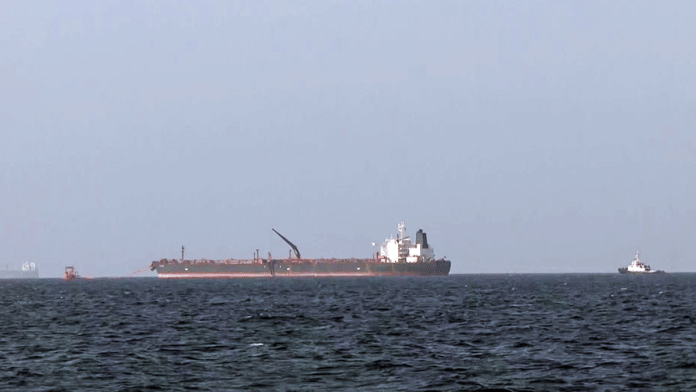
New Delhi: With timely diversification of energy sources helping India minimise the impact of the Hormuz crisis, the Centre is now exploring ways to diversify the shipping routes through which crude and gas can reach the country, to tide over any future crisis.
The US/Israel-Iran war that started on 28 February had led to the near closure of the Strait of Hormuz, disrupting crude supplies for weeks, with its impact felt across the globe.
India handled one of the biggest disruptions to the global energy market in recent years without significant supply shortages, supported by higher crude and gas imports from Russia, the US, Venezuela and Africa.
Overall, India managed to shore its supplies by diversifying its energy imports from nearly 40 countries.
Petroleum and Natural Gas Minister Hardeep Singh Puri told a press conference last week India had successfully navigated the crisis through diplomatic engagement, timely policy interventions, increased domestic production and diversifying imports from nearly 40 countries.
But policymakers now believe that while supplier diversification has reduced dependence on individual countries, India’s imports remain exposed to a handful of vulnerable maritime corridors, including the Strait of Hormuz.
“We were able to diversify countries for energy sourcing, but the next focus is diversifying trade routes,” a person familiar with the development told ThePrint. The person said the government is evaluating ways to reduce concentration risks arising from dependence on key shipping routes.
Before the West Asia conflict, around 45 percent of India’s crude oil imports, 50 percent of liquefied natural gas (LNG) imports and nearly 90 percent of liquefied petroleum gas (LPG) imports passed through the Strait of Hormuz, one of the world’s busiest energy chokepoints.
Also Read: India needs to prepare a strategy document that charts coal’s decline, year on year
Concentrated shipping routes
Analysts say India has diversified its supplier base but the shipping routes remain heavily concentrated, exposing it to risk during similar crises in future.
Natalia Katona, a commodity analyst based in Abu Dhabi, said India has diversified away from Gulf suppliers but not from maritime chokepoints.
“Around 60 percent of India’s crude imports currently come from Russia, but most of these shipments still pass through the Red Sea rather than Asian waters. However, including Saudi crude shipped from Yanbu Port means nearly 70 percent of India’s crude imports depend on the Red Sea route,” Katona told ThePrint.
The analyst added, “India may still have a long list of supplier countries but concentrating around 70 percent of imports on one maritime corridor is not necessarily much safer than the previous dependence on Gulf barrels moving through Hormuz.”
In the long-term, Katona said the Cape of Good Hope is a more credible alternative, particularly as oil production is expected to rise in Brazil, Argentina and Guyana. At the same time, weakening European crude demand and India’s rising import requirements could encourage more Latin American cargoes to head east.
Russia has the flexibility to divert its crude around the Cape of Good Hope, although shipments would take about a week longer to reach. However, this option is unavailable for Iraqi crude and some UAE exports, which continue to rely on the Strait of Hormuz.
According to Katona, even if both the Red Sea and the Strait of Hormuz were to be disrupted simultaneously, Russian cargoes could still be rerouted around the Cape of Good Hope with manageable delays because freight costs are typically borne by the seller.
Meanwhile, imports from Latin America, Angola and Nigeria, which already use the Cape route, account for just 7 percent of India’s total crude imports.
LPG diversification option limited
The government’s diversification options are also shaped by the differing economics of crude oil and LPG.
Nikhil Dubey, Lead Analyst at Kpler, a global data analytics firm, said India’s ability to diversify crude imports largely stemmed from discounted Russian oil, which became attractive only after Western sanctions and was sold at a discounted rate.
“LPG does not offer the same economics. Sourcing it from more distant locations would increase freight and other associated costs,” Dubey told ThePrint.
He said diversifying LPG imports away from the Middle East has inherent limitations. The Gulf is the world’s second-largest LPG exporting region after the US, and its proximity to India makes it the most cost-effective source of supply.
Before the conflict, nearly 90 percent of India’s LPG imports came from the Gulf through the Strait of Hormuz. While some diversification is necessary to reduce concentration risk, a large-scale shift is unlikely.
“Once traffic through the Strait of Hormuz normalises, it is likely to remain the most optimised route because of its geographic advantage and established reliability,” Dubey said.
(Edited by Ajeet Tiwari)
Also Read: SHANTI Bill, SMRs and now Australian uranium—why India’s nuclear pieces are falling into place