





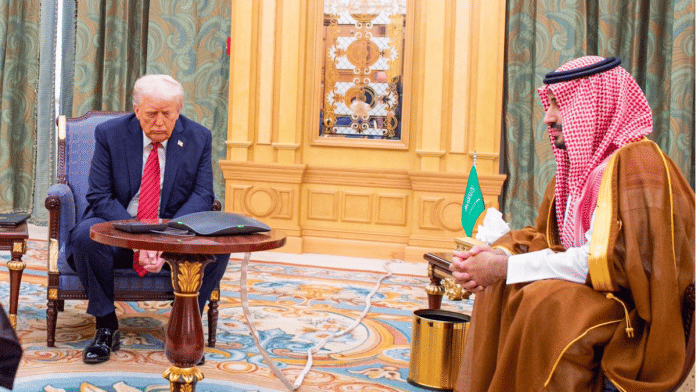


New Delhi: A 30-year US-Saudi civilian nuclear agreement approved by US President Donald Trump could eventually allow Riyadh to enrich uranium on its own soil, raising concerns in the US and Israel that the kingdom could acquire the infrastructure needed to develop nuclear weapons.
The Wall Street Journal reported Tuesday that Trump had approved the agreement, which could permit Saudi Arabia to construct a domestic uranium-enrichment facility following a joint US-Saudi feasibility study. The agreement is expected to be formally signed and announced Wednesday.
The legally binding pact would establish the conditions for transferring American nuclear technology, material, and equipment to Saudi Arabia. According to a New York Times report citing two US officials familiar with the negotiations, the accord could generate billions of dollars for the US nuclear industry, beginning with the American reactor manufacturer Westinghouse.
Saudi Arabia would not be required to permanently renounce domestic nuclear-fuel production. The agreement is also not expected to require the kingdom to adopt the International Atomic Energy Agency’s Additional Protocol, which gives inspectors broader powers to monitor nuclear activities and investigate suspected undeclared sites.
The ‘123 Agreement’
The pact is known as a ‘123 Agreement’, named after Section 123 of the US Atomic Energy Act, which governs the transfer of American civilian nuclear technology, material, and equipment to foreign countries. It would allow US firms to participate in the construction and operation of Saudi nuclear facilities and establish the safeguards and monitoring arrangements governing the programme.
The Trump administration is expected to argue that joint US-Saudi ventures would give Washington continued access to and oversight of the kingdom’s nuclear activities.
The deal must be submitted to Congress, which can pass a resolution rejecting it. Yet, opponents would likely need a veto-proof majority to block Trump from implementing it.
Two secret ‘side letters’ are reportedly attached to the agreement. Some lawmakers may demand their disclosure amid concerns that they contain additional provisions relating to inspections, enrichment, or sensitive commercial information.
What US and Israeli establishments fear
American lawmakers and non-proliferation experts fear that allowing Saudi Arabia to enrich uranium could create a pathway towards a future weapons programme.
Enrichment is not sufficient by itself to produce a nuclear bomb. However, the same centrifuges used to manufacture low-enriched fuel for civilian reactors can also produce weapons-grade uranium if operated for longer or at higher levels.
The agreement could also encourage other regional powers, including Turkey, Egypt, and the UAE, to demand equivalent enrichment rights, which would increase the risk of a nuclear arms race in West Asia.
Israeli officials have also expressed opposition to such a plan, fearing that the kingdom could use a civilian nuclear project to eventually develop nuclear weapons. Israel has never publicly acknowledged possessing nuclear weapons, but is widely believed to maintain the region’s only nuclear arsenal.
Such concerns are heightened by Crown Prince Mohammed bin Salman’s previous statement that Saudi Arabia would develop a nuclear weapon if Iran acquired one. Asked in 2018 whether Riyadh would follow Tehran, the crown prince said it would do so “without a doubt”.
Saudi Arabia also signed a mutual defence pact with nuclear-armed Pakistan in September 2025. Pakistan’s defence minister Khawaja Asif subsequently said that its nuclear programme “will be made available” to Riyadh if required.
Iran factor behind Saudi nuclear ambitions
Saudi Arabia’s nuclear ambitions have long been tied to Iran, its principal regional rival. Iran maintains that its nuclear programme is for civilian purposes. However, it has enriched uranium to near weapons-grade levels since Trump in 2018 withdrew the US from the Obama administration’s 2015 nuclear agreement.
The deal comes amid a wider conflict involving the US, Israel, and Iran that began on 28 February. After a ceasefire agreement secured under a 17 June Memorandum of Understanding (MoU) faltered, Trump said on 8 July that he believed the ceasefire was “over” as fighting resumed.
The current conflict follows American and Israeli attacks on Iranian nuclear facilities in June 2025, with a central aim in the 2026 US-Israel military operations being to prevent Tehran from developing nuclear weapons capabilities.
Saudi Arabia has relied on the US for interceptor missiles against Iranian projectiles during the conflict. Nonetheless, Riyadh has expressed concern that Washington’s military policies and close relationship with Israel are exposing Gulf Arab countries to greater regional instability.
Saudi diplomats have consequently continued engaging Iran after the two countries restored diplomatic relations in 2023 through an agreement brokered by China.
How Saudi deal differs from UAE agreement
The Saudi pact would be the second major civilian nuclear agreement the US has signed with a Gulf Arab state, following its 2009 agreement with the UAE.
The UAE deal became known as the “gold standard” of nuclear cooperation because Abu Dhabi permanently renounced domestic uranium enrichment and plutonium reprocessing. It agreed to import nuclear fuel and adopted the IAEA Additional Protocol to allow for more extensive monitoring and inspections.
Saudi Arabia would not accept the same permanent restrictions. The kingdom could retain the option to enrich uranium domestically and is not expected to adopt the Additional Protocol under the deal. The Saudi deal’s distinction from the UAE agreement is significant, as it could establish a less restrictive precedent and prompt other West Asian states to seek the same terms.
Deal no longer linked to recognising Israel
Under the Biden administration, civilian nuclear cooperation was discussed as part of a broader package under which Saudi Arabia would establish diplomatic relations with Israel and receive stronger US security guarantees.
That prospect diminished following Hamas’ 7 October 2023 attack on Israel and the subsequent Gaza war.
Trump separated the nuclear negotiations from any requirement that Saudi Arabia recognise Israel. He and Prince Mohammed agreed to proceed with civilian nuclear cooperation when the crown prince visited the White House last November, according to the NYT.
The two leaders also reached an understanding on a defence plan that could include the sale of advanced F-35 fighter jets to Saudi Arabia. The arrangement, though, did not provide the mutual defence treaty Riyadh has sought, which would require Senate ratification.
The nuclear agreement is also intended to repair tensions in bilateral relations after Prince Mohammed reportedly refused to allow the US military to use Saudi airspace for an operation escorting commercial tankers through the Strait of Hormuz.
(Edited by Viny Mishra)
Also read: 60% uranium enrichment: What we know about Iran’s nuclear programme