



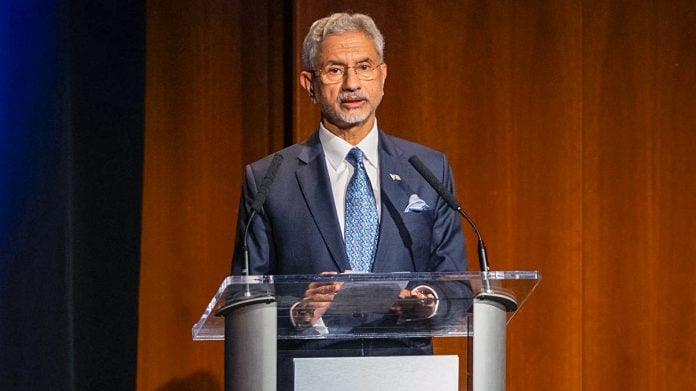
New Delhi: External Affairs Minister S. Jaishankar, speaking at the Asia Society Monday evening, underlined that a ‘bump’ in the relationship with the US were caused by drawn-out negotiations for a trade deal last year, coupled with a lack of sensitivity shown towards India’s concerns, especially about cross-border terrorism emanating from Pakistan.
At the event, Jaishankar highlighted that, “There are at least for many countries, at least the bigger countries, there are very specific issues, issues to that relationship…In our case, one of course was the trade negotiations…a trade negotiation required a certain amount of patience and detailing to see it through. The expectation that it could rapidly move forward was tested against a ground reality which was much more complex. We have reached a situation where there is more or less an understanding on the trade agreement.”
However, an issue remains with changes on the American side, said Jaishankar. The reciprocal tariffs were struck down by the US Supreme Court in February, which has led to a “new basis of tariff imposition,” still unfolding. The issue for India, he said, remains at “what point do you close out an agreement that is very advanced.”
The closing out of the agreement, the Indian Minister of External Affairs explained, would lead to a better relationship.
“For us in India, what is particularly important is the issue of terrorism. We feel that as a country, there are very few countries which have been subjected to the kind of terrorism that we have by a neighbour as part of a deliberate, conscious policy over many decades,” said Jaishankar.
He added, “If something that matters so deeply to us, there isn’t enough understanding or empathy of that, I think it creates a problem too. If one of my primary concerns is not fully appreciated by my partner, there is an impact on the overall relationship.”
The comment is aimed at deepening ties in recent months between the Trump administration and the Pakistani military leadership. Over the last few decades, especially during the war on terror, the US remained one of Pakistan’s critical military partners.
India-US ties were further hit by President Donald J. Trump consistently taking credit for the cessation of hostilities after Operation Sindoor, last year, leading to further tensions in the overall relationship.
Jaishankar also highlighted that growing backlash against mobility in the US, where thousands of Indians have benefitted from the H1-B and student visa regime, has also influenced overall ties. Data shows that nearly three out of every H-1B visas approved by the US go to Indian nationals. The Trump administration has taken multiple steps to slow down the process, and for months in 2025, Indian nationals faced a number of issues in receiving their visas.
The overall trajectory of the relationship between the two countries have seen a recent stabilisation in recent months following the announcement of the framework for a bilateral trade deal earlier this year. Prime Minister Narendra Modi met with Trump on the margins of the G7 summit this year as well.
However, the recent legislation passed by the US congress empowering Trump to impose restrictions and tariffs on countries trading with Russia and Iran has led to stern warnings from India that any action would have “potential implications” on bilateral ties.
In his remarks, Jaishankar was candid in highlighting that the growing paradox of diplomacy lies between the economic interdependence and almost “obsessive” nature of competition globally. Without naming countries, he highlighted global powers who may be on an economic decline, trying to reset the global trading regime, in an effort to regain its economic positioning, thereby corroding the current economic systems.
He referred to the meeting between the Presidents of the US and China, as one where while “convergences” may be found in certain areas, the overall relationship between the two largest global economies remains one of “competition”.
Speaking on India’s own relationship with China, Jaishankar underlined that it was in “nobody’s interest” for prolonging the standoff between New Delhi and Beijing following the military skirmishes in eastern Ladakh in the summer months of 2020.
He highlighted that continued standoff would allow for “third countries” to fill the gap. While highlighting that “structurally not much has changed” in the relationship between India and China, he said that the continued peace at the borders has allowed the stabilisation of overall ties.
Jaishankar led the Indian delegation for the United Nations high-level meetings over the last week, while also making India’s national statement during the General Assembly.
(Edited by Archishman Ganguly)
Also Read: IBSA at UN: India, Brazil, South Africa take stronger Palestine line & reject unilateral sanctions
My concern is that Indian foreign policy rests on continued US – China hostility, as not just an enduring fact in international relations but as something desirable. Something which opens up space ( contradictions to be exploited ) for India. Feels troubled, apprehensive about the prospect of a much improved US – China relationship. Not necessarily in a collusive G 2 sense, to the detriment of lesser powers. Simply two very powerful countries placing their competition on a less hostile path. 2. This is a testing time for Indian diplomacy.