





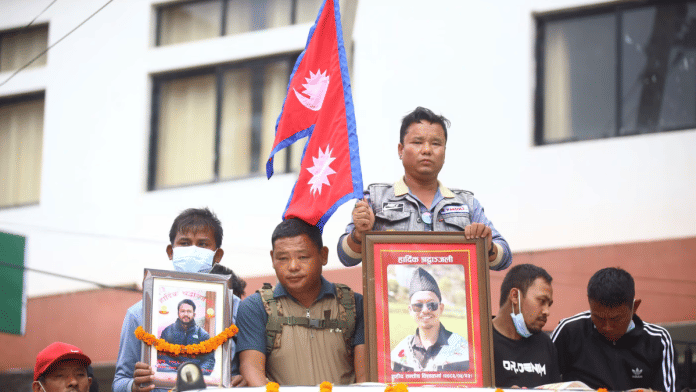


New Delhi: A year after GenZ protest led to the toppling of the KP Oli government, Nepal’s Human Rights Commission has released a scathing indictment of the former prime minister and other public functionaries.
The Oli government, it says, violated constitutional protections for free expression when it imposed a nationwide social media ban through an executive directive rather than legislation. The report found that peaceful demonstrations led largely by young protesters were infiltrated by organised violent groups and met with excessive and often lethal force by security personnel.
“The events…represent one of the gravest human rights crises in Nepal’s recent history,” the Commission wrote, warning that “impunity must not be allowed.”
Apart from the human rights and constitutional crisis, the report released Wednesday called for an investigation into how prison officials released Rastriya Swatantra Party chief Rabi Lamichhane under pressure and threats from violent groups.
On 9 September last year, Lamichhane was released from Lalitpur’s Nakkhu prison and handed over to his wife. He, however, had returned to prison after an order by the jail administration.
Also Read: Nepal’s Gen Z are drawing up roadmap for interim govt. They want ‘clarity, not rowdy leadership’
Damning findings
The Commission concluded that the release helped trigger prison breakouts across Nepal and said the circumstances surrounding it involved “criminal elements” and remained under investigation.
Thirty-six prisons were attacked and 28 were breached, allowing 13,585 detainees and 974 juvenile inmates to escape, according to the report. Ten detainees and juvenile inmates were later shot dead during escape attempts on 8 September.
According to the 29-page report, the events of 9 September were no longer part of a legitimate protest movement but instead constituted “pre-planned criminal activities.”
The unrest began on 8 September when members of the Gen Z movement gathered at Kathmandu’s Maitighar Mandala to protest the government’s Social Media Regulation Directive 2080, demand good governance and denounce corruption.
What began as a peaceful demonstration spiralled into violence after provocateurs infiltrated the movement, investigators found.
Among the evidence cited by the Commission were a fake Nepal Police Facebook page that spread misleading information to demonstrators, a TikTok account called ‘Wake Up Nepal’ that asked its followers to bring Molotov cocktails, and AI-generated images depicting government buildings engulfed in flames circulated online before the protest began.
Investigators identified a biker group wearing black T-shirts marked with the letters ‘TOB,’ many with matching tattoos, as key instigators in turning the demonstration violent.
Forensic and ballistic evidence reviewed by the Commission showed that protesters were struck by 5.5mm and 7.7mm rounds, despite official orders to use rubber bullets aimed below the knee. Most victims, the report said, were shot in the head, neck or chest.
Nineteen people died on 8 September. Another 23 later died in hospitals from gunshot wounds sustained during the crackdown. Five more people were killed in shootings in Sunsari and Jhapa districts.
Three police officers were beaten to death. Twenty-one civilians died in arson attacks, including 12 whose bodies remain unidentified. Government institutions, including Parliament, Singha Durbar, the Supreme Court, Shital Niwas, police stations, media offices and private businesses, were attacked and set ablaze.
The Commission criticised the state’s response to the crisis, noting that the Nepal Army was not deployed during the crucial daytime hours of 8-9 September, despite rapidly deteriorating conditions. Military deployment began only at 10 p.m. on 9 September, after “76 lives had been lost and major national infrastructure destroyed,” the report said.
Investigators also faulted the Rastriya Anusandhan Bibhag, or the National Investigation Department, for failing to provide timely intelligence and said Kathmandu’s Chief District Officer, Chhabilal Rijal, “did not go to the field during the crisis.”
Recommendations
The Commission recommended that the government enact new legislation on human rights violations to enable the prosecution of former Prime Minister K.P. Sharma Oli, former Home Minister Ramesh Lekhak, and former Information and Communications Minister Prithvi Subba Gurung.
The proposed law will allow penalties of up to six months in prison, a fine of 3 lakh Nepalese rupees, or both, with cases to be heard in a special court. It also calls for those convicted to be barred from holding political office or contesting elections for at least five years, prohibited from administrative responsibilities for three years and subjected to travel restrictions for a minimum of three years.
It further suggested automatic suspension from office upon indictment and urged the immediate suspension of all individuals named in the report from any public position for at least six months until such legislation is enacted.
“Accountability from the political leadership down to field commanders, is essential for the restoration of the rule of law and the protection of human rights in Nepal,” the Commission wrote.
Oli and Lekhak were arrested on 28 March, a day after Prime Minister Balendra Shah assumed office. They were released after 12 days.
(Edited by Tony Rai)
Also Read: Will a Gen Z revolt spur Nepal to pick young over old? The chatter on the streets of Kathmandu