


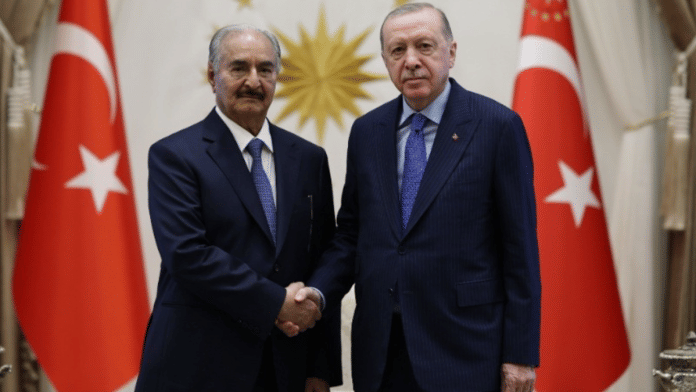
New Delhi: For years, Khalifa Haftar, who controls much of eastern Libya, was among the biggest obstacles to Turkey’s ambitions in the North African country, which has been divided between rival powers since 2014. During the Second Libyan Civil War, Ankara backed Haftar’s opponents, deploying military personnel and drones to help repel his forces as he sought to expand his control over the country.
But things have taken a turn now. On Wednesday, Haftar met Turkish President Recep Tayyip Erdoğan in Ankara, smiling and embracing the man who was once his adversary.
Haftar, who commands the Libyan National Army (LNA), arrived in Turkey on Tuesday for his first official visit. His delegation included his son Saddam Haftar, widely regarded as his potential successor. During the visit, he met senior Turkish officials, including Foreign Minister Hakan Fidan, Defence Minister Yaşar Güler, Energy Minister Alparslan Bayraktar and intelligence chief İbrahim Kalın, before meeting Erdoğan on Wednesday, according to local reports.
The visit comes at a consequential moment for Libya and the wider region. On Sunday, Ukraine claimed responsibility for sinking the Russian warship Merkury at Benghazi’s naval base. Satellite imagery subsequently supported the claim. The attack highlighted the strategic sensitivity of Russia’s military presence in eastern Libya and the risks Haftar faces in relying heavily on Moscow, which has supported his forces for years.
For Ankara, however, Haftar’s visit carries significance beyond the immediate security situation. Turkey is seeking to build ties with the eastern Libyan commander while preserving its longstanding relationship with the rival government in Tripoli.
Turkey’s ambitions in Libya are shaped by a combination of geopolitical, historical and economic considerations. Its Mediterranean strategy is partly rooted in the legacy of the Ottoman Empire, which controlled Libya until the Italian invasion in 1911, and its maritime doctrine of ‘Blue Homeland’, which asserts Turkey’s strategic interests across the surrounding seas. Erdoğan has also sought to expand Turkish influence across regions with historical and cultural connections to the country. Libya occupies an important place in this strategy because of its Mediterranean location, energy resources and historical links with Turkey.
Also Read: Tarique Rahman, Recep Tayyip Erdogan and Turkiye’s growing ties with Bangladesh
From backing Haftar’s rivals to engaging with his camp
Turkey’s relationship with Libya predates the 2011 uprising that toppled Muammar Gaddafi. Ankara maintained close economic and political relations with Gaddafi’s government and when the uprising broke out in 2011, Turkey was initially reluctant to support foreign military intervention and favoured a negotiated settlement. However, as Gaddafi’s position weakened, Ankara shifted towards supporting the opposition and eventually contributed to NATO’s operation.
Following the uprising, Erdoğan, then Turkey’s prime minister, visited Libya in September 2011, travelling to Tripoli and Benghazi to meet the country’s emerging leadership. Turkey was among the first countries to recognise the National Transitional Council and appointed its ambassador to Tripoli on 2 September 2011.
Libya’s political transition subsequently collapsed, and renewed fighting in 2014 divided the country between rival powers. As the political and military landscape fragmented, Turkey aligned itself with the western, Tripoli-based establishment. It supported the internationally recognised Government of National Accord (GNA), led by Fayez al-Sarraj, while Haftar consolidated his military and political authority in the east.
The relationship deteriorated sharply in April 2019, when Haftar, backed by the UAE, Egypt and Russia, launched an offensive to capture Tripoli. Turkey responded by expanding its military assistance to the GNA, supplying armed drones, weapons and air-defence systems and deploying military personnel to help repel the offensive.
In November 2019, Ankara and the Tripoli government signed two significant agreements: one delimiting maritime jurisdiction in the Mediterranean and another establishing a framework for security and military cooperation. The following January, Turkey’s parliament authorised the deployment of Turkish troops to Libya.
Erdoğan was openly critical of Haftar during this period, describing him as a ‘coup plotter’ and questioning his credibility as a negotiating partner. He also denounced the offensive as a ‘conspiracy against the Libyan people’ and assured al-Sarraj that Ankara would provide the assistance necessary to counter Haftar’s forces.
Turkey’s military intervention helped the GNA reverse Haftar’s offensive and push his forces away from Tripoli in 2020.
The political circumstances have since changed. Rather than limiting its engagement to western Libya, Ankara has gradually cultivated contacts with eastern political and military figures, recognising that its long-term interests cannot be secured through relationships with only one side of the divided country.
What does Turkey stand to gain?
Turkey’s renewed engagement with Haftar reflects a combination of maritime, energy, security and economic interests.
One of Ankara’s main strategic objectives is to strengthen its position in the eastern Mediterranean, where competing claims over maritime boundaries and energy exploration rights have long generated tensions with Greece, Cyprus and Egypt.
The November 2019 maritime agreement with Libya’s then-Tripoli-based GNA established a bilateral boundary between the two countries’ respective claims to maritime jurisdiction. The arrangement was strongly opposed by Greece and several other regional countries, which argued that it disregarded the maritime rights of Greek islands.
Ankara’s outreach to eastern Libya is therefore a strategic hedge, say experts. By cultivating relationships with both sides, Turkey hopes to secure broader domestic Libyan support for its maritime claims, protect its interests against competing Greek and regional initiatives, and strengthen its position in future negotiations.
For years, eastern Libya’s parliament rejected the 2019 agreement and opposed Ankara’s involvement in the country. That position changed last month when the eastern-based House of Representatives on 20 October unanimously approved the agreement and reversed earlier decisions to sever political ties with Turkey.
The decision represents a significant diplomatic opening for Ankara. With political backing for the agreement now extending beyond western Libya, Turkey could strengthen its position in the Mediterranean and advance its claims over maritime jurisdiction and potential energy resources. However, the approval does not resolve the wider international dispute, with Greece continuing to argue that the agreement infringes on the maritime rights of other countries.
Energy cooperation is another important consideration. Libya possesses some of Africa’s largest proven oil reserves, making access to its energy sector a key part of Ankara’s regional calculations. Turkey has been seeking opportunities for its state-owned energy companies to participate in exploration and development projects.
The European Commission’s 2026 assessment of Turkey’s relations with the region noted that Libya’s National Oil Corporation had granted an exploration licence to Turkish state-owned petroleum company TPAO in February.
Beyond energy, Libya offers considerable opportunities for Turkish construction and infrastructure companies. Before Gaddafi was overthrown, Turkish firms had secured substantial contracts across the country. Much of this business was disrupted by the civil wars, which provided Ankara an opportunity to help rebuild what was destroyed. Closer relations with Haftar could give Turkish companies greater access to eastern Libya, including Benghazi and other territories under his administration.
Security cooperation could also become an important dimension of the relationship. Turkey has established a substantial military presence in western Libya, and closer engagement with Haftar could expand its influence over the country’s wider security institutions and military infrastructure. Haftar’s meetings with senior Turkish defence, military and intelligence officials suggest that security issues featured prominently in the discussions.
Why Haftar is reaching out to Turkey
Haftar has his own reasons for improving relations with Ankara. For years, he relied heavily on support from Russia, Egypt and the United Arab Emirates. Developing ties with Turkey offers an opportunity to diversify those partnerships, strengthen his international standing and potentially secure access to Turkish military expertise and economic investment.
The political ambitions of his family are another consideration. His son Saddam Haftar has emerged as an increasingly prominent figure in eastern Libya and is widely regarded as a potential successor. Closer relations with Turkey could help expand his international profile and strengthen the family’s position in discussions over Libya’s future political leadership.
Erdoğan’s balancing act
For Turkey, the challenge is to cultivate its relationship with Haftar without undermining its established partnership with the Tripoli government.
Turkey has spent years building its military and political influence in western Libya. Its agreements with the Tripoli administration have provided strategic access to the Mediterranean and an important foothold in North Africa. At the same time, eastern Libya remains politically and militarily significant. Engaging with him gives Turkey an opportunity to avoid being excluded from the political and economic arrangements that could eventually determine Libya’s future.
The eastern parliament’s approval of the maritime agreement is particularly significant in this regard, suggesting that Ankara’s diplomatic outreach is beginning to yield results on an issue that had previously been a major source of disagreement.
The rapprochement also comes amid efforts to unify Libya’s rival military institutions. Turkey hosted discussions between representatives of the eastern and western military establishments in October, although the talks did not produce an agreement.
Erdoğan’s planned visit to Tripoli in December 2026, ahead of the Africa-Turkey Partnership Summit, further indicates Ankara’s intention to maintain its engagement with western Libya even as it builds bridges with Haftar. The reopening of Turkey’s consular presence in Benghazi in August 2026, after more than a decade of suspension, is another sign of this changing approach. Ankara had temporarily closed the consulate in June 2014, citing deteriorating security conditions.
The latest visit also needs to be viewed against the backdrop of Haftar’s relationship with Moscow. Russia has supported his forces since at least 2019, when Wagner Group personnel assisted the LNA’s offensive against Tripoli. Moscow continues to maintain a military and logistical presence in eastern and southern Libya.
Turkey, meanwhile, has maintained relations with Russia while supporting Ukraine in various areas. The attack on Russian vessels at Benghazi adds another layer of complexity to Ankara’s calculations as it seeks to preserve its influence amid competing regional interests.
For Erdoğan, the challenge is no longer simply about backing one side against another. It is about ensuring that Turkey remains an indispensable partner in Libya, regardless of how the country’s political and military arrangements eventually evolve.
(Edited by Chingkheinganbi Mayengbam)