





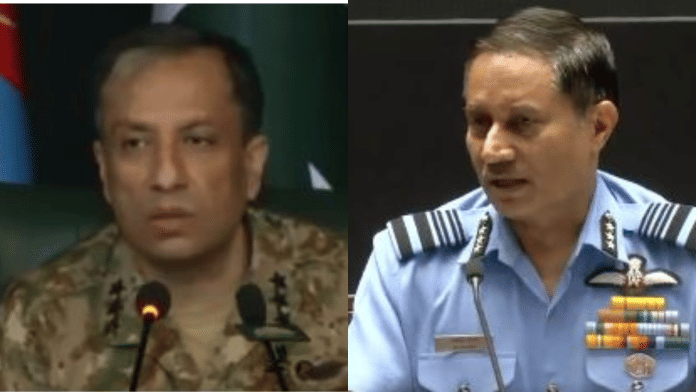


New Delhi: Pakistan’s military Thursday held a lengthy press conference marking a year since Op Sindoor or the Pakistan operation ‘Bunyan un Marsoos’ (built with lead) with the disclaimer that it would not dwell on the past, yet spent nearly three hours talking about India.
The same claims, counter claims, exaggerated allegations, videos and comments were repeated, all targeted at India. And then, of course, there was Kashmir.
The press conference, which started late since they waited for the Indian military press conference to end, was rife with misogynistic commentary on India’s use of the term ‘Sindoor’, the Hindi word for the vermilion traditionally worn by married Hindu women.
Director General of the Inter–Services Public Relations (DG-ISPR) Ahmed Sharif Choudhary mocked the choice of terminology, saying: “I don’t know what ‘Sindoor’ they keep talking about. Why don’t they move beyond it and adopt a more masculine name? Sindoor is something traditionally worn by women. I don’t know why they became so obsessed with this term.”
The Indian government’s decision to name the mission ‘Op Sindoor’ symbolised vengeance for the women widowed in the 22 April Pahalgam terrorist attack.
The DG ISPR, who was himself speaking in Punjabi-Urdu, also wondered why the Indian military officers addressed the media in English.
“Their DGMO, Director of Operations, and senior officers appeared. First of all, who told them to speak in English? Because they wanted to narrate their version of events to the world. They spent an entire hour repeating old stories,” he said.
Even though his own press conference was focused on repeating past allegations, the DG ISPR said in a message to India: “Move forward. The world has already heard your old story.”
The military then outlined what it described as the “ten strategic consequences of Marka-e-Haq (2025 India-Pakistan conflict).”
The first, officials said, was “the Indian narrative of portraying Pakistan as a source of terrorism has been buried forever.”
“Because the international community, as a consequence of Marka-e-Haq, has come to understand that Pakistan is not a perpetrator of terrorism, but itself a victim of Indian state-sponsored terrorism,” the DG ISPR said.
The second consequence, according to Pakistani officials, was “the consolidation of Pakistan as the net security stabiliser in the region”.
This claim came even as Pakistan topped the 2026 Global Terrorism Index for 2025, reflecting a rapid security decline and over 1,000 deaths.
The third consequence, Pakistan said, was “the politicisation of Indian military leadership and the militarisation of Indian political leadership”.
The military also accused India of “externalising” domestic unrest while “internalising” international disputes.
Other “strategic consequences” listed by officials included the “transformed character of warfare”, “Pakistan’s proven potential and resilience” and what they called the “re-establishment of deterrence” between two nuclear powers.
Officials also claimed the conflict had led to “recognition of Pakistan as a geopolitically significant and responsible middle power on the global stage”.
The final point, emphasised the officials, was national unity, calling it “the Bunyan-un-Marsoos effect”.
“By the grace of Allah, this country, its armed forces, its leadership, and above all its people are united,” the speaker said. “There were doubts about this—from some inside the country and many outside it.”
The conference concluded with warnings about future conflict and new military announcements including the establishment of the Army Rocket Force Command “equipped with modern technology and capable of striking the enemy from every direction”.
Responding to Pakistan’s assertions that it had carried out successful strikes against India, Air Marshal A.K. Bharti Thursday dismissed the claims, saying Islamabad had failed to cause any significant damage.
“They have not been able to inflict any major damage on our side,” he said. “Neither any military infrastructure nor much of the civilian structures. Whatever they may say, narratives and rhetoric do not translate into victory. Victory is measured by hard facts.”
Air Marshal Bharti described India’s retaliation Op Sindoor as forceful and uncompromising.
“When we responded, it was lethal and ruthless,” he said. “After taking the beating, sense kicked in for the adversary. They asked for cessation of hostilities.”
“We paused when the request came,” he added. “We stepped back, but we didn’t blink. The message was delivered: Acts of terror will have consequences.”
(Edited by Viny Mishra)
Also read: The Op Sindoor lessons—not just how to fight wars, but also how not to