







New Delhi: After 14 years of diplomatic efforts, the Netherlands is set to return the Anaimangalam Chola copper plates during Prime Minister Narendra Modi’s three-day visit to the European nation.
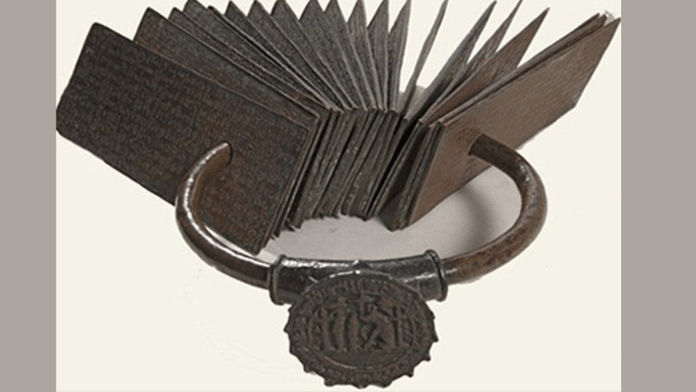
The Anaimangalam copper plates also known as the Leiden plates are among the most significant surviving records of the Chola dynasty and are important artefacts of Tamil heritage held outside of India.
The 21 copper plates date back to the reign of Rajaraja Chola I, who ruled significant portions of Southern India between 985 and 1014 CE. The plates were brought to the Netherlands around 1700 CE, by Florentius Camper, who was in India as a Christian missionary when the city of Nagapattinam in present day Tamil Nadu, was under Dutch control.
While there is no clarity on the precise legal circumstances under which Camper was able to obtain the 21 plates, they were eventually donated to Leiden University. The plates have remained at the Asian section of the university library for over three centuries.
India started pursuing the repatriation of the plates in 2012. Finally on 30 October 2023, the push received significant momentum when India formally requested the inclusion of the 21 copper plates in the agenda of the 24th session of the Intergovernmental Committee for Promoting the Return of Cultural Properties to its Countries of Origin or its Restitution in Case of Illicit Appropriation (ICPRCP).
The ICPRCP found validity in India’s claim and in November 2023, urged the Netherlands to begin the process of returning the plates to its nation of origin through bilateral dialogue. The process backed by UNESCO (United Nations Educational, Scientific and Cultural Organisation) eventually led to an agreement between India and the Netherlands, with the plates set to be returned during Modi’s visit to the country.
The lack of clarity over the legal circumstances of the transfer of the plates into Camper’s ownership led to significant delays in the process of returning the plates to India. The 21 copper plates passed into Dutch hands after the Dutch East India Company (VOC) moved its headquarters to Nagapattinam from Pulicat in 1690 CE.
Modi is in the Netherlands from 15 to 17 May. This is his second visit to the European nation, and the first after the European Union and India announced the conclusion of negotiations for a Free Trade Agreement (FTA) in January. Modi is set to meet with Rob Jetten, who became the Prime Minister of the Netherlands in February.
Apart from official meetings, Modi will address the Indian community Saturday. The Netherlands is one of India’s most important trading partners in the EU, with bilateral trade worth $27.8 billion in the 2024-2025 financial year.
The visit will aim to strengthen the trade partnership as well as open new avenues for ties to deepen including sectors such as semiconductors and advanced manufacturing. The Netherlands is home to ASML, the world’s largest manufacturer of lithography machines, which is a key system in the manufacture of semiconductors.
Significance of Chola plates
The plates have been studied by a number of scholars of Indian history and Tamil epigraphy and are referenced in Kalki Krishnamurthy’s historical novel, ‘Ponniyin Selvan’.
The plates cover the genealogy of the Chola dynasty beginning with praises of the Hindu god Vishnu and proceeding through an entire list of divine ancestors, establishing the legitimacy of the ruling family from Thanjavur.
Split into two sections, one written in Sanskrit and the other in Tamil, the Anaimangalm
copper plates highlight that Rajaraja Chola I pledged the entire revenue of villages bordering Anaimangalam to support a Buddhist vihara in the city of Nagappatinam. The vihara is said to have been built by the Malay king of Srivijaya. The highlight of the award was noted in the 21st year of Rajaraja Chola I’s reign and was inscribed in Tamil.
While the order was issued by Rajaraja Chola I, it was his son Rajendra Chola I, who had the grant etched onto a durable copper plate to preserve the grant. The bronze ring that binds the plate bears Rajendra Chola I’s seal. It is said that Rajaraja Chola’s verbal order was first recorded on palm leaves.
(Edited by Tony Rai)