





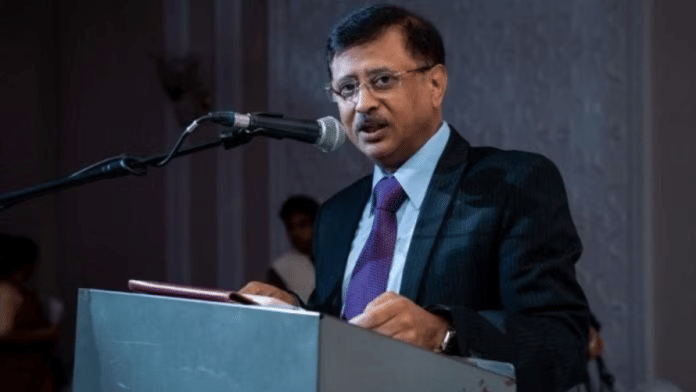


New Delhi: Khalistani extremists pose a danger to Canada because of their ties to organised crime, former Indian High Commissioner to Ottawa Sanjay Kumar Verma has told ThePrint, adding that Ottawa must correct the record on the Indian diplomats withdrawn by New Delhi nearly two years ago.
In an exclusive interview with ThePrint, Verma, who was one of the six Indian diplomats withdrawn from Canada in October 2024, explained that the original allegations outlined by then Canadian Prime Minister Justin Trudeau of links between Indian government officials and the killing of a Canadian citizen stands “null and void” in a way, following the indictments unveiled by the US Department of Justice a couple of weeks ago.
“If you recall our first statements in this connection (on the allegations raised by Trudeau), we started with it as politically motivated. And that is what we still stand on, that it was a politically motivated step in order to probably save his own political future. Any sitting prime minister making such statements in the parliament should have been backed by solid evidence, credible evidence, legally acceptable evidence,” said Verma.
He added, “But unfortunately, after three years, nothing has come out. And as far as the statement to the parliament is concerned, that itself, in a way, circumstantially, stands null and void.”
Trudeau alleged that Indian officials were involved in the killing of Hardeep Singh Nijjar, a designated terrorist in India, outside a gurdwara in Canada in June 2023.
As ties between the two countries cratered, the Canadian government requested India to waive diplomatic immunity for six diplomats posted in its missions in the North American nation. India rejected the request and withdrew the diplomats, while expelling six Canadian diplomats. These actions in October 2024 brought the bilateral ties to its lowest ebb in the recent past.
“In the episode, those people who have suffered, their prestige, their reputations should be restored. They should be cleared of everything which was told in the media on the floor of the parliament. To malign them, to wrong them. So these things need to be corrected after all. Their families have suffered…So that is an issue which needs consideration from both sides,” Verma said.
The US Department of Justice unveiled three indictments against transnational criminal organisations led by Indians or those with roots from the country, specifically Lawrence Bishnoi, Jaggu Bhagwanpuria and Ravinder Singh Dhanda.
The indictment against the Bishnoi network specifically links this criminal gang to the killing of Nijjar. The Royal Canadian Mounted Police (RCMP) had also highlighted that the ongoing investigations into the transnational criminal gangs had so far uncovered no evidence linking Indian government officials to the killing.
“Now, if Canada is a country which is based on the rule of law, India too is. And therefore, if there are claims or information which cannot be backed up by credible evidence, it is neither here nor there. So therefore, in response to your first question, of course, there was no credible evidence presented to us, which we could have followed up in India,” said Verma.
Also Read: No ‘evidence’ linking Indian govt to killing of Nijjar, says RCMP, 3 years after Trudeau accusations
‘Khalistani extremists real danger to Canadians’
The former High Commissioner pointed out that within Canada, Khalistani extremists pose a “real danger” to the safety of Canadians, misusing the freedom of speech laws to illegally raise funds to cause trouble in India.
“In Canada, what has happened is that in the garb of the freedom of speech, the propagandist Khalistani extremists started their appearance on the Canadian scene. And slowly, what we realised is that they are actually getting into anti-India activities in Canada. But they’re also prompting violence against the Indian community in Canada, extortion in Canada, as well as prompting violence in the Indian territory as well,” said Verma.
He added, “Through transfer of money through Hawala, using our neighbouring countries to sneak in weapons and other things. So in a way, till the time it is only contained within the geographical boundaries of Canada, it’s a Canadian issue, largely.”
These extremists are involved in “gun running, drugs, racketeering, extortion and human trafficking” across North America, to “finance their nefarious activities” against India, the former envoy explained.
Describing their modus operandi for the expansion of the Khalistani networks, Verma pointed out to their methods of “brainwashing” Indian students into seeking asylum in Canada, which bolstered their recruitment.
“So, most of the Indian students who were going to Canada, they really went as students…Canada is an expensive country after all. So, in order to support them, they would take up odd jobs…Some of them were targeted by the Khalistani gangs. And they will be brainwashed and recruited,” said Verma.
He added: “We will provide you a place to stay. We will provide you food. Why don’t you come and join our so-called protests? Anti-India protests. Then these innocent boys and girls will go there without understanding what they are doing. Then once they are there, they will desecrate the Indian flag. They will shout out anti-India slogans… And then those students will be asked to go and stake a claim for asylum.”
The current administration under Mark Carney has, however, tightened the scrutiny of such asylum applications, while also taking a closer look at student visa applications. The number of students from India moving to Canada has seen a fall in the last year.
In the 2025-2026 academic year, the number of international students in universities and colleges in Canada fell by 26 per cent in comparison to the year before, according to Statistics Canada. Canadian Prime Minister Mark Carney last month highlighted that the intake of international students has fallen by 60 per cent since his administration came to power.
The Carney change in ties
Prime Minister Carney led the Liberal Party to victory in federal elections in April 2025, and as a part of his foreign policy vision sought closer cooperation with India. The Canadian Prime Minister visited India in March this year, and has sought to bifurcate the irritants in ties from the larger strategic partnership.
Apart from taking aim at immigration, Carney has overseen a change in track on India, reopening negotiations for a trade deal, ramped up security cooperation and worked on stabilising diplomatic relations.
India and Canada appointed new high commissioners last August, and have since seen a number of high-level exchanges.
“The two prime ministers met (Modi and Carney) and they decided to relaunch CEPA (Comprehensive Economic Partnership Agreement) negotiation which is absolutely new because the ground realities have changed, the economic size and economy might have changed, the priorities would have changed a little bit,” said Verma.
He added: “If you look at the universities, they are collaborating. Canada is trying to open courses in Indian universities now… If you look at the innovation..If you look at the pension funds, today Canada has invested close to about 100 billion Canadian dollars, which is close to say 73-74 billion US dollars in India through their pension funds…So, therefore, I think investment relations, trade relations, innovation, students, people-to-people, all these things are improving. They are on the right track.”
(Edited by Ajeet Tiwari)