





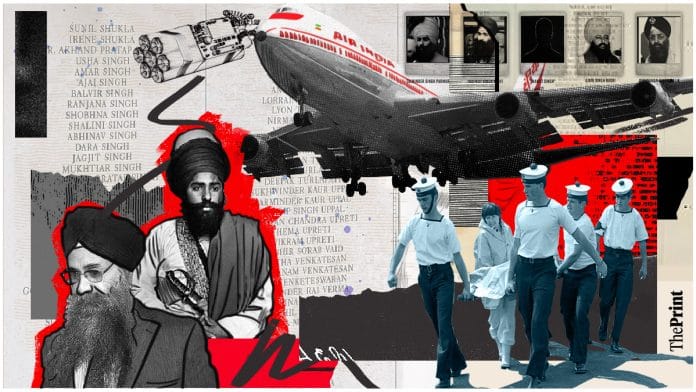


New Delhi: Canada’s intelligence agency Wednesday, for the first time, blamed “Khalistanis” for the Air India Flight 182 bombing that left 329 people dead in 1985. Incidentally, Canadian Prime Minister Mark Carney’s statement on the attack was more nuanced on his government’s efforts to confront terrorism in the country than his predecessor.
“On this National Day of Remembrance for Victims of Terrorism, CSIS remembers the 329 people on Air India Flight 182 who lost their lives due to a heinous act of terror. On June 23, 1985, a bomb planted by Canada‑based Khalistani extremists destroyed the aircraft, killing everyone on board—most of them Canadians. It remains the deadliest terrorist attack in Canada’s history and a defining moment for our national security community,” Canadian Security Intelligence Service (CSIS) said in a statement on social media platform, Facebook, on 23 June.
“CSIS was less than a year old at the time, and the tragedy shaped our evolution. Over the past four decades, we have remained committed to protecting Canadians from political, religious, and ideologically motivated violence,” the statement added.
Only one individual was ever convicted for the bombing of the Air India plane. Canadian authorities failed to identify the seriousness of the threats ahead of the attack, despite numerous warnings from India. The cascading series of errors by the Canadian authorities allowed extremists to target two Air India flights.
While the bomb on Flight 182 detonated mid-air off the coast of Ireland killing all on-board, the second bomb, targeting Flight 301 in Tokyo, detonated early, leaving two baggage handlers dead at Narita International Airport.
The recognition from the Canadian intelligence services is an important shift in its position. Just last month, the intelligence agency noted the existence of Sikh separatists who are using the country to fund extremist activities abroad, specifically against India.
For the better part of the last four decades, Canada has often refused to recognise the growing role of Sikh separatists within the country and their activities enabling extremist attacks abroad. Rather, Canada has defended their activities under the guise of protecting freedom of speech.
Even this year’s CSIS report notes that the “peace advocacy for a separate state of Khalistan” is lawful, even as a small group of individuals are using Canada as a staging ground for collection of funds and planning of violent activities abroad.
The previous Canadian administration, led by Prime Minister Justin Trudeau, had clashed with the Indian government numerous times over the issue. Trudeau accused Indian officials of being linked to the killing of Hardeep Singh Nijjar.
Nijjar, an Indian designated terrorist, was killed outside a gurdwara in Surrey, British Columbia, in June 2023. Three months later, on 18 September, Trudeau accused Indian officials of being linked to the killing on the floor of the Canadian Parliament.
The accusations led to a complete breakdown in ties between the two countries. A year later in October 2024, India expelled six Canadian diplomats, including Acting High Commissioner Stewart Wheeler, while withdrawing six of its own diplomats, including then High Commissioner Sanjay Kumar Verma from the country.
The episode marked a rare moment when India took strong measures diplomatically against a G7 country. The relationship has since improved with Mark Carney assuming the leadership of the Liberal Party in March 2025.
Carney led the party to victory in the April 2025 elections, and has since bifurcated the lingering security issues from the larger political conversation with the Indian leadership. Prime Minister Narendra Modi travelled to Canada for the G7 summit last June, which allowed for both countries to almost simultaneously reappoint high commissioners.
The Canadian Prime Minister made an official visit to India earlier this year in March, which further led to a strengthening of ties. India and Canada have reopened negotiations for a free trade agreement, aiming to conclude the deal by the end of the year.
Carney’s statement on the anniversary of the attack this year was stronger, highlighting that the “legacy of Air India Flight 182 demands remembrance, but also vigilance”.
“Canada’s government is confronting and condemning violent extremism in all its forms, with new legislation to defend the safety and security of Canadians, strengthen our national security institutions, and disrupt terrorist financing and support networks,” he added.
The Canadian Prime Minister also highlighted that of the 329 innocent lives killed, 268 were Canadian citizens. The attack was the most deadly incident of aviation terrorism until the September 11, 2001 attacks across the US.
(Edited by Niyati Kothiyal)