



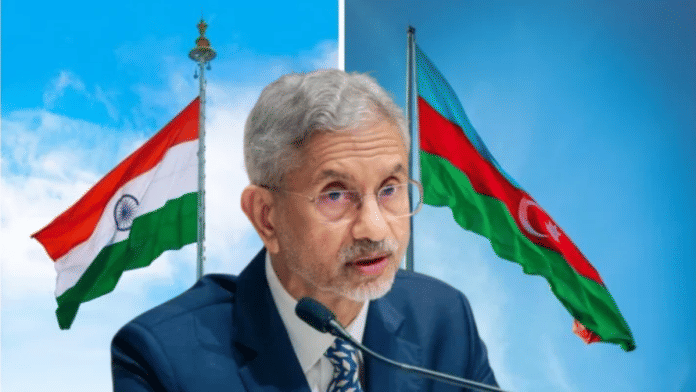
New Delhi: External Affairs Minister S. Jaishankar is set to make his first standalone bilateral visit to Azerbaijan Friday, as the two countries continue to engage on a number of issues including energy, trade, technology and tourism.
The visit marks a shift in India’s relations in the region, as Azerbaijan has in recent years been perceived as focusing on closer cooperation with Pakistan and Türkiye, while New Delhi has focused on deepening its partnership with Armenia in the region. Azerbaijan and Armenia have fought two conflicts in the last half-decade, in 2020 and 2023, with Baku finally capturing the region of Nagorno-Karabakh following their last offensive.
Armenia has been beefing up its military capabilities, and has become an important buyer of Indian-made defence platforms. At the same time, Baku, along with Ankara and Islamabad focused on building a trilateral cooperation format, with two leaders level summits held in 2024 and 2025.
“External Affairs Minister Dr. S. Jaishankar will be paying an official visit to Azerbaijan on 23 October, 2026. During the visit, EAM will hold a meeting with his counterpart to review bilateral ties between the two countries,” the Ministry of External Affairs said in a statement Thursday.
Jaishankar had earlier visited Baku in 2019, while accompanying a delegation headed by the then Vice President of India Vankaiah Naidu to attend a summit related to the Non-Aligned Movement (NAM).
Ties between India and Azerbaijan remained frosty in 2025, when Baku condemned New Delhi’s strikes against terrorist infrastructure situated in Pakistan during Operation Sindoor. Almost two weeks after Operation Sindoor, Azeri President Ilham Aliyev met with Pakistani Prime Minister Shehbaz Sharif, during the Azerbaijan-Türkiye-Pakistan trilateral leaders summit on 28 May 2025.
However, earlier this year, a thaw of sorts was witnessed in the bilateral ties between New Delhi and Baku, when Secretary (West) in the Ministry of External Affairs Sibi George visited Baku and held foreign office consultations with his counterpart on 3 April.
“They comprehensively reviewed the current state of bilateral relations covering areas of mutual interest. The issues discussed included trade, technology, tourism, pharmaceuticals, energy, culture, people to people exchanges and fight against cross border terrorism,” the ministry said in a statement on the foreign office consultations earlier this year.
The usage of “cross border terrorism” in the statement issued by India following the foreign office consultations in April is significant. For India, Pakistan has remained a constant source of cross-border terror attacks.
For India, Azerbaijan remains the top country in the region for trade. The Azeri economy is the largest in the Caucasus at $89 billion in gross domestic product (GDP). ONGC Videsh, the foreign arm of India’s Oil and Natural Gas Corporation (ONGC) has a stake worth over $1 billion in the Azeri-Chirag-Gunashli oil fields and the Baku-Tbilisi-Ceyhan pipeline. In 2024, ONGC Videsh increased its stake in the oil fields and pipeline.
In 2025, around 166,944 Indian tourists made the trip to Azerbaijan. Indians are the fourth largest group of foreign tourists visiting the country. The number of tourists has been impacted by the situation in West Asia, but was on an upward trend before the current crisis in the region.
Baku has also been involved in a diplomatic spat with Ankara in recent months. Turkish social media commentators criticised Azerbaijan’s decision to have a diplomat remain present during Israeli Prime Minister Benjamin Netanyahu’s speech at the United Nations General Assembly last month.
Similarly, a number of Islamic countries boycotted Israel President Isaac Herzog’s speech at the seventh summit of the Conference on Interaction and Confidence Building Measures in Asia (CICA), hosted by Baku on 15 October this year. Kirti Vardhan Singh, the Minister of State in the Ministry of External Affairs, represented India at the CICA Summit last week.
(Edited by Gitanjali Das)
Also Read: The mediator who cannot chose: Caught between Iran & Saudi Arabia, Pakistan’s West Asia dilemma