





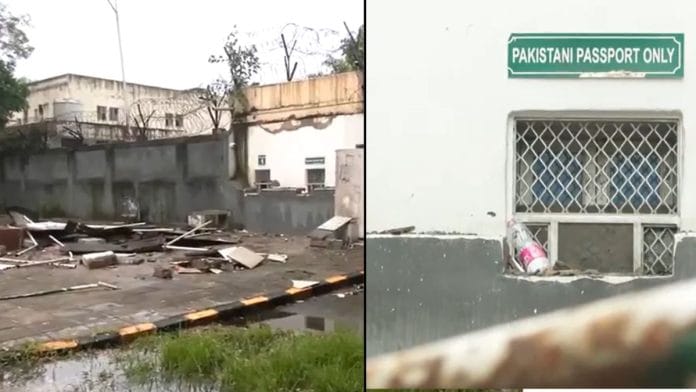

New Delhi: Indian authorities dismantled unauthorised structures and encroachments outside the Pakistan High Commission in the national capital late Wednesday evening. The structures were located near the visa section of the High Commission, and are said to have been outside the designated perimeter of the compound.
This comes against the backdrop of Pakistani authorities removing parking poles outside the Indian High Commission in Islamabad. Sources told ThePrint that the parking poles were removed despite a formal protest lodged by the Indian High Commission in Islamabad. The tit-for-tat move continues the norm in India-Pakistan ties.
In the past, both sides have mutually reduced staff and tightened access controls and administrative restrictions as relations continue to remain strained. In the last year the relationship cratered further, following the terror attack in Jammu and Kashmir’s Pahalgam, which left 26 people dead.
India launched Operation Sindoor last May, hitting terrorist camps across Pakistan, which led to an 87-hour conflict between the two neighbours. India moved to hold the Indus Water Treaty in abeyance in April 2025, until Pakistan ceases its support for cross-border terrorism.
The relationship between the two countries fell to its lowest point in many years. Formal diplomatic relations between the countries have remained in a deep freeze. In August 2019, Pakistan reduced its diplomatic relationship with India to that of a Charge d’Affaires from the post of High Commissioner.
Last year, following the Pahalgam terror attack, India expelled the military, naval and air force advisers from the Pakistani High Commission in New Delhi, closed the integrated check post at the Attari border crossing and barred Pakistani nationals from visa-free travel to India. New Delhi further reduced the strength of the High Commission to 30 from the then 55 staff.
In response, Pakistan closed its airspace to Indian-owned airlines and closed its own side of the border post. The latest back-and-forth over structures surrounding their respective High Commissions is part of a similar trend in ties.
India’s actions also came on the day when US Ambassador Sergio Gor declared the union territory of Jammu and Kashmir an “important part” of the country. A miffed Islamabad summoned the American charge d’affaires late Wednesday evening and lodged a strong protest over Gor’s statement.
The US has long maintained that the issue surrounding Jammu and Kashmir must be resolved bilaterally between India and Pakistan. Gor made the comments during his first visit to Jammu and Kashmir since becoming the US Ambassador to India, earlier this year.
Gor met with Omar Abdullah, the Chief Minister of Jammu and Kashmir—the first meeting by a US ambassador in almost 15 years with a sitting chief minister of the Union territory. The US envoy also promised to reevaluate the travel advisory issued by the State Department for the Union territory, citing improved safety and security in the region.
(Edited by Nivedita Patil)
Also Read: Pakistan has no locus standi—MEA on Sharif, Dar’s Article 370 abrogation remarks