





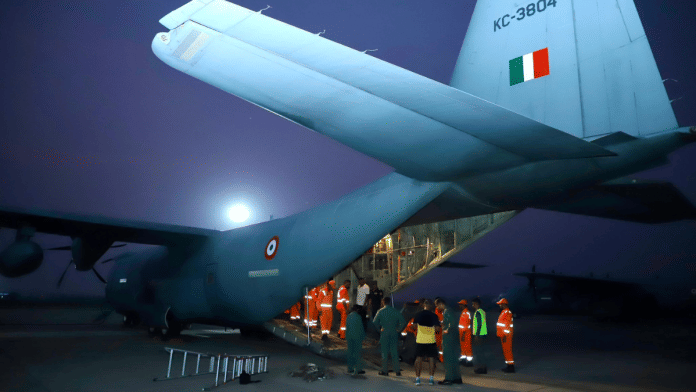

New Delhi: India rushed emergency assistance to Nepal Wednesday after a flash flood swept through districts bordering Tibet, killing at least 95 people and leaving nearly 400 others missing, according to Nepalese authorities. This is among Nepal’s worst disasters since the 2015 earthquakes.
India dispatched 10 tonnes of humanitarian assistance and essential medicines aboard an Indian Air Force (IAF) C-130J aircraft, External Affairs Minister S. Jaishankar said Wednesday. Supplies include emergency items such as temporary shelters, blankets, hygiene kits, solar lamps, and medicines.
“Our thoughts are with the bereaved families and all those affected. In face of this challenge, India stands with Nepal and its people,” Jaishankar wrote on X.
Nepal’s Foreign Affairs Minister Shisir Khanal thanked the Indian government for the aid. “Jaishankar. Thank you Hon. EAM and the Government of India for the generous humanitarian aid and critical medical supplies extended to support our flood relief operations. India’s swift response reflects the strength of our bilateral partnership and mutual solidarity in this difficult hour,” he wrote on X.
An IAF C-17 transport aircraft is scheduled to carry additional relief supplies at 6 am Thursday, while a flood-rescue team from India’s National Disaster Response Force remains on standby for possible deployment.
The aid comes as rescue efforts in Nepal have been complicated by destroyed roads, bridges and other infrastructure and by dangerously high water levels.
Dispatched 10 tonnes of HADR assistance and essential medicines to support Nepal’s response to the devastating floods.
Our thoughts are with the bereaved families and all those affected.
In face of this challenge, India stands with Nepal and its people. pic.twitter.com/FUJdkJzi1o
— Dr. S. Jaishankar (@DrSJaishankar) August 26, 2026
Thank you Hon. EAM @DrSJaishankar and the Government of India for the generous humanitarian aid and critical medical supplies extended to support our flood relief operations.
India’s swift response reflects the strength of our bilateral partnership and mutual solidarity in this… https://t.co/PrxvugpfN3
— Shisir Khanal (@shisir) August 26, 2026
The flash flood struck the Bhote Koshi River in Rasuwa and neighbouring districts on Wednesday after a sudden surge of water entered the river from the Tibetan side of the border at around 9 am, according to Nepalese officials.
Riverside communities in Rasuwa and Nuwakot were among the hardest hit. Floodwaters swept away homes, vehicles and bridges and disrupted communications across the region.
Nepal’s Tourism Board said 384 people were unaccounted for, including 291 foreign nationals and 32 members of the security forces. At least 88 people had been rescued.
Among those reported missing are at least 105 Indian tourists. More than 300 Indian pilgrims traveling to Tibet for the Kailash Mansarovar Yatra were also cut off from communications in the Rasuwagadhi area, according to The Kathmandu Post.
Two Nepal Army helicopters were dispatched from Kathmandu toward the disaster zone, but officials said they were unable to land in Timure and Syapru Besi because floodwaters were too high.
Army spokesperson Raja Ram Basnet said the difficult conditions had severely hampered rescue operations.
The flooding has also raised questions about its cause. Nepal’s Flood Forecasting Division said the disaster did not appear to have been triggered by heavy rainfall in Rasuwa. Satellite imagery instead showed substantial rainfall on the Tibetan side of the border.
The flooding also affected the Tibetan side of the border, where a mudslide near the Gyirong border crossing caused casualties and left people missing. Nepal’s Foreign Minister Shisir Khanal told Parliament that preliminary information suggested the flooding in the Rasuwa district might have been caused by an avalanche triggered by an earthquake Wednesday in the Tibetan region.
(Edited by Gitanjali Das)
Also Read: NGT issues notice to centre over rules changing definition of Ganga floodplains