





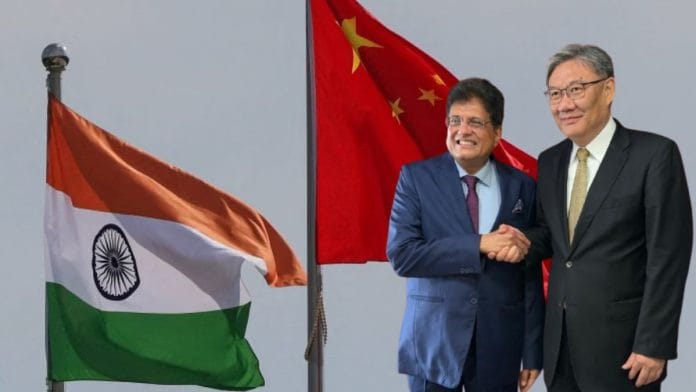



New Delhi: India has nudged China towards more balanced trade ties as the political and economic thaw between the two countries continues to move forward, with Commerce and Industry Minister Piyush Goyal meeting Chinese counterpart Wang Wentao—the first such interaction in over half a decade.
Economic ties have come into focus in recent weeks, as India further eased foreign direct investment restrictions from China last month through amendments to Press Note 3.
Trade between the two countries has expanded in the last year. China is the largest source of merchandise imports to India. New Delhi’s merchandise exports to China for the 2025-2026 financial year till February 2026 stood at $17.5 billion, while its imports from Beijing were at $119.56 billion during the same time period. Both imports and exports have seen growth in the last fiscal year.
However, trade remains heavily skewed in favour of China, as India continues to import merchandise necessary for its own manufacturing sector.
At a press briefing Thursday, Goyal said: “I met with the Minister of Trade from China with whom we discussed ways to expand trade, move towards balanced trade and generate trust to help smoother bilateral trade between China and India and give greater opportunities for our exporters to export goods including in pharmaceuticals.”
Met Mr. Wang Wentao, Minister of Commerce of China, on the sidelines of the #WTOMC14.
Exchanged views on the MC-14 agenda and discussed bilateral trade matters. pic.twitter.com/Rw613FCzfn
— Piyush Goyal (@PiyushGoyal) March 27, 2026
Goyal’s meeting with Wang on the margins of the World Trade Organisation (WTO) Ministerial in Cameroonian capital Yaounde last week was the first at this level in almost seven years, according to a person familiar with the matter. Goyal met with a vice-minister a few years ago.
India-China ties nosedived following the clashes at Galwan valley in the summer months of 2020. Both countries took steps to curb trade and investment ties, with India issuing Press Note 3 in 2020, which restricted the flow of investments emanating from China.
However, there has been a move to ease these restrictions, which was seen with amendments to the Note on 10 March. India and China have moved forward step by step through confidence building mechanisms in the last year.
The two countries arrived at an agreement to disengage across the friction points at the Line of Actual Control (LAC) in October 2024, which paved the way for Prime Minister Narendra Modi to meet with Chinese President Xi Jinping on the margins of the BRICS Summit in the Russian city of Kazan a few days later.
Modi travelled to China last year for the Shanghai Cooperation Organisation (SCO) Heads of States Summit and held another bilateral with Xi. Other mechanisms of communication between the two countries have been activated including at the levels of Special Representatives on the Boundary Question (SR-level) and other channels of discussions.
National Security Adviser Ajit Doval is expected to travel to China at some point this year for the next round of SR-level talks. Last year, China also cooperated for the resumption of the Kailash Mansarovar Yatra, as a confidence building measure.
Later in 2025, both countries resumed direct flights, and India started issuing visas to Chinese nationals.
(Edited by Gitanjali Das)