







New Delhi: Away from the frenzied social media narratives and peaked emotions, India and Bangladesh are quietly working behind the scenes to normalise relations between the two countries, ThePrint has learnt.
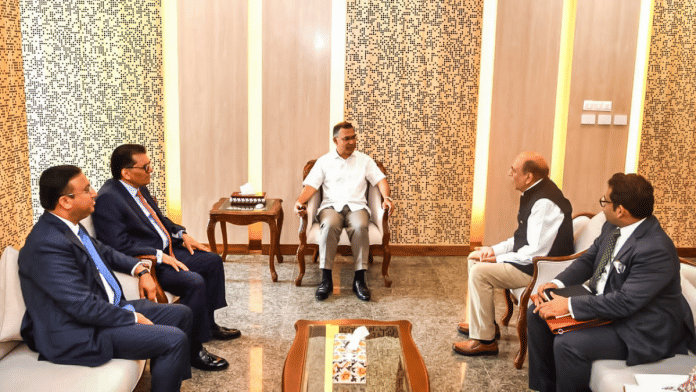
Government sources said that India’s High Commissioner Dinesh Trivedi, a political appointee, calling on Bangladesh Prime Minister Tarique Rahman on Monday is a reflection of what is actually happening on the ground.
The sources said the meeting lasted about half an hour during which the focus was on getting things moving on the bilateral front.
Incidentally, a high-level team from India’s security establishment reached Dhaka over the weekend. This is the first such high-profile visit by the Indian side since the government led by Sheikh Hasina was ousted in August 2024.
The Bangladesh High Commission in New Delhi posted on X that the meeting between their prime minister and Trivedi “is expected to go distance in cementing and advancing ties and engagements”.
The Indian High Commission in Dhaka issued a statement saying that Trivedi conveyed greetings from Prime Minister Narendra Modi and the intent to work together with the government and the people of Bangladesh “in a positive, constructive and forward-looking manner”.
Rahman has been invited by India to attend the BRICS Summit to be held next month. Despite sections of Bangladesh media reporting that the visit may be cancelled, it is understood that the visit is expected to go on.
The sources admitted that there is still friction in some areas but India is very keen to stabilise relations.
High Commissioner Dinesh Trivedi paid a courtesy call on Hon'ble Prime Minister of Bangladesh, H.E. Tarique Rahman on 10 August 2026.
High Commissioner conveyed greetings from Hon’ble Prime Minister of India and the intent to work together with the Government and the people of… pic.twitter.com/hkTmUYb1Bs
— India in Bangladesh (@ihcdhaka) August 10, 2026
The appointment of Trivedi has been done exactly to normalise ties. After a very long time, India has chosen to send in a politician as the top diplomat. The sources explained that the ties had reached such a low point that it was beyond the capability of a mere bureaucrat to revive them.
What was needed was someone who could go beyond the stated protocols and help establish ties by talking to everyone at the same level. Trivedi was the natural choice since he was a heavy weight and has not only been five-time MP, but also a Union minister.
High Commissioner of #India, @DinTri (HE Dinesh Trivedi) paid maiden courtesy Call to Hon. Prime Minister of #Bangladesh, HE Tarique Rahman (@trahmanbnp), in Dhaka, this morning.
The half an hr discussion is expected to go distance in cementing | advancing 🇧🇩 🇮🇳 ties |… pic.twitter.com/aPp6CVU6WI
— Bangladesh High Commission, New Delhi (@bdhc_delhi) August 10, 2026
Born in a Gujarati family, he did an MBA from the University of Texas at Austin in 1974 and worked in Chicago for two years before returning to India, where he worked for a logistics provider.
Trivedi joined the Congress in the 1980s, but switched over to the Janata Dal in 1990. In 1998, he joined Mamata Banerjee-led TMC when she started the Trinamool Congress party and became its first general secretary.
In 2021, he joined the BJP. He has served as the Union minister for Railways and Union minister of State for Health and Family Welfare.
(Edited by Ajeet Tiwari)
Also Read: Indian envoy to Dhaka meets Bangladesh PM Tarique Rahman amid unease over Hasina’s Delhi speech
Mere bureaucrat to revive them. That sounds very dismissive of the Indian Foreign Service. Especially when many of the strains in the bilateral relationship have been created in the political domain. One, going all out with PM Sheikh Hasina, equating a leader who can be voted out in a free and fair election, with her country. Second, making Bangladesh a factor in domestic politics in a manner that hurts the official relationship.