



New Delhi: Amid the escalating West Asia war, the India-Middle East-Europe Economic Corridor (IMEC) is back in focus after US President Donald Trump renewed Washington’s support for the proposed trade network which is meant to offer an alternative to vulnerable maritime chokepoints such as the Suez Canal and Strait of Hormuz.
Speaking at a meeting with Gulf Cooperation Council and Arab leaders on the sidelines of the United Nations General Assembly in New York on Wednesday, Trump said his administration supported efforts to develop alternative routes for transporting oil and reduce the region’s dependence on vulnerable maritime routes.
“Iran’s terrorist attacks on commercial shipping in neighbouring countries have shown the need to shift Middle East energy infrastructure away from the Iranian checkpoints,” Trump said.
“That’s why my administration strongly supports the India-Middle East-Europe Economic Corridor and other places to get oil out, whether it is pipelines or anything else. Together we are on the verge of overcoming challenges that have plagued this region for a decade,” he added.
Trump’s remarks have renewed attention on a project that India and its partners unveiled in 2023 as a potential new trade link between South Asia, the Middle East and Europe. The corridor remains a work in progress, however, with regional conflict and political uncertainty complicating its development.
Also Read: Dead on arrival to revival: IMEC regains momentum as India, UAE & US look for new trade route
A proposed bridge between India and Europe
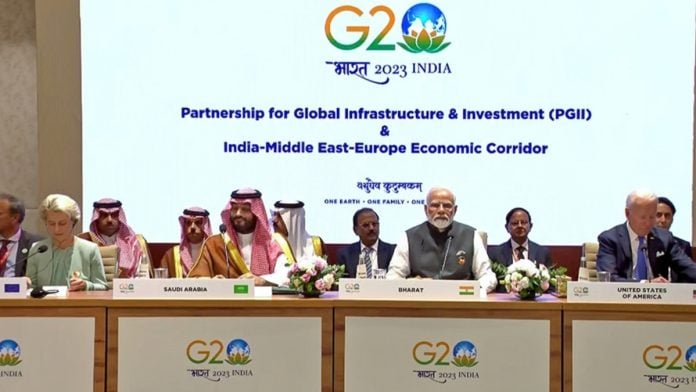
India, the US, Saudi Arabia, the UAE, France, Germany, Italy and the European Union signed an MoU on the sidelines of the G20 summit in New Delhi in September 2023, setting out plans for IMEC.
The project envisages two main routes: an eastern corridor connecting India to the Gulf and a northern corridor linking the Gulf to Europe. Goods arriving at Gulf ports would be transferred to rail networks, transported across the region and then moved towards the Mediterranean and European markets.
The proposed infrastructure would combine maritime shipping and rail transport with electricity cables, digital connectivity and a pipeline for clean hydrogen. The UAE would serve as a key maritime gateway, connecting shipments from India with the proposed rail network.
IMEC is intended to provide India with an alternative route to European markets while strengthening commercial ties with Gulf economies. Its proponents say it could reduce transport costs and travel time, improve supply-chain resilience and create opportunities in energy and digital infrastructure.
The project is projected to reduce logistics costs by up to 30 percent and transportation time by 40 percent, according to Union Commerce Minister Piyush Goyal, who cited the figures in April 2025.
For India, the project has added significance because a large proportion of its exports to Europe currently travels through the Red Sea, a route that has faced repeated security threats and disruptions. An alternative land-sea network could offer exporters another means of reaching European markets, although its commercial viability would depend on new infrastructure and reliable cross-border connections.
The project’s progress has been overshadowed by deteriorating security conditions in West Asia.
The Hamas-led attack on Israel in October 2023 and the ensuing Gaza war disrupted the diplomatic environment in which IMEC was announced. The conflict also complicated efforts towards Saudi-Israeli normalisation, an important part of the broader regional landscape surrounding the corridor.
The subsequent US-Iran war and disruptions to commercial shipping have added further uncertainty. The Strait of Hormuz, through which 20-25 percent of the world’s oil shipments pass, has become a focal point of concern over the security of energy supplies and maritime trade.
IMEC has also been viewed as a strategic counterweight to China’s Belt and Road Initiative, although its stated objectives extend beyond geopolitical competition to trade, infrastructure development and clean-energy cooperation.
Trump’s remarks place IMEC within a broader US effort to promote alternative energy and transport routes in a region where geopolitical tensions can quickly disrupt global trade and energy supplies.
(Edited by Chingkheinganbi Mayengbam)
Also Read: This is how Strait of Hormuz shock is forcing a global trade reset