





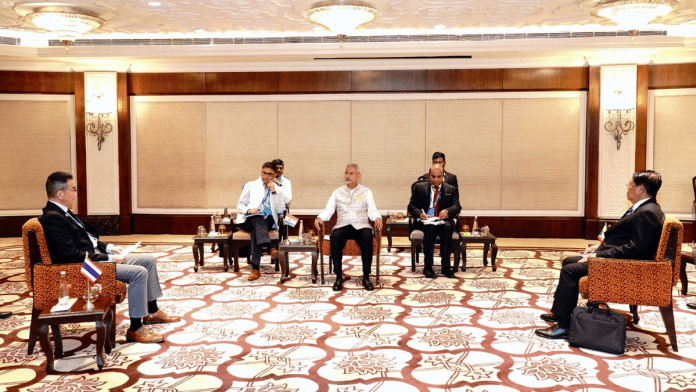

New Delhi: Border stability, connectivity projects and countering transnational crimes were all part of the discussions held between Minister of External Affairs S. Jaishankar and his Myanmarese and Thai counterparts Thursday on the sidelines of the BIMSTEC foreign ministers’ retreat.
In his separate meeting with the deputy prime minister and foreign minister of Myanmar, U. Than Swe, Jaishankar “shared concerns regarding border stability and flow of displaced persons”, while also raising the “activities of insurgent groups” and the trade in illegal narcotics and arms, according to a post on X.
The external affairs minister added: “Pressed strongly for the early return of Indians unlawfully detained by cyber scam gangs. India supports the return to democracy in Myanmar and engages all stakeholders in that regard.”
Also read: EAM Jaishankar meets with Qatari PM. Energy, investment & people-to-people ties discussed
This is the second meeting between Jaishankar and U. Than Swe in the past two weeks. At the end of June, during a transit visit through New Delhi by the Myanmarese leader, the two met and held discussions on the return of Indians trapped in the town of Myawaddy.
Earlier this year, the Indian government announced that it would fence the entire length of the 1,643-kilometre border with Myanmar and end the Free Movement Regime (FMR) with the country due to security concerns.
Myanmar has been gripped by a civil war since 2021, after a military junta took over the reins of government from the previous democratically elected institutions. In October 2023, three powerful ethnic armed organisations (EAOs) formed a military coalition and launched an offensive against Nay Pyi Taw.
The offensive has seen the military lose control of swathes of villages and positions across the country, with EAOs taking control over some border checkpoints. Forces opposing the military government captured the strategically important town of Myawaddy near the border of Thailand in April 2024. The junta was able to regain control of the town after nearly two weeks of fighting.
Jaishankar also held a trilateral meeting with the Myanmarese leader and Thai Minister of Foreign Affairs Maris Sangiampongsa.
The meeting focused on connectivity projects that Jaishankar described as “crucial for BIMSTEC” in a post on X. The three countries have been building the India-Myanmar-Thailand highway (IMT highway) since 2012. About 30 percent of the total construction work remains to be done. If completed, the highway would connect Moreh in Manipur with Mae Sot in Thailand, a total distance of about 1,360 kilometres, mostly through Myanmar.
“Held trilateral meeting with my counterparts Thailand FM @AmbPoohMaris and Myanmar DPM & FM U Than Swe. Our discussions focused on the connectivity projects, so crucial for the future of BIMSTEC. Also exchanged views on border stability and humanitarian assistance,” said Jaishankar on X.
Held trilateral meeting with my counterparts Thailand FM @AmbPoohMaris and Myanmar DPM & FM U Than Swe.
Our discussions focused on the connectivity projects, so crucial for the future of BIMSTEC. Also exchanged views on border stability and humanitarian assistance.
Countering… pic.twitter.com/CmQWgAX5wh
— Dr. S. Jaishankar (@DrSJaishankar) July 11, 2024
Myawaddy, the town in Myanmar that came under attack from forces opposing the regime in Nay Pyi Taw earlier this year, is the border town that connects to Mae Sot in Thailand — the final leg of the IMT highway.
For India, the IMT highway is the final piece of its grand vision to connect the Atlantic and Pacific oceans, with New Delhi being the bridge.
(Tikli Basu)
Also read: India issues new advisory against fake job rackets in Myanmar, flags another ‘dangerous’ area