



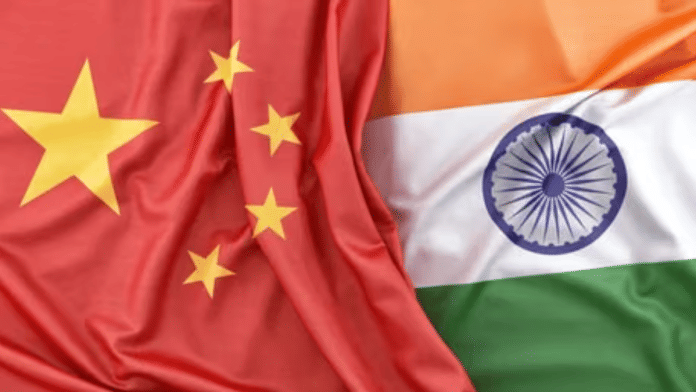
New Delhi: The Union Ministry of Civil Aviation’s proposal to allow Indian air carriers to use a northern route via China’s Xinjiang province, to cut their losses due to closure of Pakistani airspace, faces a geopolitical test, as it has implications for India’s territorial integrity.
The Hotan route proposed by K. Ram Mohan Naidu, the civil aviation minister, involves potential flights over Aksai Chin—the roughly 38,000 square kilometres of Indian territory occupied by China. Beijing has claimed the territory, administering it from Hotan, a city in Southwestern Xinjiang.
The proposal by the Ministry of Civil Aviation has been received by the Ministry of External Affairs, but any negotiations with China on it, especially on airspace use over Aksai Chin, has implications for India’s continued claims on the region.
Sources indicated that questions over which side’s air traffic controllers would guide the aircraft are largely related to issues of territorial sovereignty. A source said that the Hotan route would have to be bilaterally negotiated with China, given that Beijing is not a signatory to the International Air Services Transit Agreement, which generally allows contracting states the privilege of overflight over their territories.
Furthermore, another source highlighted that large parts of Chinese airspace in Xinjiang is military controlled, and that any negotiation, especially overflight over sensitive areas, given that the Hotan Airport’s dual-use nature would be extremely complicated.
The Hotan Airport is used for both military and civilian purposes, and had opened a second runway in 2024, as reported by ThePrint. This is the closest Chinese air base to India’s Eastern Ladakh. The two countries had clashed across the Line of Actual Control (LAC) in Eastern Ladakh in the summer months of 2020, which had led to a diplomatic and political standoff until 2024.
The two countries were able to finally agree to disengage at the friction points in October that year, which allowed for implementation of confidence-building measures for stabilisation of ties over the last two years.
Even with the resumption of direct air services, issuance of visas and the running of the Kailash Mansarovar pilgrimage over the last two years, External Affairs Minister S. Jaishankar Tuesday made it clear that no real “structural” change has been seen in India-China ties. The overall relationship continues to be linked to peace and tranquility at the border areas.
Prime Minister Narendra Modi’s own flight path to Uzbekistan last month saw India One travel eastwards before turning North towards China, before flying over Xinjiang to reach Tashkent. The longer route took roughly eight hours, but also pointed to a route bypassing the proposed Hotan route.
The proposal by the civil aviation ministry has been supported by Air India, given that the closure of Pakistan airspace has heavily impacted India’s international air carriers flying West.
It is understood that the technical feasibility of flights over the terrain—especially mountains as high as 20,000 feet—has been completed. Boeing 787-8 and 787-9 aircraft were found proficient enough to handle flights over such terrain, especially in cases of emergencies.
The technical questions revolved around the capabilities of aircraft to handle any descent at a safe range, especially due to engine failure or depressurisation of the cabin.
Despite technical feasibility, negotiations for overflight permissions are likely to open serious questions on territorial disputes between the two countries. Pakistani airspace has been closed to Indian air carriers since April 2025, with the latest extension of closure till the middle of October.
The closure has hit Indian air carriers hard, with Air India highlighting losses upwards of Rs 4,000 crore between April and October last year alone. The war in West Asia, launched by the US and Israel against Iran, has further impacted air carriers, especially India-owned ones using the Southern routes over the Arabian Sea and West Asia to reach Europe.
Iranian airspace has remained dangerous due to the ongoing military conflict, which has further made routing decisions for Indian airliners complicated. The increasing fuel costs and usage has made it more difficult for Indian airlines to compete for international travel with global counterparts.
(Edited by Mannat Chugh)
Also Read: Days after Trump-Xi bonhomie, US envoy says China ‘weaponising’ rare earths against the world