



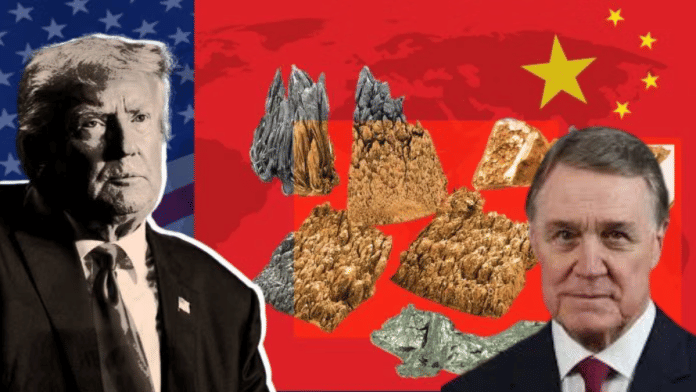
New Delhi: Accusing Beijing of turning its dominance of critical minerals into an economic weapon, US ambassador to China David Perdue Tuesday said China is tightening its control over the rare-earth industry and increasingly targeting efforts by companies to build supply chains outside the country.
Perdue’s remarks come days after a highly published Trump-Xi meeting at the White House—the first time a Chinese premier visited the US a second time. The US envoy had at that time admitted that Trump asked Xi if China is keen to purchase American-made weapons. Rare earths and critical minerals did not find a mention.
“This is a single-source dominant position that China is weaponising against the world right now,” Perdue said in a post on social media platform X. “We have told them this is unacceptable,” he said. “We are not going to live in a world where we have to go to China and kowtow to do business the way we want.”
In a second post on Tuesday, Perdue described what he called an evolution in Beijing’s approach: from controlling exports of rare-earth materials to imposing restrictions that could penalise companies and individuals seeking to develop alternatives to Chinese supplies.
“Back in April of last year, China put the export regime process in place for rare-earth elements and magnets,” he said. “Then, on 9 October, they weaponised that by expanding that to the entire world.”
“Now, they’ve weaponized it even further by escalating to the point where they make any diversification effort away from China a criminal offense, where they can arrest people, prosecute criminally, seize assets, exit ban, and so forth,” he added.
China dominates much of the global rare-earth supply chain, including 60 to 70 percent of global rare-earth mining, nearly 90 percent of processing and processing and over 94 percent of advanced permanent magnet manufacturing of magnets used in electric vehicles, electronics, renewable-energy equipment and defence systems.
Beijing has expanded its controls over the sector in the past few months as the United States and other countries seek to reduce their dependence on Chinese supplies.
In June, China’s commerce ministry introduced a whistleblower system encouraging organisations and individuals to report suspected violations involving strategic minerals. The violations subject to reporting include routing controlled materials through third countries and illegally transferring controlled technology overseas through investment, research and development, consulting or other means.
People whose reports were verified can receive rewards, according to the ministry. Companies that discover they have violated, or may have violated, the rules are instructed to report themselves, with voluntary disclosure potentially serving as grounds for a lighter penalty. The system took effect from 1 July.
China’s controls extend beyond shipments of rare-earth minerals. Rules announced by Beijing last October covered technologies used in rare-earth mining, refining, metal production, magnet manufacturing and recycling.
The rules define exports broadly, including the transfer or provision of controlled technology to foreign organisations or individuals through investment, joint research, employment, hiring and consulting. They also prohibit Chinese citizens and organisations from providing substantial assistance, without government approval, to overseas rare-earth mining, refining and magnet-making operations.
China suspended implementation of those controls in November 2025 after trade talks with the United States. The suspension was formally scheduled to remain in place through November 2026.
Washington and Beijing agreed this month to extend their broader trade truce by two months, through January 2027. China, however, has not announced a similar extension of the suspension covering the specific rare-earth technology controls.
Beijing added another enforcement mechanism this month. Regulations that took effect from 15 September allow Chinese authorities to prevent citizens from leaving the country if they are found to have violated export-control or technology import-export rules that officials determine could threaten China’s industrial or technological security. Human rights organisations like Human Rights Watch condemned the move calling it a “violation of the internationally protected right to leave a country”.
The measures have also affected two companies at the centre of American efforts to establish rare-earth supply chains outside China.
On 22 June, China’s commerce ministry placed MP Materials and USA Rare Earth on an export-control list alongside eight other American companies. MP Materials operates the Mountain Pass rare-earth mine in California, while USA Rare Earth is developing what it describes as a mine-to-magnet supply chain in the United States.
Under the Chinese order, exporters are barred from supplying the listed companies with dual-use items. Organisations and individuals in other countries are also prohibited from transferring Chinese-origin dual-use items to the companies, unless they obtain a special exception from the commerce ministry, according to reports.
Beijing said the measures were imposed in response to the US government’s decision to add Chinese companies to its list of “Chinese military companies”.
(Edited by Nardeep Singh Dahiya)
Also Read: No country built rare earths resilience alone. India must take lessons from Japan, Taiwan