





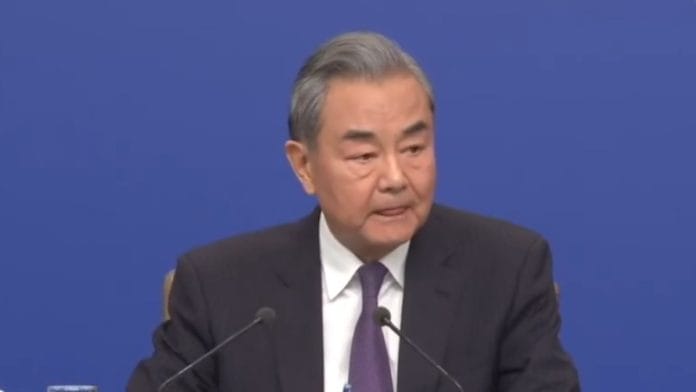



New Delhi: Wang Yi, China’s foreign minister, Tuesday asserted that Beijing acted as the mediator between India and Pakistan earlier this year, even as Islamabad used Chinese weapons against New Delhi during the conflict in May.
“To build peace that lasts, we have taken an objective and just stance, and focused on addressing both symptoms and root causes. Following this Chinese approach to settling hotspot issues, we mediated in northern Myanmar, the Iranian nuclear issue, the tensions between Pakistan and India, the issues between Palestine and Israel, and the recent conflict between Cambodia and Thailand,” Wang said at the Symposium on the International Situation and China’s Foreign Relations in Beijing.
“In our efforts, there was no interference in the internal affairs of others, no incitement, no biased manipulation, and no selfish gains. There was only sincerity and good faith. Our principles and hard work will stand the test of history.”
The Ministry of External Affairs offered no reaction to his statement. However, India has maintained that the end to the 87-hour conflict with Pakistan this year was a result of bilateral discussions at the appropriate level, specifically between the Director General of Military Operations (DGMOs) of both countries.
“This year, local wars and cross-border conflicts flared up more often than at any time since the end of WWII. Geopolitical turbulence continued to spread. The question of peace or war weighed heavily on many people’s minds,” Wang said Tuesday.
“Facing a troubled world where peace is under threat, China acted as an anchor for stability. As once-in-a-century transformations accelerate, international relations are being reshaped amidst turbulence, and the risks of conflict or confrontation between major countries are clearly on the rise.”
US President Donald Trump has also claimed credit for the pause in the hostilities between India and Pakistan following Operation Sindoor, and the conflict that lasted from 7 May to 10 May. India has rejected the US’ claim, maintaining that the end of the conflict was bilateral in nature and had no mediation from a third party.
Wang has claimed that China helped mediate the end to a number of conflicts, including between Israel and Hamas, Thailand and Cambodia, and the Iranian nuclear issue. These are all conflicts where Trump has also claimed to have mediated a ceasefire. The US president had witnessed the signing of a ceasefire agreement between Bangkok and Phnom Penh during his visit to Malaysia earlier this year, as well as travelling to Egypt to see the signing of a ceasefire between Tel Aviv and Hamas.
This is the first time that Beijing has claimed any role in ending the India-Pakistan conflict, and ironically comes after Islamabad used Chinese weaponry against the Indian armed forces. From the PL-15 missile to the J-10 aircraft, Pakistan relied heavily on Chinese equipment.
Deputy Chief of Army Staff (Capability Development and Sustenance) Lieutenant General Rahul R. Singh in July had said that China provided “all support” to Pakistan during the conflict following Operation Sindoor. He had added that Pakistan was receiving live strategic inputs from China on the Indian military position.
For Beijing, Operation Sindoor was a “live lab” testing its equipment against India, along with Turkish military equipment, according to Singh. More than 81 percent of Pakistan’s military equipment in the last five years has come from China, according to the Deputy Chief of Army Staff.
Ties between India and China have seen positive momentum in 2025. Both sides introduced a number of confidence-building measures, including the resumption of direct air flights, visa services and the Kailash Mansarovar Yatra.
Wang travelled to India in August, and met with National Security Adviser Ajit Doval and External Affairs Minister S. Jaishankar. Prime Minister Narendra Modi travelled to the Chinese city of Tianjin at the end of August for the Heads of State Summit of the Shanghai Cooperation Organisation (SCO).
But despite the positive momentum, a number of irritants in ties remain, including a lack of consensus on the boundary question, and Beijing’s continued support for Islamabad at various international fora. Beijing has also sought to deepen its engagement in South Asia with a trilateral meeting that included officials from Pakistan and Bangladesh this year.
India and China have both pushed for the junta in charge of Myanmar to find a solution to end the civil war that began in the country following the coup d’etat in 2021. Nyipyidaw held the first phase of its general elections Sunday, with the second and third phases scheduled for 11 January and 25 January, respectively.
(Edited by Mannat Chugh)
Also Read: 2025 was a busy trade year for India. King of Tariffs strain, FTA with New Zealand, UK & Oman deals
Ha ha. China has supplied 81% arms and ammunition to Pakistan and even actively helped Pakistan during Operation Sindoor and now says it tried to mediate between India and Pakistan. What a joke! In any next operation India must decimate Pakistan’s military facilities to such an extent that it’d take decades for Pakistan to rebuild again.