



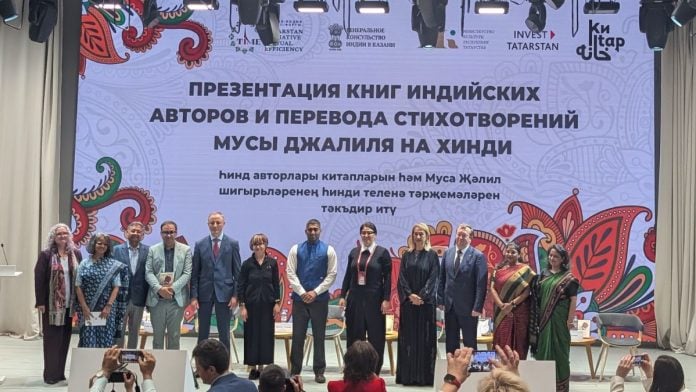
Kazan, Russia: A collection of poems summing up the life and experiences of noted Urdu poet Firaq Gorakhpuri; a Bengali book reflecting the political and social atmosphere of India in the 1960s-70s, when the Naxalite movement was developing; an Odia account about a woman who, faced with cruelty and injustice of the caste system, is forced to make a difficult choice between her personal feelings and her duty to her family and community; poet-lyricist Gulzaar’s fictional work on the themes of nostalgia, India’s partition and loss; a novel on family relationships by Amrita Pritam; and a travel essay on the ancient city of Mohenjodaro.
All of these books and stories are now available for the people of Russia to read in their own language.
And for the readers of Hindi language in India—a book by Musa Dzhalil, a Soviet Tatar poet and resistance fighter during World War II, who is celebrated as a symbol of resistance in Tatarstan.
Last week, the second India-Russia Business Forum ‘TIME’: Tatarstan Initiative Mutual Efficiency witnessed a cultural exchange between the two countries at Kazan in Tatarstan, Russia.
The National Library of the Republic of Tatarstan received seven books by Indian authors—Pratibha Ray, Firaq Gorakhpuri, Amrita Pritam, Agyeya, Om Thanvi, Mahasweta Devi, and Gulzar Saab—translated into Russian, alongside a collection of poems by Musa Dzhalil translated into Hindi.
The inaugural TIME forum was held in October last year at the Bashir Rameev IT Park. While the 2025 forum between Russian and Indian business circles focused primarily on establishing a dialogue, this year’s forum expanded the emphasis to a deeper integration of the two countries in business, cultural and social spheres.
As Vinay Kumar, Ambassador of India to Russia, put it: “When we do this business forum, we are not only talking about money and dollars and rubles, but also about culture, about film festivals, about exporting events, about book launches—in essence, bringing people together, which will make the forum the foundation for further growth of Tatarstan and India, and India and Russia relations forward.”
It is this cultural bridge between India and Russia that was brought up multiple times during the event.
Jaisundhar D., the Consul General of India in Kazan, spoke about the power of the spoken and written word. Beginning his speech in fluent Russian, he switched to English while talking about the festival of Navratri in India—displaying the very confluence of language and culture that the event was supposed to symbolise.
“As somebody who has enjoyed reading from a very young age and continues to enjoy this, I would like to say that the power of words is measured usually, in terms of the messages that they convey rather than the amount of space that they occupy… In India, right now, we are celebrating the festival of Navratri—the nine days are dedicated to various forms of the goddess. Three out of those nine days are dedicated to Goddess Saraswati, who presides over the ‘word’,” he said.
Jayasundhar’s message was clear: The spoken word, and eventually the written word, has the power to not only build bridges, but also burn them. How we use those words decides whether our bridges are built or burnt, he remarked.
‘Building bridges’
The translation of Dzhalil’s book was completed by Sonu Saini, Associate Professor at the Centre of Russian Studies in New Delhi’s Jawaharlal Nehru University, and the edition has been prepared by the Academy of Sciences of the Republic of Tatarstan.
The event was also attended by translators and representatives of Indian publishing house Vani Prakashan Group. The Jawaharlal Nehru Cultural Centre at the Embassy of India, Moscow joined hands with Vani Prakashan to publish the Russian translations of the Indian books that have won the coveted Jnanpith Puraskar.
The attempt was to bring people of the two countries together, find common grounds, and hope that investment and business follow suit.
Timerkhanov Aynur Akhatovich, vice president of the Republic of Tatarstan Academy of Sciences, even drew parallels between Indian culture and that of Tatar Muslims in Russia: “In Indian culture, there is a statement that motherland and mother, together are more important than paradise. Whilst here in the Muslim community, Tatar Muslims share the cultural concept that the key or the entrance to paradise is under the feet of one’s mother… Musa Dzhalil’s poetry was happening at the Prison in Berlin and in that prison, awaiting his beheading, he was writing about the motherland, about children and about continuation of life.”
He explained that for the residents of Tatarstan and representatives of Tatar culture, Dzhalil’s name has become a symbol of resistance and dedication to his cause.
After the event, he said, his poetry will become accessible to millions of speakers of Hindi language. “I am confident that any partnership that comes with a book, with a desire to understand and feel one and other, would be followed not just by economic opportunities, looking forward, but many other things for the years ahead,” he asserted.
He added that based on his understanding, the authors of the books that were translated into Russian speak about similar feelings, as have been spoken about in Dzhalil’s book.
“[T]he readers—there in India, who would be exposed to the poetry by Musa Dzhalil, and us here in Russia—will be recognising somewhat familiar characters, hearing similar voices strengthening respective messages,” he said.
“And finally, they say interpreters are those who built the bridge from the sides of the bank of the river on his side. But today we are building the bridges from both sides. So my wishes let these bridges be the bridges of developing and strengthening the friendship, mutual understanding and trust between the people in these two countries.”
This reporter was in Kazan at the invitation of the Government of Republic of Tatarstan for the annual Russian-Indian Business Forum ‘TIME: Tatarstan Initiative Mutual Efficiency’.
Also Read: A library lost, a cultural bridge broken: India’s Dhaka centre awaits a future after 2024 vandalism