







New Delhi: Bangladesh Prime Minister Tarique Rahman, in a direct outreach to the Bharatiya Janata Party, has proposed a more formal line of communication between his Bangladesh Nationalist Party and the BJP.
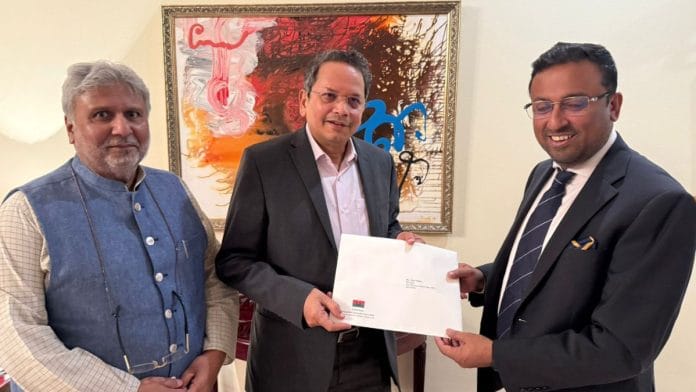
The outreach was made through a letter addressed to BJP National President Nitin Nabin, which was delivered on April 9 by Humayun Kabir, Bangladesh’s Adviser to the Prime Minister on Foreign Affairs and BNP Joint Secretary General (International Relations).
Speaking at a conference hosted by the Hudson Institute, Vijay Chauthaiwale, who oversees foreign affairs for the BJP, described the move by Bangladesh’s governing BNP as an effort to establish a structured political dialogue with the BJP. “We had in the past some relationship with BNP, but not very strong. Both the BJP and BNP would like to start the dialogue. There is a top-level interest to start a political dialogue between the two countries,” he said at the event.
Vijay Chauthaiwale had shared the news of the communication on X after Kabir met him and handed the letter in New Delhi. “Met Mr Humayun Kabir, Joint General Secretary, BNP, Bangladesh. During the meeting, Mr Kabir handed over to me a letter from Mr Tarique Rehman (President of BNP and Prime Minister of Bangladesh) addressed to BJP National President Shri Nitin Nabin ji,” he wrote.
The outreach comes as India and Bangladesh cautiously rebuild engagement, following a diplomatic chill, after the fall of former Bangladesh Prime Minister Sheikh Hasina’s government in Dhaka. Bangladesh’s interim leadership had minimal political contact with New Delhi.
Recent high-level visits suggest a shift.
Earlier this month, Bangladesh’s foreign minister, Khalilur Rahman, travelled to New Delhi—his first visit to India in this role—accompanied by Kabir.
During the trip, he met with External Affairs Minister S. Jaishankar, National Security Adviser Ajit Doval and senior cabinet ministers such as Piyush Goyal and Hardeep Singh Puri.
In a statement, India’s Ministry of External Affairs said it conveyed a desire to “engage constructively” with Bangladesh’s new government and explore ways to deepen cooperation through existing bilateral mechanisms. At the time, officials on both sides indicated that follow-up meetings were expected soon.
Behind the formal language lies a broader recalibration.
For Bangladesh, the immediate priority is to stabilise ties while setting aside contentious issues, including its request for the extradition of Hasina, who remains in India. Dhaka has signalled a willingness to prevent that issue from dominating the relationship.
Economic concerns are also central.
Bangladesh is seeking relief from trade restrictions imposed by India last year, including the suspension of trans-shipment privileges for Bangladeshi exports through Indian airports. The measures forced exporters to reroute goods through more distant ports, raising costs and complicating access to global markets.
During Khalilur’s visit, talks between the two sides included efforts to restore smoother trade flows and revive economic cooperation.
Energy has emerged as another area of engagement, with India supplying additional diesel to Bangladesh amid disruptions linked to the conflict in West Asia.
New Delhi, for its part, is looking forward to reviving a series of infrastructure projects in Bangladesh, which had been stalled during the interim government’s tenure.
Other longstanding issues remain on the agenda. Bangladesh has pressed India to ease visa restrictions that have tightened in recent months. And both countries are preparing for negotiations over the Ganges Water Treaty, a critical agreement on river sharing that is set to expire in December 2026.
(Edited by Madhurita Goswami)
Also Read: Bangladesh brings 200 years of weaving lineage. More than diplomacy, a saree-length bond
We Hindu unity is totally against the Anti Hindu Muslim terrorist country bengladesh relation at any form,we want finish all Muslim terrorists who involved in Hindus genocide in Bangladesh,we also against giving Hindus tax payers money to muslim terrorist country bengladesh,we seeks permission from the govt send Hindu Sangh Parivar soldiers to bengladesh during the Hindu genocide,one cr well trained Hindu soldiers were wating, govt not only given permission also fail to send our army to protect hindus.cant understand Modijis love to muslim terrorist country bengladesh?we elected RSS BJP govt to protect Hindus all over the world,if Modiji feels he can’t handle he can step down,we have many nationalist RSS leaders to take the post of PM,we Hindus unity is asking again stop the appeasement policy to the Anti Hindu Muslims, punish the guilty Muslims who involved Hindu genocide.jai Hindu unity Jai Hindus Jai shree Ram.