



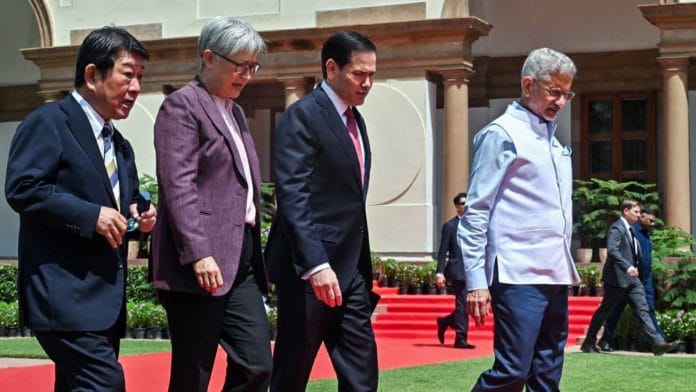

New Delhi: Apart from focusing on maritime security issues and a free Indo-Pacific region at the Quad foreign ministers’ press briefing Tuesday, External Affairs Minister S. Jaishankar also laid emphasis on “zero tolerance for terrorism” and a country’s “right to defend itself” in case of an attack.
“As democratic nations, we also devoted attention to countering the common threat of terrorism. There must be zero tolerance for terrorism, and nations subject to terrorist attacks have the right to defend themselves,” he said at the joint briefing at Hyderabad House in Delhi.
Leading the briefing alongside counterparts from the United States, Japan and Australia, Jaishankar presented the four-nation partnership as a coalition of “maritime democracies” confronting an increasingly uncertain global order, from fragile supply chains and energy insecurity to maritime tensions and terrorism.
“Much of the discussions and indeed the bilateral exchanges were devoted to the current state of the world,” Jaishankar said. “Being co-opted, we naturally focused on issues of particular relevance to the Indo-Pacific.”
The meeting comes at a moment of sharpening geopolitical competition across Asia, with the Quad seeking to broaden its role beyond security cooperation into technology, infrastructure and economic resilience.
“Our four nations are also market economies,” Jaishankar added. “We believe strongly that economic resilience should be promoted, that supply chains should be strengthened, trusted and secure technologies diffused, and production capacities enhanced.”
His remarks reflected a growing concern among Quad nations about dependence on concentrated manufacturing networks and vulnerable trade corridors. The minister also warned of “connectivity chokepoints, manufacturing and resource concentration and gaps in critical infrastructure”, describing them as global challenges that required “deeper collaborations, stronger growth and realising the promise of technologies”.
He stressed on the maritime dimension of the partnership, portraying the Indo-Pacific as central to future global commerce and stability. “The maritime domain has seen a steady expansion of collaboration,” he said, listing surveillance, domain awareness, logistics networks, undersea cables, training, capacity building and Humanitarian Assistance and Disaster Relief (HADR) operations among areas of growing cooperation.
“We spent some time on the question of safe and unimpeded maritime commerce and reaffirmed the significance of scrupulously observing international law,” he added.
Without directly naming China, the remarks echoed longstanding Quad concerns over coercion, contested waterways and strategic infrastructure competition across the Indo-Pacific.
“At the global level, we have to address issues like supply chain resilience, connectivity chokepoints, manufacturing and resource concentrations, and gaps in critical infrastructure. Each one of them offers a new argument for more partnerships, stronger growth and realizing the promise of technologies,” Jaishankar said in his opening statement.
He also highlighted cooperation in energy, fertilisers and critical minerals, sectors that have acquired heightened importance amid geopolitical disruptions and intensifying competition over industrial supply chains. “Our deliberations touch on the current energy and fertiliser availability, as well as that of critical minerals and resources,” he said.
The Quad, originally conceived as a strategic dialogue after the 2004 Indian Ocean tsunami, evolved later into a broader platform for coordination among the four democracies in 2007. Quad foreign ministers met for the first time in September 2019, on the margins of the UN General Assembly in New York. In 2021, the Quad was elevated to a leader-level format.
Jaishankar noted that the foreign ministers had now met for the third time in 18 months, highlighting what he described as the growing momentum of the grouping.
In his opening remarks earlier, Jaishankar had added that Ind0 Pacific remains a key driver of growth and stability. “As maritime democracies, pluralistic societies and market economies, we share the responsibility towards a free and open Indo-Pacific,” he said. “The region must remain a driver for global growth and stability.”
“In the coming days, whether it is economic activity, energy trade, or maritime commerce, the Indo-Pacific will become even more important to the world,” he added. “The responsibilities of the Quad will grow commensurately, and we must prepare for that.”
(Edited by Nardeep Singh Dahiya)