



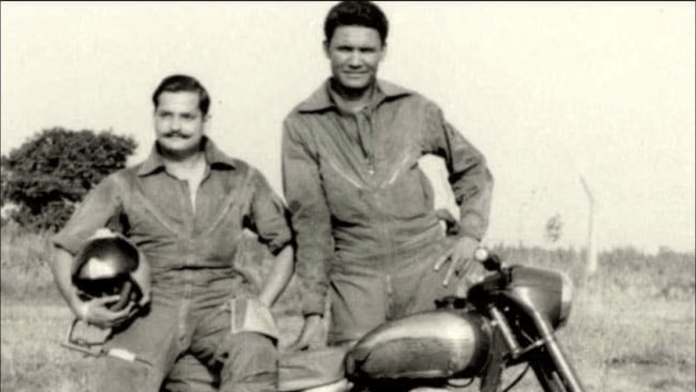
New Delhi: For 61 long years, late Flight Lieutenant Alfred Tyrone Cooke (retired) carried the memory of one aerial battle over Kalaikunda that kept him awake several nights.
The fight on 7 September, 1965 made him one of India’s and Indian Air Force’s (IAF) most celebrated fighter pilots. It also left him with a sense of grievance that never quite disappeared till his death this Friday.
Cooke, who was awarded the Vir Chakra for his actions during the 1965 India-Pakistan war, felt he should have been awarded the Param Vir Chakra.
His mind-blowing aerial fight, that was witnessed by civilians on the ground, and his bitterness was captured in what would become his final interview aired on NDTV news channel’s ‘Control Alt Defence’ show anchored by journalists Shiv Aroor and Vishnu Som.
All Air Warriors of the Indian Air Force extend their deepest condolences on the passing of Flight Lieutenant Alfred Tyrone Cooke, VrC.
A war hero whose courage is etched forever in the annals of military aviation, Flt Lt Cooke exemplified supreme valor during the 1965 Indo-Pak… pic.twitter.com/KhRUGUWRhm
— Indian Air Force (@IAF_MCC) September 19, 2026
The fight over Kalaikunda
The battle unfolded over West Bengal on 7 September 1965, when Pakistani F-86 Sabres attacked Kalaikunda.
Cooke was flying a Hawker Hunter from No. 14 Squadron and was operating with his wingman, Flying Officer Subodh Chandra Mamgain.
Cook said that the IAF’s air defence picture in the eastern sector was complicated since they had limited information about Pakistani air operations across what was then East Pakistan.
He and Mamgain had already flown sorties that morning when a scramble order came. The pair were initially directed towards an area north of Barrackpore. Then came the call from the radar unit controlling them: Kalaikunda was under attack.
Cooke and Mamgain turned towards the airfield. He said that the duo approached at high speed and descended to roughly 4,000-5,000 feet.
As they closed in, Cooke recalled seeing black smoke trails and aircraft attacking the airfield. He counted four Pakistani Sabres in the air. He decided to split with Mamgain rather than keep his wingman directly behind him.
Cooke said this was deliberate. He believed that keeping Mamgain as a close wingman could result in both pilots being targeted by the Pakistani formation.
“I didn’t think it was fair that you shoot one of them, they shoot one of you down,” he said.
Cooke engaged the first Sabre, which he identified as that of Flight Lieutenant Afzal Khan, and shot him and eventually flew through the fireball created.
But there were still other Pakistani fighters in the area. Cooke immediately engaged another Sabre and this turned into a prolonged low-level dogfight.
He recalled seeing the Pakistani pilot’s white helmet as the two aircraft repeatedly crossed paths.
Cooke eventually got behind the Sabre and fired repeated bursts and the Sabre began streaming smoke. The damaged aircraft, he recalled, crossed towards the Pakistan side.
According to Cooke’s account, the pilot was later identified as Flight Lieutenant Tariq Habib Khan. Cooke said he never learned conclusively what happened to him. “I would have liked to have met them and had a beer with them.”
Also Read: Alfred Cooke is the Bull who cooked the PAF’s goose. He deserved more than a Vir Chakra
‘Why isn’t he exploding?’
Cooke then engaged another Sabre and despite firing, the Sabre did not explode. He was now himself in danger of hitting the ground.
He recalled pulling back hard on the stick while still holding the trigger. His ammunition was exhausted. That was when he looked back towards the airfield and saw Mamgain who was flying at about 3,000 feet.
A Pakistani Sabre was closing in on him and Cooke immediately warned him.
“Hard left! Hard left!” When Mamgain did not respond quickly enough, Cooke shouted again. The Sabre turned towards Cooke who had no ammunition left.
What followed became, in Cooke’s telling, the part of the battle that mattered most to him.
He manoeuvred behind the Sabre anyway. The Pakistani pilot began performing low-level aerobatics over Kalaikunda—loops and barrel rolls—and Cooke followed him. But he could not fire.
He called Mamgain and asked him to come and take over the engagement. There was no response. Mamgain had landed.
Cooke later learned that Mamgain’s aircraft was low on fuel and that he had returned to base. He, nevertheless, continued chasing the Pakistani aircraft until it withdrew towards the border.
For him, this was the moment that defined the mission. “I knew I had no ammunition, but I took him on.”
Cooke eventually turned back towards Kalaikunda. His fuel was running low. He also discovered that his aircraft had been damaged. His wingtip was shattered and his pitot tube had been bent upwards, leaving him without a functioning airspeed indicator.
As he approached the airfield, he saw anti-aircraft fire around him. He called Flying Control and asked them to stop firing. There was no response. Cooke said personnel had abandoned their positions amid the attack.
The ammunition controversy
It was after the war that Cooke said he discovered something that angered him even more than the battle itself.
According to his account, his Hunter had not been configured correctly for wartime operations.
He said each of the aircraft’s four 30 mm Aden cannons should have carried 125 rounds of high-explosive ammunition. Instead, he had been sent into combat with only 25 rounds per gun.
He also claimed the guns had been configured for point harmonisation rather than spread harmonisation.
Cooke believed this explained why some of the Sabres he hit survived. “It was like throwing cricket balls at them,” he said of the ball ammunition he believed he was using against the other aircraft.
His argument was that a properly configured Hunter, carrying the correct high-explosive ammunition and harmonisation, could have destroyed more Pakistani aircraft.
These are Cooke’s recollections of the aircraft’s configuration and the circumstances of the battle.
‘Nothing was mentioned about saving Mamgain’s life’
Cooke’s second grievance concerned his citation. He said the official recognition did not mention that he had warned Mamgain of the approaching Sabre and then engaged the Pakistani fighter despite having no ammunition.
For Cooke, this was not a minor omission. It became one of the reasons he eventually decided to leave the IAF.
He was particularly angry that Mamgain received the same decoration. Cooke acknowledged that Mamgain acted under intense circumstances but believed the record of the engagement did not accurately reflect what had happened.
(Edited by Tony Rai)
Also Read: Pakistani Naval ship collides with Navy vessel in Arabian Sea, India lodges protest