





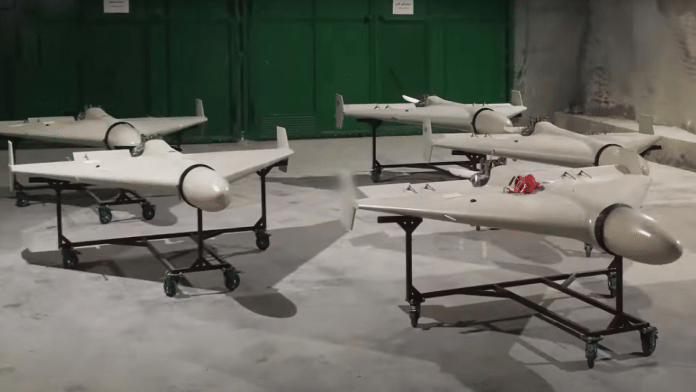



New Delhi: The next chapter in drone warfare is unfolding, and it’s all about bringing them down on the cheap. Conflicts from Iran to Ukraine have shown that the high costs involved in bringing down mass-produced attack drones is an arithmetic that wrecks the defender even when interceptions are successful.
Former NASA engineer Jason Cornelius is among those who have already reacted to the cost arithmetic of beating drones. Now engaged in making a missile that will cost just $10,000 to intercept such cheap drones, Cornelius is, however, just one of many such startups in the race.
The Iran and Ukraine conflict have shown the vulnerability associated with highly sophisticated defence interceptors, including the Patriot systems, which are in limited supply but have to be used against much cheaper attack drones like the Shahed-136.
The Wall Street Journal has reported that new startups are making the interceptor technology cheaper by introducing basic changes in designs, using off-the-shelf parts, and switching to automated manufacturing, in the hope of reducing the cost to tens of thousands of dollars from the hundreds of thousands it takes now.
Rewriting air defence economics
Cornelius, who left his job at the age of 30 at NASA and has co-founded Perseus Defense, told WSJ, “We saw what was happening in Ukraine, and we saw a need for cheap counterdrone tech that was not being met.” According to Cornelius, the company started with a simple idea: Can we produce a smaller, cheaper, and quicker-to-make version of the AIM-9 Sidewinder, which is one of the world’s most used air-to-air missiles?
First introduced in 1956, Sidewinders are an expensive defence system. Last year, Washington sold 60 to Ankara, including additional front ends, spare parts and training, at an estimated cost of $80 million.
While talking about the Sidewinder, Cornelius told the WSJ that, “Sidewinders are highly effective, but were designed to destroy jet fighters and other expensive targets. They were not designed to shoot down $5,000 drones in quantities of thousands or tens of thousands. ” In contrast, Perseus produces 15-inch missiles that can be fired from drones, ground vehicles, and boats, with a range of about 1,100 yards, Perseus Defense said.
However, this new generation of missiles hasn’t been tested on the battlefield. These missiles are designed for short-range targets, and the interceptors used lack the capabilities of high-end missiles. For instance, Patriot systems are faster, long-range, accurate, and can target ballistic missiles.
Perseus Defense stated that it is fielding inquiries in the Gulf and Western countries to increase production. The US and Germany have already ordered large quantities of lower-cost missiles or guided rockets.
Elaine McCusker, a top Pentagon budget official during Trump’s first administration, through his analysis told the WSJ that, “The Pentagon likely fired about $5.7 billion worth of interceptors to shoot down Iranian ballistic missiles and drones in the first four days of the war alone.”
Countries in West Asia, including Saudi Arabia, are spending on Patriot systems to shoot down incoming Iranian drones. Even Washington also requires cheaper munitions. While highlighting the need for low-cost munitions, Lt. Gen. Frank J. Lozano, Portfolio Acquisition Executive (PAE Fires) at the U.S. Army, said in a Senate Armed Services Committee hearing, “Smaller new companies are providing the department with potential new options in affordability and scalability.”
Also Read: Explainer-Drones and mines: taking Kharg Island would pose risks for US troops
The Shahed shock
The Iranian-made Shahed drone has dramatically changed the conflict in West Asia, alongside the Russia-Ukraine conflict. Due to the numbers, Shahed, which dives into its target, can overwhelm the adversary’s defences and burn through stocks of costly interceptor missiles.
Kusti Salm, chief executive of Estonian startup Frankenburg Technologies, which is also working on cheaper interceptors, told WSJ that, “I thought, if Russia is going to launch 100 Shaheds a month as weapons, every single country in Europe will have trouble. Now, they send up to 400 a day.”
While highlighting Frankenburg’s missile technology, the company says that its missiles can travel at more than 600 miles per hour and reach targets up to a mile away. The cost of the system is also in the low tens of thousands and can be produced in just a few hours.
“This kind of speed and affordability is made possible by advances in ordinary consumer technology. While missiles once relied on custom‑built components made only for the defence sector but some parts can be taken from consumer electronics,” Salm added.
For example, inertial navigation systems, which are used to track objects’ position, orientation, and speed, were developed for rockets but are now used in smartphones.
Salm said that Frankenburg has already sold its missiles to two countries, but declined to name them, saying that the company is flooded with inquiries from the Gulf states.
Ralph Savelsberg, a missile expert at the Netherlands Defence Academy, a research and training institute for the Dutch defence ministry, told WSJ that, “Missiles are the most precise. They generally outrange bullets and can function in all weather conditions, unlike interceptor drones.”
Their cost stems from complexity and limited production runs, Savelsberg explained. R&D and infrastructure expenses must be recovered from a relatively small number of units, and small batch sizes often mean specialist workers assemble them rather than mass‑production lines.
Rising demand could shift that dynamic. The White House’s push to accelerate output has opened room for savings, a Lockheed Martin spokeswoman said, regarding the company’s Patriot interceptors.
Other major contractors are also chasing cheaper options: Europe’s MBDA inked a deal with Germany last year to produce DefendAir, a low‑cost missile aimed at small to medium-sized drones, while Sweden’s Saab is negotiating exports of its own inexpensive missile design.
Startups such as Cambridge Aerospace are betting on modern methods like 3‑D printing and artificial intelligence to trim costs. Its CEO Steven Barrett told WSJ that the UK firm is developing Skyhammer, targeted at high‑speed threats like ballistic missiles.
Skyhammer is an anti-drone and cruise‑missile interceptor with a range of nearly 19 miles and a price in the low tens of thousands. Skyhammer reached initial production within a year, bypassing the usual multi‑year development cycles.
Beyond advanced tech, Cambridge has leaned into simpler efficiencies: its missiles use just two types of bolts. “You can have the perfect way of joining everything, or you can keep it simple,” Barrett added.
(Edited by Nardeep Singh Dahiya)
Also Read: US considers diverting Patriot, THAAD systems intended for Ukraine to West Asia conflict