





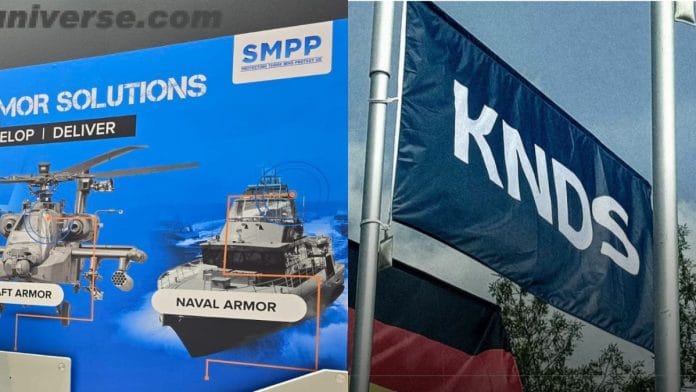

New Delhi: Defence manufacturer SMPP signed an agreement with European defence company KNDS Thursday to manufacture advanced loitering munitions in India under a Transfer of Technology deal.
The agreement was signed at the Eurosatory defence exhibition in Paris. A statement issued by SMPP said the partnership combines technology transfer with domestic manufacturing and is aimed at meeting operational requirements of the Indian Army.
The agreement builds on an earlier partnership signed by the two companies in November 2025 to jointly offer KNDS’s KATANA precision-guided artillery ammunition in India, reflecting a broader effort by both companies to expand cooperation in the Indian defence market.
SMPP, an Indian defence and aerospace manufacturer, produces a range of military systems including ballistic protection equipment, ammunition, drone and counter-drone technologies, and precision strike systems. KNDS is one of Europe’s major land warfare firms, supplying armoured vehicles, artillery systems, ammunition, and combat technologies to dozens of militaries worldwide.
Under the agreement, the loitering munitions will be offered to the Indian Army as part of efforts to address what the companies described as an “urgent requirement” for advanced precision-strike systems capable of “neutralizing high-value threats with exceptional precision”.
Also Read: US Pacific Command seeks $122 bn, warns of rising threat of war with China—Washington Times report
Rise of loitering munition
The systems being brought to India under the SMPP-KNDS partnership include the VELOCE and RODEUR loitering munitions, along with the ISTAR family of surveillance and reconnaissance drones.
According to the companies, the systems are designed to provide a “search-and-destroy” capability, enabling operators to locate, track, and strike targets with precision. They feature “fire-and-forget” functionality and combine satellite-based and onboard navigation systems to maintain accuracy across varied combat environments.
Loitering munitions are often described as a hybrid between a drone and a guided missile. Unlike conventional missiles, which are launched at a pre-designated target, they can remain airborne over a battlefield for extended periods, searching for targets before engaging them.
Their ability to loiter over a target area before carrying out a self-destructive attack has earned them the nickname “kamikaze drones”.
Modern loitering munitions vary considerably in size and capability. Some can be carried and launched by infantry units, while others are larger systems capable of travelling long distances and striking heavily defended targets. Many carry electro-optical and infrared sensors that allow operators to identify vehicles, command posts, radar installations, artillery batteries, and troop concentrations before authorising a strike.
Their relatively low-cost compared with manned aircraft and long-range missiles have made them increasingly attractive to militaries seeking precision-strike capabilities without exposing pilots or expensive platforms to enemy air defences.
Kyra Menon is an intern at ThePrint
(Edited by Tony Rai)
Also Read: Is it a toll? Is it a fee? Trump, Iran aren’t on same page about ships transiting Strait of Hormuz