





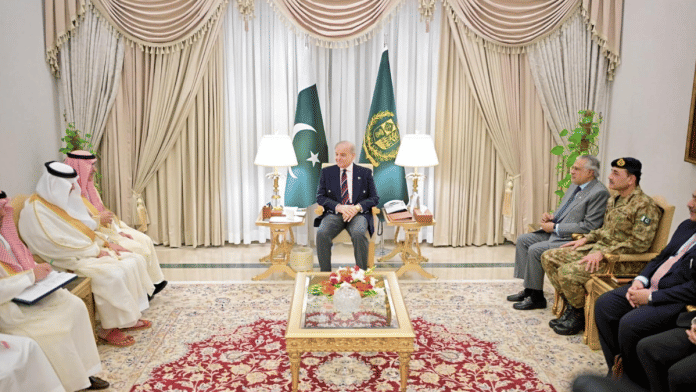


New Delhi: Saudi Arabia has invoked the Strategic Mutual Defence Agreement (SMDA) signed with Pakistan under which the Pakistani military has deployed an unspecified number of F-16s and related personnel on the ground at the King Abdulaziz Air Base in the Eastern Sector.
However, the true extent of the pact is yet to be known.
Drop Site News has published a report detailing how the new pact really came into being. It reports that the new pact has been pending since the tenure of former Prime Minister Imran Khan who sat on it for over a year, refusing to sign.
It also reveals that the pact does not entail any military commitment by Saudi Arabia in case of a war that Pakistan wages.
In the context of conflict between Iran and the U.S./Israel, the risk that Pakistan may itself be pushed into the war is also an important context for the zeal of Pakistan’s leaders to bring an end to the fighting, the report said.
Iran has launched a series of missile and drone strikes on Saudi Arabia since the onset of its conflict with the United States, targeting key energy and military infrastructure.
The defence pact between Pakistan and Saudi Arabia began with a confidential agreement signed between the two countries on 14 December 1982. A revised version, titled the Military Cooperation Agreement (MCA), was signed on 30 July 2005.
The classified 2005 agreement, a copy of which was obtained by Drop Site, states that the goal of the MCA is “to develop and strengthen cooperation in the military field between the two countries through expansion in areas such as training, deputation of personnel, defense production and transfer of technology, exchange of experience, purchase of weapons, equipment, spare parts and military medical services”.
There was no obligation on Pakistan to engage in actual military action or assume responsibility for the defence of Saudi Arabia.
تُعلن #وزارة_الدفاع عن وصول قوة عسكرية من جمهورية باكستان الإسلامية إلى قاعدة الملك عبدالعزيز الجوية بالقطاع الشرقي ضمن اتفاقية الدفاع الإستراتيجي المشترك الموقعة بين البلدين الشقيقين.
وتتكون القوة الباكستانية من طائرات مقاتلة ومساندة تابعة للقوات الجوية الباكستانية، بهدف تعزيز… pic.twitter.com/IGpE79Pxcx
— وزارة الدفاع (@modgovksa) April 11, 2026
Drop Site reported that in August 2021, a summary of a new amendment to the defence agreement was sent to the government of then-prime minister Imran Khan.
The amendment had a new component which effectively committed Pakistan for the first time to engage in the physical defence of the Saudi government if requested.
“The second party (Pakistan) is obligated to send its forces to the Kingdom of Saudi Arabia upon a request of the first party, to support the armed forces of the first party in dealing with any threat that affects its security, safety, sovereignty, territorial integrity and interests,” the amendment stated. “A protocol will be signed between both parties and attached to this agreement to clarify the details of such arrangements.”
The report said that the proposed amendment sat on Imran Khan’s desk for a year because it was ambiguous on whether the threat to be combatted at Saudi government request was foreign or domestic.
According to two former officials who requested anonymity to discuss sensitive information, Khan was apprehensive about signing an agreement that would obligate the Pakistani military to participate in a foreign war, the report said.
It added that while imposing sweeping obligations onto Pakistan, the text of the document did not commit Saudi Arabia to any specific reciprocal support. The summary of the amendments was finally signed in February 2024 by the military-backed caretaker government after Khan was removed from power.
Citing documents seen by it, Drop Site reported that the language of the new amendment expanding Pakistani obligations to Riyadh was hotly debated inside the military establishment after it was signed.
“The amendment was one-sided, some worried, and would obligate Pakistan to defend Saudi Arabia, without imposing a reciprocal obligation on Riyadh. Assessments also noted the amendment did not clearly differentiate between conventional and nuclear forces. The documents show that the Pakistani military was only interested in committing conventional forces to any deal with Saudi Arabia, and sought to explicitly exclude nuclear capability from the obligation,” it said.
It added that internal debates also noted that threats to Saudi sovereignty and interests might not remain confined within Saudi territory, and could require military action outside Saudi Arabia.
“Many of these concerns were eventually addressed in the 2025 SMDA, signed months before the Iran war,” the report said, adding that the document was not part of the leaked set that Drop Site had access to.
As per the joint Saudi-Pakistan press release announcing the 2025 SMDA, “The agreement states that any aggression against either country shall be considered an aggression against both.”
The conditions in which such reciprocity may be triggered remain unclear, the report said, adding that Saudi Arabia has limited capacity to provide military assistance to Pakistan in a conflict.
“The primary strategic rival to Islamabad remains India, which enjoys close political and economic ties with Riyadh. Pakistan is also currently involved in a fierce cross-border war with Afghanistan, for which Saudi Arabia has not provided material assistance,” it said.
As per Drop Site analysis, under the current terms of the deal, which is entirely defensive, Saudi Arabia could not request that Pakistan counterattack Iran, even from Saudi territory. An attack launched from Pakistani soil also appears unlikely, and would likely fall outside the scope of the SMDA, it said.
(Edited by Ajeet Tiwari)
Also Read: https: Pakistan fighter jets & support aircraft reach Saudi Arabia as part of mutual defence pact
Pakistan’s attempt to invoke the defence pact with Saudi Arabia amid the West Asia conflict shows it’s trying to punch way beyond its weight. Instead of grandiose plans, Pakistan should focus on building regional trade and eliminating non-state terror groups. It’s time to prioritise economic growth and regional stability over military posturing.