


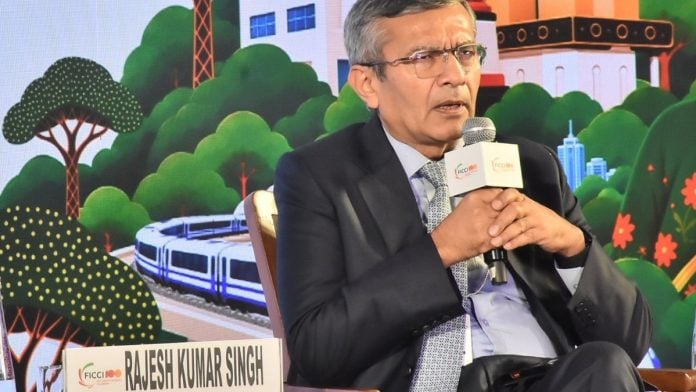
New Delhi: India could achieve the target of Rs 50,000 crore in annual defence exports by the 2028-29 financial year, a year before the 2029-30 deadline, Defence Secretary Rajesh Kumar Singh said Wednesday at an industry event. This would mean a roughly 30 percent jump from the Rs 38,424 crore of defence exports in 2025-26.
Defence exports have already reached Rs 23,479.34 crore in 2026-27 by the start of November, or about three-fifths of the Rs 38,424.01 crore achieved in 2025-26.
“We will achieve the Rs 50,000-crore defence exports target perhaps one year in advance,” said Singh, adding that it should be viewed as a “validation” of the country’s defence manufacturing industry and a reflection of its maturity. India is “exporting everything from artillery to bulletproof jackets”, he said.
Speaking as part of a panel at an event to mark the Federation of Indian Chambers of Commerce and Industry (FICCI) annual general meeting and annual convention that is to be convened Thursday, Singh underlined the overall goal: “[We] intend to grow Indian private [sector] national champions in this space.”
Responding to another question on exports of high-value platforms, including the Indo-Russian BrahMos supersonic cruise missile, Singh indicated that such exports would gain further traction in overseas markets. “There will be fairly significant exports of platforms as well,” he said. Singh pointed out, however, that artillery shells have been the “hero of export performance due to the ongoing conflict in Europe”. On the BrahMos specifically, Singh said many negotiations were ongoing, without specifying with whom.
Responding to a question on the budgetary allocation for defence in 2027-28, Singh said, “[The] focus is on higher capital expenditure, with the attendant multiplier effect on the economy.” Indicating that he had sought a higher percentage growth in the capital outlay component of the defence budget, he said, “We are confident of a 20 percent growth in capital expenditure [allocation] in compound annual growth rate terms, on top of the 22 percent [growth] last year.”
The defence services capital outlay for 2026-27 stands at Rs 2.19 trillion, nearly 22 percent more than the 2025-26 Budget Estimate (BE) of Rs 1.80 trillion. Within this, Rs 1.85 trillion is set aside for capital acquisition, or the modernisation capital budget, a rise of over 24 percent on the 2025-26 BE for the same head. This is the pot that pays for aircraft, ships, tanks, weapons, missiles and other military equipment.
Underscoring, however, that fund utilisation was more crucial than allocation, Singh said, “[In the] last two years, there was Rs 2 lakh crore plus of contract signings each year. This year, we have done Rs 80,000 crore [so far], with several big-ticket acquisitions on the anvil.” He expressed confidence that contract signings would hit another “record high” in 2026-27.
On the direction of ongoing defence sector reforms in 2027, Singh listed the outcomes he wanted to see, saying the country should have “at least 2-3 military aircraft manufacturers, multiple missile manufacturers, multiple ammo manufacturers”. This, he added, would establish the industrial surge capacity necessary to withstand a long conflict. “In new areas like drones, [we want] hundreds of companies.”
Surge capacity refers to the ability to rapidly expand military production, especially during a conflict.
“Whatever reforms are required, on the demand side in terms of visibility of orders and the supply side on ease of doing business or relaxed and faster licensing processes, all of those steps, the government will take,” said Singh.
(Edited by Nardeep Singh Dahiya)
Also Read: EXCLUSIVE: First Tejas Mk1A likely to be handed over to IAF in January ahead of Aero India 2027